
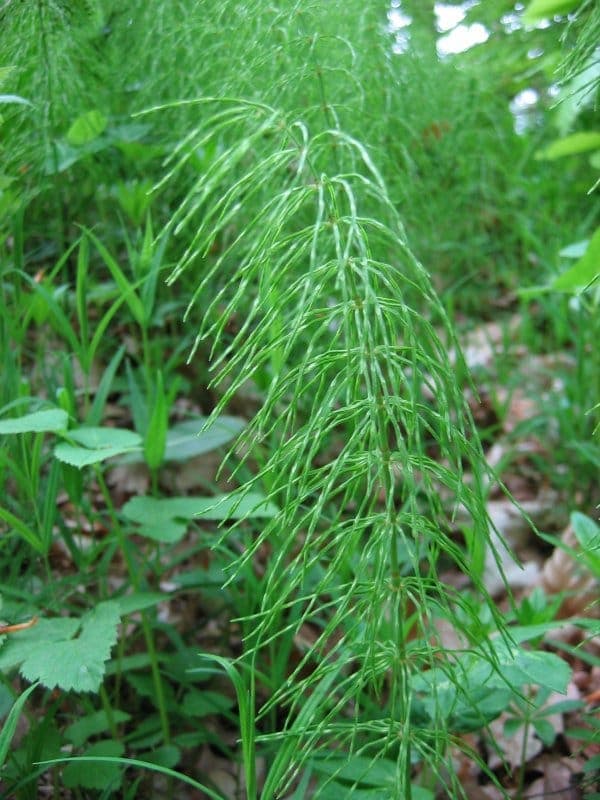
Kristian Peters -- Fabelfroh 17:32, 12 August 2006 (UTC) / CC BY-SA 3.0, via Wikimedia Commons
Meadow horsetail: complete guide
Equisetum pratense
¿Quieres ver Meadow horsetail: complete guide en tu jardín?
1 minuto, sin tarjeta de crédito
Overview
Meadow horsetail (Equisetum pratense) is a remarkable primitive plant from Northern Europe and Asia - a living fossil from the Devonian (400 million years ago). This small plant reaches 20-60 cm tall and has a unique appearance with thin, stiff, greenish stems featuring characteristic whorls of delicate branch-stems. The plant reproduces via spores, not seeds - a reproduction method predating dinosaurs.
Equisetum pratense is a wonder-plant for ecologically conscious gardeners seeking to transform wild, moisture-loving spaces. The plant is disease and pest-resistant, tolerant of varied conditions, and offers year-round structure and interest. Through gardenworld.app, design gardens where primitive plants like equisetum create mystical, timeless atmosphere.
Appearance & Growth Form
Stems are thin, with pronounced segmented structure (grooved ribs). Each node features whorls of extremely fine, greenish branch-stems (approximately 1-2 mm wide). In spring, specialized fertile stems emerge bearing brown fruiting cones at the apex - these fade as the plant matures. The plant is deep green with subtle gray waxy coating.
The plant spreads not only via underground rhizomes but also microscopic spores dispersed by wind and water. This makes equisetum highly invasive in some environments.
Ideal Location
Meadow horsetail thrives in full sun to light partial shade on moisture-loving sites. The plant prefers wet meadows, ditch bottoms, and banks where regular inundation occurs. In gardens, position equisetum in wetlands and moist zones.
Soil & Nutrition
This plant is extremely tolerant regarding soil type: sand to clay, provided moisture is present. pH ranges from acidic (5.0) to alkaline (8.0). Nutrients are non-critical; the plant grows even in poor soils.
Diseño gratis
¿Quieres ver Meadow horsetail: complete guide en tu jardín? Crea un diseño gratis ahora.
Watering & Moisture Requirements
Constant to regular moisture is essential. In natural settings, the plant inhabits permanently wet areas and ditches. In gardens, provide regular watering, especially during dry seasons. Excessive water is no problem; equisetum tolerates even semi-aquatic conditions.
Pruning & Maintenance
Equisetum requires minimal care, but invasion control may be necessary. The plant spreads aggressively via underground rhizomes. Regular mowing keeps the plant in check. Removal is difficult due to deep root systems; herbicides have moderate effect.
Maintenance Calendar
- March: Possible mowing of overwintered stems
- April-May: Growth period; vigorous growth
- June-August: Peak growth; possible mowing
- August-October: Spore ripening
- October-November: Growth stops; foliage develops
- November-March: Winter rest; greenish stems remain decorative
Winter Hardiness
Equisetum pratense is extremely hardy to USDA zone 1 (-50°C), adapted to subarctic regions of Northern Europe.
Companion Plants
Meadow horsetail pairs beautifully with:
- Sedges (Carex species) for textural variation
- Flax (Linum) for yellow accents
- Japanese iris (Iris laevigata) for vertical structure
- Marsh fleabane (Jacobaea aquatica) for orange tones
Conclusion
Meadow horsetail is a fascinating addition to wetlands and moisture-loving gardens. This primitive plant brings billions of years of heritage into your garden - a living connection with deep geological time. With gardenworld.app, create ecosystems where even Earth's oldest plant species find thriving conditions in the modern world.
¿Quieres ver Meadow horsetail: complete guide en tu jardín? Crea un diseño gratis ahora.
Sube una foto, elige un estilo y obtén un diseño fotorrealista con lista de plantas en menos de un minuto.
Más de 10.000 jardines diseñados
Sin tarjeta de crédito


Plantas similares
Common horsetail: complete guide
Equisetum arvense
Discover how to grow and care for Common horsetail (Equisetum arvense) in your garden, with tips on planting, watering, and controlling its spread in moist soils.
Great scouring-rush: complete guide
Equisetum hyemale
Complete growing guide for Great scouring-rush (Equisetum hyemale). Learn about care, ideal conditions, watering, and companion plants for this unique perennial.
Male fern: complete guide
Dryopteris filix-mas
Learn how to grow Male fern (Dryopteris filix-mas) successfully: care, soil, watering, and ideal companion plants for lush green woodland gardens.