
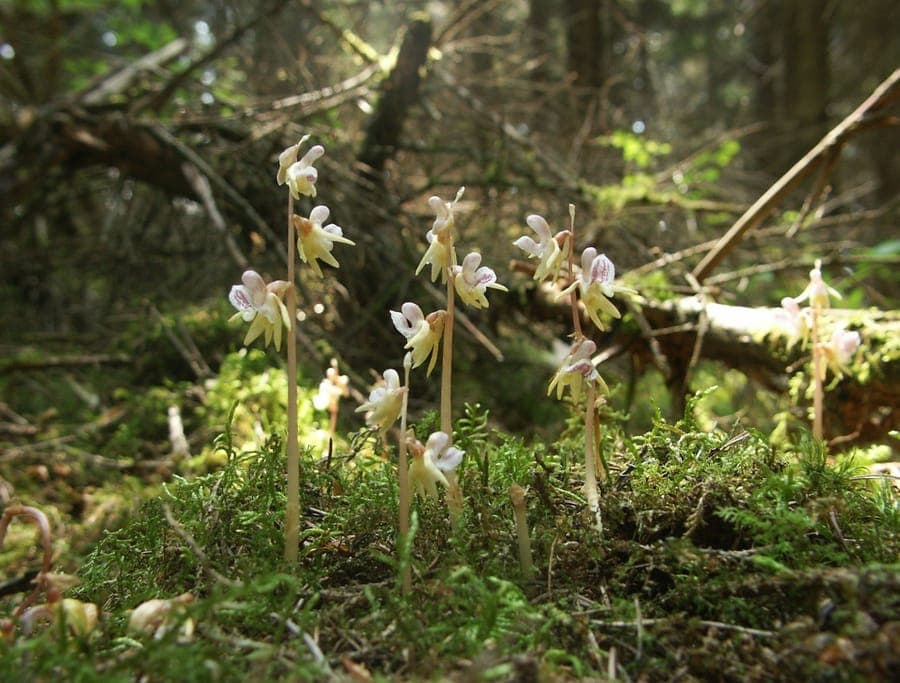
BerndH / CC BY-SA 3.0, via Wikimedia Commons
Ghost orchid: complete guide
Epipogium aphyllum
¿Quieres ver Ghost orchid: complete guide en tu jardín?
1 minuto, sin tarjeta de crédito
Overview
Epipogium aphyllum, commonly known as the Ghost orchid, is one of the most elusive plants in the temperate forest world. Unlike most orchids, it contains no chlorophyll and produces no leaves, relying entirely on a symbiotic relationship with underground fungi associated with conifer roots. This ghostly perennial emerges only in midsummer, blooms briefly, and vanishes again beneath the leaf litter. It's native across parts of Europe and Asia, from Austria to China, typically in undisturbed, moist woodlands dominated by spruce or pine.
Because of its complex life cycle and complete dependence on specific mycorrhizal fungi, the Ghost orchid cannot be cultivated in garden settings. Attempts to transplant or grow it fail almost universally. Instead, it remains a wild treasure - one to be admired in situ, not in pots or borders.
On gardenworld.app, you can map out a woodland garden design that mimics the natural conditions where rare forest species like this might theoretically appear.
Appearance & bloom cycle
The Ghost orchid grows 10–25 cm tall, with a fleshy, pale stem ranging from white to pale yellow. It bears 1 to 5 nodding, white flowers per stem, each 2–3 cm across. The petals are slightly curled, delicate, and emit a faint, sweet scent, more noticeable at night. Flowering occurs in July, occasionally extending into early August.
After pollination, seed capsules form and release microscopic dust-like seeds. These seeds only germinate when they encounter the precise fungal partner (typically Armillaria species), making natural reproduction highly unpredictable. The plant spends most of its life underground, sometimes for years, waiting for the perfect moisture, temperature, and fungal activity before surfacing.
Ideal location
This orchid thrives in deep shade (light level 2/10), under old conifers in dense, humid forests. It prefers areas with thick layers of pine needles and minimal ground competition. Ideal natural habitats include spruce-fir forests, pine woodlands, and mixed coniferous forests with high organic matter.
In gardens, it's nearly impossible to replicate these conditions. The necessary fungi are usually absent, and soil disturbance or compaction destroys the delicate underground network. If you're lucky enough to spot one, do not dig it up - it will not survive. Instead, note the location and report the sighting via apps like iNaturalist.
Diseño gratis
¿Quieres ver Ghost orchid: complete guide en tu jardín? Crea un diseño gratis ahora.
Soil requirements
The soil must be humus-rich, well-drained, and slightly acidic to neutral, with a pH between 6.5 and 7.0. It should be loose, with plenty of decomposing wood and needle litter. Organic content is crucial - the fungal hosts need constant fuel from decaying matter. Avoid compacted, clay-heavy, or overly dry soils.
If designing a forest garden, use gardenworld.app to simulate long-term soil development, including fungal networks and organic buildup over decades.
Watering
You don't water this plant. It draws moisture passively through its fungal network. In dry summers, the Ghost orchid may not appear at all. Consistent humidity and regular rainfall in July and August are essential for emergence. Drought suppresses flowering; wet seasons increase chances of sightings.
Pruning
No pruning is needed or possible. The plant dies back naturally after seeding. Never remove or disturb it - it's protected in many countries due to its rarity. Leave it undisturbed to complete its life cycle.
Maintenance calendar
- Jan–May: Underground dormancy
- Jun: Subsurface development begins if moisture and temperature align
- Jul: Bloom period; check shaded coniferous forests after rain
- Aug: Seed development and dispersal
- Sep–Dec: Retreats underground; seeds lie dormant
No maintenance actions required. Observation and documentation are the only practical engagements.
Winter hardiness
The Ghost orchid survives winter as underground rhizomes or tuber-like structures, insulated by leaf litter and snow cover. It's hardy in USDA zones 4 to 7. In zone 8 (like parts of Belgium or the UK), climate conditions may be suitable, but habitat fragmentation and lack of fungal hosts prevent establishment.
Companion plants
In the wild, it often grows near:
- Ling heather (Calluna vulgaris)
- Scots pine (Pinus sylvestris)
- Norway spruce (Picea abies)
- Bilberry (Vaccinium myrtillus)
- Bog asphodel (Narthecium ossifragum)
These plants indicate a rich, humus-filled forest floor - the kind of environment that supports the fungal networks the Ghost orchid depends on. While planting these species won't guarantee the orchid, it improves overall woodland health.
Closing
The Ghost orchid isn't a garden plant - it's a symbol of intact ecosystems. Its presence signals a healthy, undisturbed forest with a complex underground web. As gardeners, we can't grow it, but we can support conditions that might one day allow such rarities to thrive.
Instead of chasing unobtainable exotics, focus on native woodland species. Visit garden centres like those at OBI or Hornbach to find forest-compatible plants that enrich your soil over time. Respect the wild - don't collect, don't transplant. The true magic of the Ghost orchid lies in its mystery: a pale whisper in the dark, gone before you can reach for it.
¿Quieres ver Ghost orchid: complete guide en tu jardín? Crea un diseño gratis ahora.
Sube una foto, elige un estilo y obtén un diseño fotorrealista con lista de plantas en menos de un minuto.
Más de 10.000 jardines diseñados
Sin tarjeta de crédito


Plantas similares
Ram's-head lady's slipper: complete guide
Cypripedium arietinum
Everything you need to know about growing Cypripedium arietinum, a rare woodland orchid for cool, moist garden settings. Soil, care and planting tips.
Sparrow's-egg lady's slipper: complete guide
Cypripedium passerinum
Everything about growing Cypripedium passerinum, a cold-hardy subarctic orchid suited to cool, moist, shaded garden spots. Soil, care and companion plants.
Algerian Butterfly-orchid: complete guide
Platanthera algeriensis
Everything about Platanthera algeriensis, the rare Mediterranean orchid with greenish flowers native to Algeria, Morocco, Corsica and Spain.