
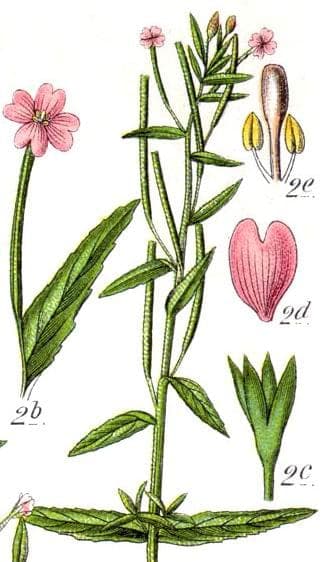
Johann Georg Sturm (Painter: Jacob Sturm) / Public domain, via Wikimedia Commons
Epilobium obscurum: complete guide
Epilobium obscurum
¿Quieres ver Epilobium obscurum: complete guide en tu jardín?
1 minuto, sin tarjeta de crédito
Overview
Epilobium obscurum, commonly called dwarf willowherb or obscure willowherb, is an elegant low-growing perennial from the Onagraceae family. This plant grows naturally in moist habitats from Europe through Turkey and North Africa. Gardeners particularly appreciate this plant for its compact growth habit and fine texture that perfectly suits natural gardens and wild planting schemes.
Appearance & Bloom
Epilobium obscurum forms a low, spreading mat reaching only 15-30 centimeters tall. The plant features narrow, lance-shaped leaves with finely serrated edges displayed in deep green tones. This gives the plant an extremely refined, almost thread-like texture that appears delicate yet resilient.
During summer, delicate pink to lilac flowers appear in abundance scattered throughout the plant. These modest blooms attract bees and butterflies. After flowering, seed capsules form that split open to release tiny fluffy seeds for dispersal.
Ideal Location
Epilobium obscurum thrives best in partial shade along waterside locations and stream edges. The plant also grows in full shade conditions. This is not a sun plant - afternoon shade is appreciated. Locations near water features are ideal for this species.
Soil
The plant requires moist, clayey to silty soil. Exceptional drainage is unnecessary since the plant naturally grows in wet locations. Add organic matter to improve moisture retention capacity and soil structure.
Diseño gratis
¿Quieres ver Epilobium obscurum: complete guide en tu jardín? Crea un diseño gratis ahora.
Watering
Keep soil permanently moist. The plant tolerates even periods of surface inundation with equanimity. Water abundantly during dry periods. In very dry gardens, additional watering may be necessary to maintain continuous blooming.
Pruning
Minimal pruning is required. Cut back the plant after flowering if it becomes excessively tall. Leave dead leaves in place to maintain ground-covering effect and provide winter interest.
Maintenance Calendar
March-April: Planting period and initial growth commencement. May-June: Plant flowers attractively. July-September: Water regularly and enjoy continuous modest blooms. October-November: Seeds ripen and disperse naturally. December-February: Plant contracts but remains visible.
Winter Hardiness
Epilobium obscurum is fully winter hardy in temperate to cold climates. The plant tolerates severe winters without protection or special care.
Companion Plants
Combine Epilobium obscurum with other moisture-loving, low-growing perennials like saxifraga, astilboides, and acorus. These plants create together a natural, woodland waterside garden composition. Mosses and low grasses form beautiful textural contrasts.
Closing
Epilobium obscurum is perfect for wild gardens and waterside plantings. Its low-growing habit and moisture-loving nature make it ideal for creating natural transitions between land and water. Plant now for a wild, organic garden environment that celebrates natural beauty.
¿Quieres ver Epilobium obscurum: complete guide en tu jardín? Crea un diseño gratis ahora.
Sube una foto, elige un estilo y obtén un diseño fotorrealista con lista de plantas en menos de un minuto.
Más de 10.000 jardines diseñados
Sin tarjeta de crédito


Plantas similares
Shortfruit evening primrose: complete guide
Oenothera brachycarpa
Everything about Oenothera brachycarpa - the shortfruit evening primrose from the American Southwest. Growing tips, placement and care for your garden.
Sundrops (Oenothera tetragona): complete guide
Oenothera tetragona
Everything about Oenothera tetragona - the cheerful daytime-blooming sundrops perennial. Growing tips, placement, pruning and care for a long summer display.
Seabeach evening primrose: complete guide
Oenothera humifusa
Full guide to Oenothera humifusa, the seabeach evening primrose native to the US Atlantic coast. Yellow blooms, silvery foliage, drought-tolerant.