
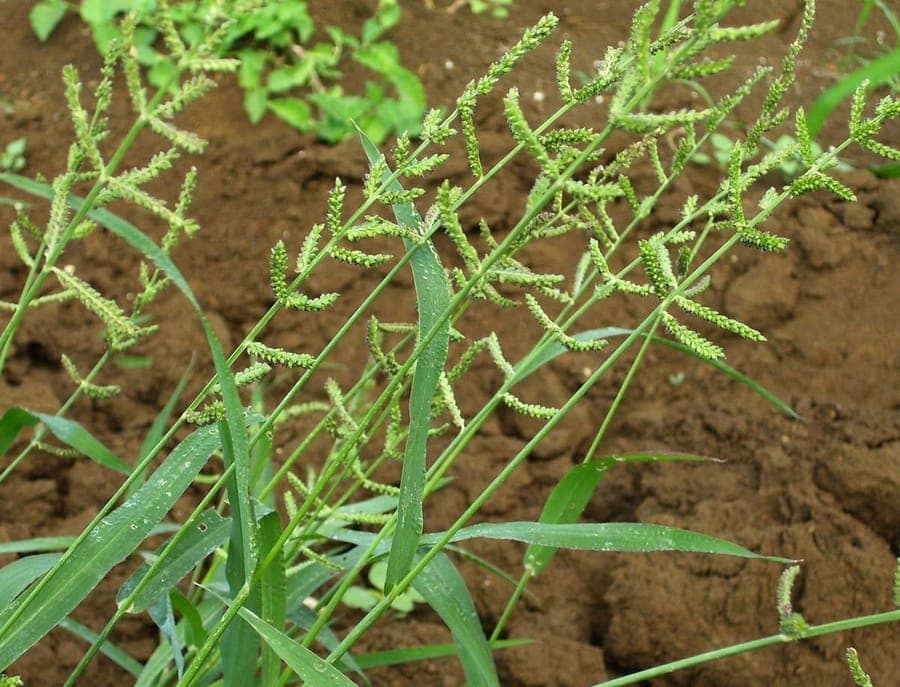
Tauʻolunga / CC BY-SA 3.0, via Wikimedia Commons
Jungle-rice: complete guide
Echinochloa colona
¿Quieres ver Jungle-rice: complete guide en tu jardín?
1 minuto, sin tarjeta de crédito
Overview
Jungle-rice (Echinochloa colona) is an ornamental cereal grass of Asian origin that thrives particularly in warm climates. This is an exceptionally bird-friendly grass that self-seeds readily and provides abundant food for seed-eating birds. The plant reaches 60-100 cm in height and forms upright, fine growth with distinctly attractive purple flower panicles.
On gardenworld.app you can create a garden design featuring Jungle-rice as a bird-friendly grass in naturalistic borders. This is a plant for gardeners who love seeing birds visit their garden. The plant flowers from August through October, abundantly, and the seed heads persist on the plant for months, providing food for finches, teasels, and other seed-eaters.
Appearance and bloom
Jungle-rice distinguishes itself through upright growth habit, very fine narrow leaves, and especially through distinctly attractive flower panicles. The panicles are compact, densely packed, and purple to brownish-purple in colour. They appear from August through October on the tips of sturdy stems.
The flower panicles are extremely attractive to birds - seed-eating mice, goldfinches and other finches love them. The seed heads persist on the plant for months if you do not remove them. This gives the plant an exceptionally long decorative period. In winter the dried panicles form very attractive silhouettes against grey daylight.
Ideal location
Jungle-rice demands full sun and warm locations. Plant this grass in the warmest spot in your garden - a south- or west-facing wall gives the best results. In partial shade the plant grows weakly and flowers sparsely.
The plant tolerates heat and even drought well, although regular watering produces better growth. This is a perfect grass for Mediterranean borders or dry, sunny corners. Space 30-40 cm apart.
Soil requirements
Jungle-rice is undemanding about soil and grows on virtually any soil type provided it drains well. Heavy clay can be lightened with sand. The plant feels at home on lean, sandy soil and makes no high demands on nutrition.
Most garden centres stock suitable sandy soil or general border compost.
Diseño gratis
¿Quieres ver Jungle-rice: complete guide en tu jardín? Crea un diseño gratis ahora.
Watering
Jungle-rice is moderately drought-tolerant once established. During the first year after planting, provide regular water until rooting, but do not overwater. Water every seven to ten days.
From the second year onward, you need only water during extended dry spells (more than three weeks). This is a very robust plant that adapts to normal European moisture. In extremely hot summers some supplementary water helps, but it is not essential.
Pruning
Jungle-rice requires minimal pruning. In early spring (March-April) cut the old stems back to just a few centimetres above ground. This promotes new growth.
You can leave the flower panicles standing through winter for natural effect and bird food. Pruning is best done before new growth appears.
Maintenance calendar
March-April: Cut back old stems. Add compost for nutrition.
May-June: New growth begins. Plant grows visibly.
July-August: Growth completes. Flowering begins.
August-October: Full bloom. Plant is extremely bird-friendly.
October-March: Seed heads remain decorative. Leave them for the birds.
Winter hardiness
Jungle-rice is not winter-hardy in colder climates. In Britain, northern Europe and the northern United States the plant dies back in winter. Actually this is not a problem because it is an annual or biennial grass that self-seeds readily. Young plants grow in spring from seed.
In southern Europe the plant can become perennial, but in colder regions it is best to resow or replant annually.
Companion plants
Jungle-rice combines beautifully in warm, sunny borders with other warmth-loving plants. Partner with Salvia nemorosa for blue colour, Achillea for warm tones, and other bird-friendly seed grains like Panicum and Setaria. In dry borders combine well with Santolina and other Mediterranean plants.
Closing
Jungle-rice is a bird-friendly grass that deserves much wider use in European gardens. Plant in groups of three to five for stronger effect. On gardenworld.app you can design warm borders featuring this grass. This is a plant that demands little maintenance and brings much vitality to the autumn garden.
¿Quieres ver Jungle-rice: complete guide en tu jardín? Crea un diseño gratis ahora.
Sube una foto, elige un estilo y obtén un diseño fotorrealista con lista de plantas en menos de un minuto.
Más de 10.000 jardines diseñados
Sin tarjeta de crédito


Plantas similares
Barnyardgrass: complete guide
Echinochloa crus-galli
Everything you need to know about Barnyardgrass: growth, care, soil needs and planting companions. Ideal for wet areas and natural gardens.
Panicum miliaceum: complete guide
Panicum miliaceum L.
Common millet (Panicum miliaceum) is a productive grain crop and ornamental grass. Learn cultivation, harvest, and uses for birdseed and garden design.
Italian Millet: complete guide
Setaria italica
Discover complete care for Italian Millet. An annual grass with elegant upright flower spikes.