
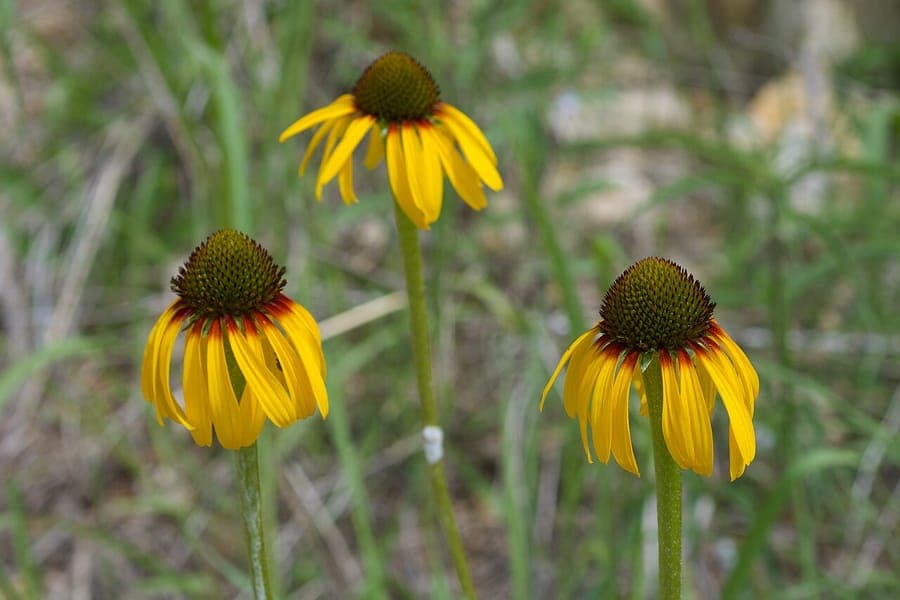
Eric Hunt / CC BY-SA 4.0, via Wikimedia Commons
Echinacea paradoxa: complete guide
Echinacea paradoxa
¿Quieres ver Echinacea paradoxa: complete guide en tu jardín?
1 minuto, sin tarjeta de crédito
Overview
Echinacea paradoxa, commonly known as Bush's purple-coneflower or yellow coneflower, is a unique variation within the coneflower genus. This plant originates from Missouri, Arkansas, Oklahoma and Texas in America and is notable for its unusual yellow flowers rather than the typical pink/purple colours of other echinacea species.
The plant reaches 60-90 cm in height and flowers from June to September in yellow flowers with characteristic red/brown central cones. This species is extremely bird-friendly, drought-resistant and a preferred plant for pollinator-friendly gardens. It is hardy to -25 degrees Celsius.
Appearance and bloom
Yellow coneflower has linear, lance-shaped leaves that feel rough and are coarsely hairy. The stems are sturdy, upright and red-tinted at maturity. The leaves grow at intervals along the stem, giving the plant an open, sculptural appearance. The hairy texture of the leaves provides a characteristic texture that distinguishes this species from many other garden perennials. This hairiness also helps the plant conserve moisture in dry conditions by reducing water loss through the leaf surface.
The flowers are the most striking features: they have yellow rays (petal-like parts) extending horizontally from the central orange-brown disk. The disk contains the true florets and later becomes a bird-attractive seed cone. The flowers appear abundantly from June to October, especially in warm summers.
Ideal location
Echinacea paradoxa thrives best in full sun locations with minimum 6 hours of direct sun daily. The plant tolerates partial shade but flowers less abundantly. In shaded positions, the plant grows poorly and produces few flowers.
The plant is not fussy about position and tolerates exposed, windy locations well. In very warm climates, partial shade in the late afternoon may be beneficial, but full shade is unsuitable.
Soil requirements
Echinacea paradoxa grows in virtually any well-draining soil, from very dry to reasonably moist. The plant is not demanding and accepts even poor soil. Heavy clay can be improved with sand and compost during planting.
PH between 6.0 and 7.5 is ideal, but the plant also tolerates alkaline soils up to pH 8.0. The plant develops a deep root system, making it extremely drought-tolerant. No special soil preparation is needed, apart from removal of large stones and weeds.
Watering
After planting, water regularly for 2-3 weeks until the plant is established. Once established (after about 1 month in good season), watering can be greatly reduced. The plant tolerates dry periods well thanks to its deep roots.
In very dry summers, supplementary watering may improve flowering, but is not essential. Water less rather than more - excess moisture sometimes leads to disease. The deep taproots of Echinacea paradoxa, which can reach 1 metre or more into the soil, make it extremely resilient in drought conditions. This is why it naturally occurs in prairie regions where rainfall is unpredictable and often insufficient. In containers, provide adequate drainage holes and use a well-draining soil mix. Never allow water to stand in saucers beneath pots. Once established in garden borders, most gardeners find they never need to water this plant at all, making it an excellent choice for water-conscious landscaping and sustainable gardening practices.
Diseño gratis
¿Quieres ver Echinacea paradoxa: complete guide en tu jardín? Crea un diseño gratis ahora.
Pruning
Echinacea paradoxa requires minimal pruning. Spent flowers can be removed for more blooms, but this is not necessary. The plant looks more natural when some seed heads are left for bird feeding.
In spring, tall or damaged stems can be carefully shortened. During autumn cleanup, dead leaves and stems can be cut down, or they can be left over winter for some insect protection.
Maintenance calendar
March-April: Plant begins to leaf out, wait until temperature is stable. May: Full growth, tips can be shortened for more compact plant. June: Flowering period begins, water regularly. July-August: Peak bloom, deadheading optional. September-October: Bloom continues, seeds ripen for birds. November-December: Plant moves towards dormancy, can be cut back. January-February: Plant rests, winter protection unnecessary.
Winter hardiness
Echinacea paradoxa is very hardy to -25 degrees Celsius and survives winters throughout Europe without protection. The plant may produce a low number of seedlings in very sheltered positions, but adult plants are highly robust. Snow and ice cause no problems.
Companion plants
Echinacea paradoxa combines well with other summer-flowering plants such as Rudbeckia, Coreopsis, and other Echinacea species. With ornamental grasses such as Miscanthus or Panicum, interesting height differences are created. In borders it works well alongside low-growing plants such as Geranium and Nepeta.
For a bird paradise, combine with Sedum, Helianthus and seed producers like Monarda and Salvia. A particularly striking summer border can be created by combining yellow Echinacea paradoxa with purple varieties such as Echinacea purpurea, creating a dynamic colour contrast. Pairing it with black-eyed Susans (Rudbeckia) and white Phlox creates a patriotic red-white-blue themed border in regions where those colours are significant. For a more subtle, warm colour scheme, pair with orange daylilies, golden Heliopsis and apricot-toned Coreopsis. Late summer bloomers such as Asters and Goldenrod can be added to extend the flower season into autumn.
Closing thoughts
Echinacea paradoxa is an excellent choice for gardeners seeking robust, long-flowering, bird-friendly and pollinator-attracting plants. The unique yellow flowers distinguish this plant from other coneflowers and offer interesting design possibilities. With minimal maintenance requirements, it is suitable for virtually all garden situations.
Order via gardenworld.app/en. For more advice on combinations and design, visit gardenworld.app/en.
¿Quieres ver Echinacea paradoxa: complete guide en tu jardín? Crea un diseño gratis ahora.
Sube una foto, elige un estilo y obtén un diseño fotorrealista con lista de plantas en menos de un minuto.
Más de 10.000 jardines diseñados
Sin tarjeta de crédito


Plantas similares
Calendula stellata: complete guide
Calendula stellata
Complete guide to Calendula stellata, the star-flowered marigold from Sicily: location, soil, watering and companion planting tips.
Korean chrysanthemum: complete guide
Chrysanthemum x rubellum
Chrysanthemum x rubellum is a hardy autumn perennial with single pink to copper flowers from August to November. Care and combinations.
Helianthus divaricatus: complete guide
Helianthus divaricatus
Helianthus divaricatus is a North American woodland sunflower with yellow summer blooms, ideal for naturalistic borders and shady edges.