
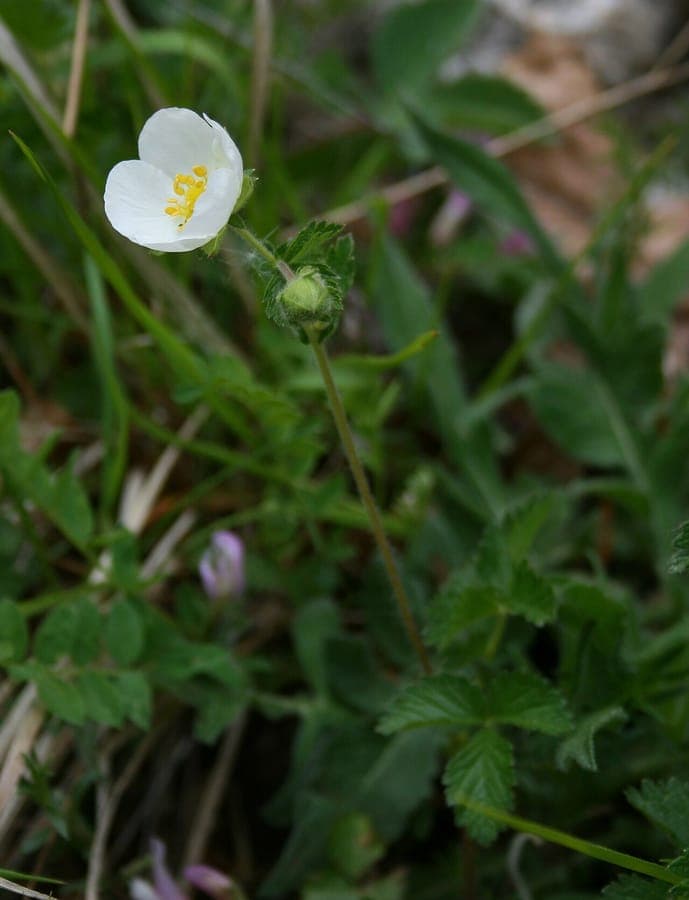
Franz Xaver / CC BY-SA 3.0, via Wikimedia Commons
Drymocallis rupestris: complete guide
Drymocallis rupestris
¿Quieres ver Drymocallis rupestris: complete guide en tu jardín?
1 minuto, sin tarjeta de crédito
Overview
Drymocallis rupestris, commonly known as Siberian-tea, rock cinquefoil or in German Felsen-Fingerkraut, is an attractive and hardy mountain plant from the family Rosaceae. This species occurs naturally in Europe, from Spain to Siberia, and also grows in parts of Morocco. The plant is known for its resilience in rocky, difficult growing conditions where many other plants struggle.
In Scandinavian countries, Drymocallis rupestris is known as Trollsmultron. The plant is not only botanically interesting but also practically valuable due to its ability to endure extreme mountain conditions.
Appearance and bloom
Drymocallis rupestris is a compact, low-growing plant that usually does not exceed 30-40 centimeters in height. The plant forms thick, fibrous roots and grows into a neat, ball-shaped form. The leaves are compound and have a silvery sheen, especially on the undersides. This silvery appearance gives the plant special appeal.
The blooming period runs from May to August, during which the plant produces numerous golden-yellow flowers that are small but striking. The flower has five petals, characteristic of the Rosaceae family. These flowers are very important for insects, especially bees and bumblebees that visit the plant in masses.
After blooming, the plant forms seed heads that remain decorative into the fall.
Ideal location
Drymocallis rupestris grows best in full sunlight. The plant tolerates partial shade but blooms most abundantly in full sun. The plant is very cold-hardy and grows on mountain slopes in its natural habitat, where it is cold and windy.
The plant grows best at elevations of 500 to 2500 meters, which shows that this plant is very suitable for mountain gardens and alpine gardens. In lowland climates, the plant grows well as long as it does not become too warm and humid.
The plant tolerates strong winds and can grow well on exposed slopes where others would fail.
Soil
Drymocallis rupestris is extremely tolerant of different soil types but grows best in well-draining, poor to moderately nutrient-rich soils. In rocks and stone, where the plant grows naturally, it does not suffer from moisture build-up.
The plant tolerates acidic to basic pH values (pH 4.5 to 8.0) and grows even on lime-poor soils. For pot cultivation, you can use a mixture of universal potting soil, grit, and sand, which provides excellent drainage.
The plant is very tolerant of nutrient-poor soils, so fertilizer can be kept to a minimum.
Diseño gratis
¿Quieres ver Drymocallis rupestris: complete guide en tu jardín? Crea un diseño gratis ahora.
Watering
Drymocallis rupestris is very drought-tolerant and grows in much drier conditions than the surrounding vegetation. Once established, the plant rarely needs extra water. In pot culture, you must be careful with excessive watering, as waterlogging leads to root rot.
Watering can be limited to dry periods. During the growing season (spring and early summer), you can water when the top centimeter is dry. In fall and winter, water can be greatly reduced.
The plant grows from mountain streams where periodic flooding occurs, so some moisture variation is well tolerated.
Pruning
Drymocallis rupestris requires little pruning. The plant grows compactly and needs no shaping. Pruning is mainly aimed at removing dead, damaged, or diseased leaves and flowers.
The plant can be lightly pruned in spring to remove old leaves and maintain a neat shape. This also stimulates new growth.
Avoid pruning when the plant is blooming, as this can disturb bird activity and insect-friendliness.
Maintenance calendar
March to May: Beginning of growing season, water carefully, no feeding needed for poor soils.
June to August: Blooming period, check regularly for pests, water only in dry periods.
September to October: Growing season begins to decline, feeding stops, water minimal.
November to February: Dormant stage, no watering or feeding needed.
Winter hardiness
Drymocallis rupestris is exceptionally winter-hardy and can withstand temperatures to -30 degrees Celsius. This makes the plant ideal for mountain gardens and alpine gardens in cold regions. The plant is not only frost-resistant but thrives even on snowy peaks.
The plant is fully hardy throughout Europe, including Scandinavia. In tropical climates, this plant is not suitable because the plant cannot tolerate high heat.
Plant companions
Drymocallis rupestris grows in mountain meadows where many other alpine plants occur. In gardens, the plant can be well combined with other alpine and rock plants such as Saxifraga, Phlox subulata, Dianthus, and other mountain dwellers.
The plant is excellent for rock gardens, borders, and flower beds with an alpine theme. In Scandinavia, the plant is used in traditional mountain gardens.
The plant attracts bees, bumblebees, and butterflies, making it valuable for wildlife-friendly gardens.
Conclusion
Drymocallis rupestris is an impressive mountain plant that proves that beauty and toughness can go together. This small jewel of the alpine flora is ideal for difficult growing places and brings centuries of alpine garden heritage to your own garden. With minimal care, this plant provides seasonal blooms and remains healthy and attractive.
Want to learn more about alpine plants? Visit gardenworld.app for inspiration and professional garden design services!
¿Quieres ver Drymocallis rupestris: complete guide en tu jardín? Crea un diseño gratis ahora.
Sube una foto, elige un estilo y obtén un diseño fotorrealista con lista de plantas en menos de un minuto.
Más de 10.000 jardines diseñados
Sin tarjeta de crédito


Plantas similares
Siberian crab apple: complete guide
Malus x robusta
Complete guide to the Siberian crab apple (Malus x robusta): location, soil, pruning, winter hardiness and the best companion plants for your garden.
Chinese flowering crabapple (Malus x spectabilis): complete guide
Malus x spectabilis
Meet the Chinese flowering crabapple (Malus x spectabilis): a classic spring bloomer with carmine buds and pink blossom.
Potentilla crassinervia: complete guide
Potentilla crassinervia
Potentilla crassinervia, the Corsican cinquefoil, grows wild on Corsica and Sardinia's peaks. Discover how to grow this hardy alpine rock garden gem.