
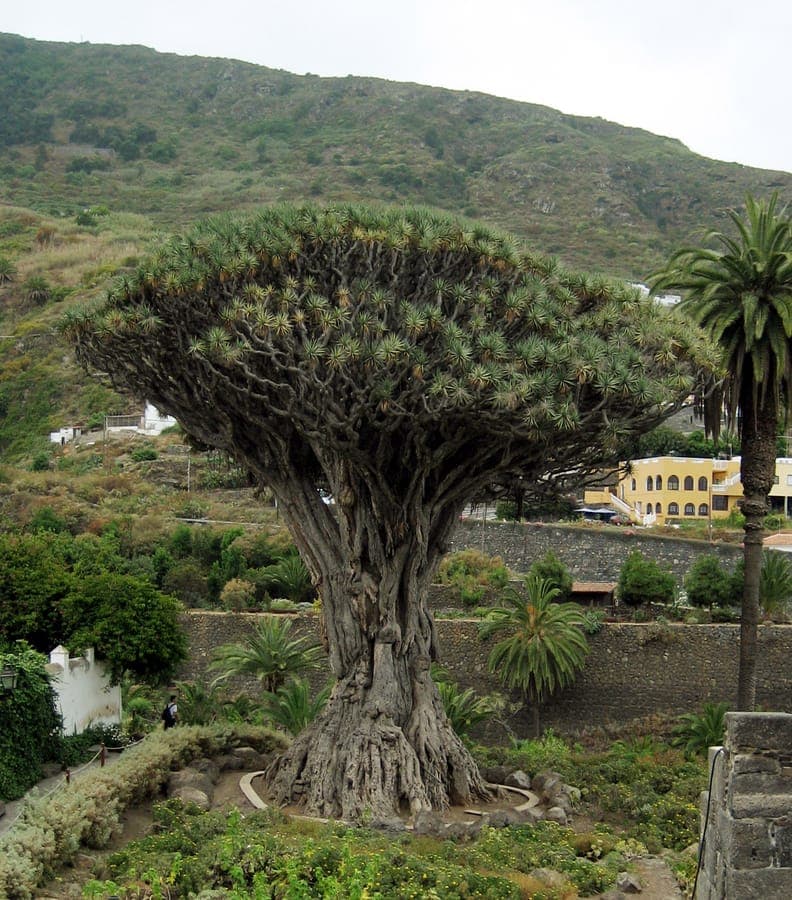
Wikimedia Commons / CC BY-SA 3.0, via Wikimedia Commons
Dragon Tree: complete guide
Dracaena draco
¿Quieres ver Dragon Tree: complete guide en tu jardín?
1 minuto, sin tarjeta de crédito
Overview
The Dragon Tree (Dracaena draco), also called Canary Island Dragon Tree, is a special ornamental plant native to the Canary Islands. This tree is known for its distinctive, impressive form with a broad, dense crown on a relatively slender trunk.
The tree grows slowly to heights of 5 to 8 meters, with a width that can exceed its height. This makes it particularly suitable for visual impact in large gardens. As a container plant in cooler climates, it grows even more slowly.
Appearance & Bloom
The Dragon Tree is distinctive through its unique form. The leaves are lance-shaped, stiff, and blue-green, arranged in dense rosettes at branch ends. They can reach 60 centimeters in length.
The flowers are small, yellow or white, and appear in panicles on mature trees. They are not spectacular but have a pleasant fragrance. The plant sometimes also bears red berries.
The tree gets its name from the red resin that flows from wounded areas. This dragon's blood (dracorubine) is used in traditional medicines.
Ideal Location
The Dragon Tree thrives best in warm, sunny locations with at least 6 hours of direct sunlight daily. The tree is very light-hungry and grows poorly in shade.
The tree is frost-sensitive and cannot tolerate temperatures below 10 degrees Celsius. In temperate climates, a greenhouse or warm room is essential for overwintering.
A sheltered location is desirable to protect against strong wind that can damage branches.
Soil
The Dragon Tree is not particular about soil type but thrives best in well-draining, sandy soil. The tree tolerates a pH of 5.5 to 7.5.
Heavy clay soils should be amended with sand and perlite. In pots, a mix of cactus soil and perlite is recommended.
The tree tolerates dry soil well thanks to its fleshy leaves. Excessive water is the greatest risk.
Watering
The Dragon Tree is very drought-tolerant and handles periods of dryness well. This makes it ideal for gardens where water is scarce.
Water sparingly, especially in winter. Ensure the soil dries well between waterings. Root rot is the greatest problem with excessive water.
In summer, more water may be needed, but still moderate. Container plants require slightly more moisture than ground plantings.
Diseño gratis
¿Quieres ver Dragon Tree: complete guide en tu jardín? Crea un diseño gratis ahora.
Pruning
The Dragon Tree grows naturally into an attractive form and requires minimal pruning. Remove only dead or diseased branches.
Maintenance pruning can be done in spring. Avoid heavy pruning because the tree grows slowly and has difficulty recovering.
Damaged or broken branches can be removed, but this does not cause branching.
Maintenance Calendar
Spring (March-May): Begin regular watering as it gets warmer. Feed monthly. Inspect for pests.
Summer (June-August): Ensure consistent moisture during periods of intense heat. Avoid exposure to intense afternoon sun in very hot regions.
Autumn (September-October): Reduce feeding as growth slows. Bring container plants indoors before temperatures drop below 10 degrees.
Winter (November-February): Minimal moisture. No feeding. Provide plenty of light in a warm indoor location.
Winter Hardiness
The Dragon Tree is not winter-hardy in temperate climates. Mild frost to -2 degrees can be briefly tolerated, but prolonged frost is fatal.
In all regions with winter temperatures below 10 degrees, protection is essential. A warm interior, greenhouse, or veranda is needed.
Old woody tissue is somewhat more resistant than new growth, but young trees are most vulnerable.
Companion Plants
The Dragon Tree works well with other succulents and drought-tolerant plants. Combinations can include:
Other Dracaena species or palms create a tropical effect.
Low-growing succulents like sedum or echeveria form a nice underplanting.
Agave, yucca, and other xeric plants fit well with the same watering schedules.
Closing Thoughts
The Dragon Tree is a statement plant for those wanting drama and exoticism in their garden. With its distinctive form and minimal moisture requirements, this is a plant with many possibilities. Ideal for warm climates or as a container plant that moves indoors.
Looking for plant material? Specialized tree nurseries carry this species. Visit gardenworld.app/en or gardenworld.app/nl for more information.
¿Quieres ver Dragon Tree: complete guide en tu jardín? Crea un diseño gratis ahora.
Sube una foto, elige un estilo y obtén un diseño fotorrealista con lista de plantas en menos de un minuto.
Más de 10.000 jardines diseñados
Sin tarjeta de crédito


Plantas similares
Narrow-leaved dracaena: complete guide
Dracaena angustifolia
Everything about Dracaena angustifolia - the narrow-leaved dracaena: location, care, overwintering and use as a houseplant or patio plant.
Chaparral yucca: complete guide to Hesperoyucca whipplei
Hesperoyucca whipplei
Hesperoyucca whipplei (Our Lord's candle) is a dramatic rosette-forming plant from California that produces a towering flower spike, ideal for dry and gravel gardens.
False lily-of-the-valley: complete guide
Maianthemum dilatatum
Everything about Maianthemum dilatatum, the false lily-of-the-valley. Care, shade location, propagation and garden combinations for this popular shade ground cover.