
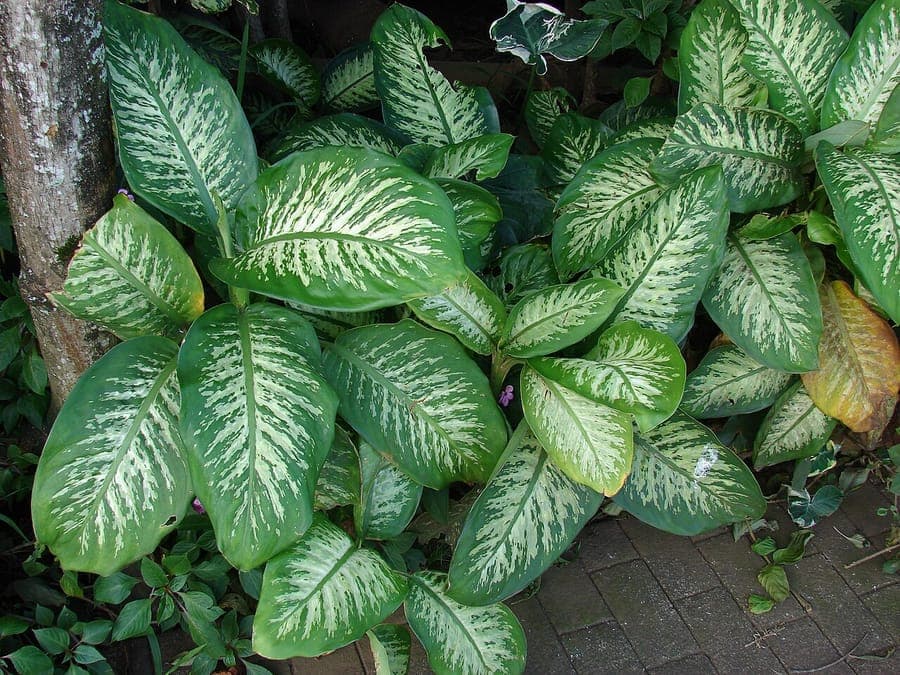
Forest & Kim Starr / CC BY 3.0, via Wikimedia Commons
Dieffenbachia seguine: complete guide
Dieffenbachia seguine
¿Quieres ver Dieffenbachia seguine: complete guide en tu jardín?
1 minuto, sin tarjeta de crédito
Overview
Dieffenbachia seguine, also known as "dumb cane," is a popular foliage plant originating from the Caribbean and South Tropical America. This plant belongs to the Araceae family and is widely grown as a houseplant due to its striking, variegated leaves.
The plant grows rapidly and can become quite large. Although beautiful, it is important to note that all parts of the plant are toxic, especially if ingested. The sap causes irritation of the mouth and throat, hence the name "dumb cane."
Although not ideal for households with small children or pets, it is an excellent choice for offices and adult households.
Appearance and bloom
Dieffenbachia seguine is a shrubby plant with thick, fleshy green stems. The leaves are the highlight - large (20-40 cm long), oval to lance-shaped, with whitish or yellow-green spots or stripes against a deep green background.
The plant can grow to about 1 meter tall indoors, and can grow much larger in optimal tropical conditions. The stems have a robust, brown appearance.
The flowers are very small, white to yellow, grouped in a spadix (characteristic of Araceae). However, they are not very conspicuous and the plant is mainly appreciated for its foliage.
Young plants have more compact, darker leaves, while older plants develop larger, lighter leaves.
Ideal location
Dieffenbachia thrives best in bright, indirect light. Do not place it in direct sunlight, which can cause leaf burn. A spot near a window, but not directly in the sun, is ideal.
The plant also grows under artificial light, making it perfect for offices. It can also grow in partial shade, although growth is slower.
Avoid very dark corners. In winter, when light is weaker, the plant benefits from more light.
Soil
Use well-draining potting soil. A mix of potting soil, perlite and peat moss in equal parts works well. Humus-rich soil is preferred.
The plant prefers slightly acidic soil with pH 6.0-6.5. Well-draining soil is essential to prevent root rot.
Once a year, when repotting, it may be recommended to add extra organic material to the soil.
Watering
Let the top layer of soil dry between watering. Overwatering is one of the biggest threats to Dieffenbachia's health. Water moderately moist, not soggy.
In winter, watering can be less frequent. Check moisture by inserting your finger into the soil.
The plant prefers warm water with minimal chloride. If the water is very hard, let it sit overnight before watering.
Diseño gratis
¿Quieres ver Dieffenbachia seguine: complete guide en tu jardín? Crea un diseño gratis ahora.
Pruning
Pruning helps keep the plant compact and dense. Pruning is best done in spring. Pinch off the top if the plant gets too tall, stimulating side growth.
Remove yellow or damaged leaves regularly. This helps keep the plant healthy.
Be careful - all parts are toxic. Wear gloves and avoid sap contact.
Maintenance calendar
FEBRUARY-MARCH: Repot in fresh soil; light pruning. APRIL-MAY: Regular watering; place in light. JUNE-AUGUST: Full growth; fertilize bi-weekly; mist. SEPTEMBER-OCTOBER: Water less; reduce fertilizing. NOVEMBER-JANUARY: Winter dormancy; minimal water; no fertilizing.
Winter hardiness
Dieffenbachia is not frost-hardy. It cannot tolerate temperatures below 10 degrees Celsius. The plant thrives best at temperatures of 18-25 degrees Celsius.
Plants outdoors in subtropical areas can stay outside in warm months, but must be brought indoors when temperatures drop.
Avoid drafts and sudden temperature changes, which can cause leaf drop.
Companion plants
Dieffenbachia combines well with other foliage plants. Place it next to plants like Philodendron, Monstera or Anthurium for a jungle-like effect.
Smaller growers like Peperomia or Syngonium can grow underneath in the same pot.
The plant is large enough to be grown alone as a specimen in a pot.
Warning: Toxicity
Dieffenbachia contains crystalline oxalates that cause irritation. All parts are toxic: leaves, stems and roots.
Ingestion can cause mouth irritation, swelling of lips and tongue, difficulty swallowing and stomach irritation.
Keep the plant out of reach of children and pets. Wear gloves when handling. Rinse immediately with water in case of accidental contact.
Closing thoughts
Dieffenbachia is a beautiful, easy-to-care foliage plant for adult households and offices. With caution for the toxic sap, you can enjoy its beautiful foliage for years to come.
Visit OBI or Hornbach for quality plants and potting soil. For more tips on foliage plants, visit gardenworld.app.
Gardenworld.app helps you create a beautiful plant-filled interior, even with toxic species like dieffenbachia.
¿Quieres ver Dieffenbachia seguine: complete guide en tu jardín? Crea un diseño gratis ahora.
Sube una foto, elige un estilo y obtén un diseño fotorrealista con lista de plantas en menos de un minuto.
Más de 10.000 jardines diseñados
Sin tarjeta de crédito


Plantas similares
Arrowhead vine: complete guide
Syngonium auritum
Everything about Syngonium auritum, the tropical five-fingers houseplant. Care, location, watering, and pruning explained clearly for beginners and enthusiasts.
Minute duckweed: complete guide to Lemna perpusilla
Lemna perpusilla
Everything about Lemna perpusilla, the minute duckweed: ecology, pond management, water quality and care in garden water features.
Dead horse arum lily: complete guide
Helicodiceros muscivorus
Everything about the dead horse arum lily (Helicodiceros muscivorus): growing conditions, spectacular bloom, thermogenesis, and care for this Mediterranean aroid.