
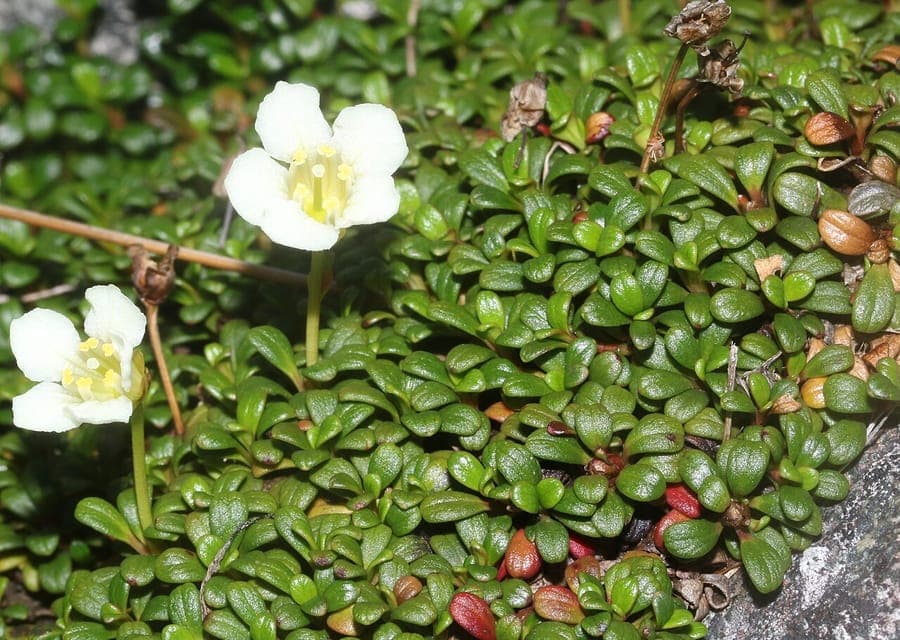
Alpsdake / CC BY-SA 4.0, via Wikimedia Commons
Diapensia lapponica: complete guide
Diapensia lapponica
¿Quieres ver Diapensia lapponica: complete guide en tu jardín?
1 minuto, sin tarjeta de crédito
Overview
Diapensia lapponica, commonly known as Lapland diapensia or cushion plant, is an extremely alpine plant from arctic and subarctic regions. This extremely compact, cushion-shaped plant grows in the harshest mountain climates of northern Europe, from Greenland to Lapland and beyond. Standing only several centimeters tall, Diapensia lapponica is for very specialized gardeners who want to grow extreme alpine species.
The plant thrives in inhospitable arctic tundra on rocks and hillsides where ice and snow dominate. This habitat preference makes achieving moisture balance critical. At gardenworld.app, qualified alpine gardeners find support for this challenging plant.
Appearance and bloom
Diapensia lapponica forms extremely densely growing cushions of minuscule, surface leaves that are deep green. The plant rarely exceeds 3 to 5 cm in height and can reach width to 15 cm. The structure is extremely compact to resist strong arctic winds.
Blooming occurs in early summer with tiny, white to very light pink flowers that sit moderately on the cushion surface. Flowers are extremely fragile and short-lived, typically lasting only 2 to 3 weeks. After blooming, seed pods form with minuscule seed. The plant is valued more for its structure than its blooms.
Ideal location
Diapensia lapponica requires full sun and airflow, minimum 6 to 8 hours of direct sunlight daily. The plant tolerates very strong winds much better than other alpines - in fact thrives in them. In warm climates, heat exhaustion must be avoided with shading by nearby structures.
Although arctic in origin, the plant also grows on mountain ridges in arctic taiga zones and on rocks along mountain streams. Air movement is essential; still, warm enclaves promote rot. A mountain location or roof garden with strong airflow is ideal.
Soil
Diapensia lapponica grows best in very well-draining materials, extremely sparse on nutrients. Alpine stone mix (40% coarse sand, 20% perlite, 20% gravel, 20% minimal compost) gives the best results. The plant prefers acidic pH, ideally 5.5 to 6.5.
Wet soil will almost certainly kill this plant. In summer good drainage; in arctic habitats, water drains away from permafrost soil. Adding sand and gravel to 70% of total mixture is not excessive. Seed starting in pure sand or perlite mixture works better.
Watering
Diapensia lapponica is extremely drought-tolerant once established, especially because it grows naturally in arctic environment with very limited water. After planting, moderate water should be given with extra attention to drainage. Summer watering should be limited to morning spraying in extreme heat.
Winter watering requires special attention: prevent moisture accumulation around the plant. In non-arctic climates, shelter the plant from winter precipitation with a frame or shelter. This is a plant that prefers "neglect" to excessive care.
Diseño gratis
¿Quieres ver Diapensia lapponica: complete guide en tu jardín? Crea un diseño gratis ahora.
Pruning
Diapensia lapponica requires virtually no pruning. Its natural cushion form must be maintained. Dead leaves are naturally shed and should not be removed. Pruning will damage this delicate plant more than help.
Remove only seed pods after blooming if seed collection is not desired. Avoid any significant manipulation. If portions become necrotic, they can be carefully removed, but a healthy plant requires no pruning.
Maintenance calendar
Spring: Water only if very dry, inspect for winter damage, minimal nutrition. Late spring to early summer: Blooming, leave blooms undisturbed, limited deadheading. Summer: Minimal watering, inspection for pests/diseases, prevention of overwatering. Autumn/Winter: Keep dry, protection from precipitation, prevention of moisture accumulation.
Winter hardiness
Diapensia lapponica is extremely winter hardy in arctic to temperate climates and does not die back above -30 degrees Celsius. Cold tolerance is not the problem; wet winters are. This plant dies more often from moisture than cold in non-arctic zones.
In very warm regions, this plant can only grow at very high elevation (above 2000m) or in very special alpine greenhouse conditions. In Scandinavian gardens, this plant can thrive outside; in warmer Europe, alpine frame or very protected setting required.
Companion plants
Diapensia lapponica combines with other extremely alpine plants such as Silene acaulis (moss campion), Androsace, Saxifraga species, and other very compact alpines. This grouping creates an arctic tundra miniature scene. Rarely at same height in same grouping for visibility.
Minuscule grasses such as Nardus stricta (mat grass) can be added in very small amounts. Other cushion plants such as Azalea procumbens combine nicely. Preference for very compact, minimal-disturbance groupings.
Closing
Diapensia lapponica is for extreme lovers of arctic and alpine flora. This plant requires exceptional drainage, cold-like temperatures (even in warmer climates), and tendency toward very conservative handling. For Netherlands gardeners, this plant is very challenging and better suited for very special alpine enthusiasts.
Rarely available in Dutch retail; can be ordered from international nurseries. Intratuin and Gamma almost never carry this. With gardenworld.app resources, very experienced alpine gardeners find support for this rare plant species.
¿Quieres ver Diapensia lapponica: complete guide en tu jardín? Crea un diseño gratis ahora.
Sube una foto, elige un estilo y obtén un diseño fotorrealista con lista de plantas en menos de un minuto.
Más de 10.000 jardines diseñados
Sin tarjeta de crédito


Plantas similares
Acer pycnanthum: complete guide
Acer pycnanthum
Acer pycnanthum, the Japanese swamp maple, is a fast-growing tree with early red flowers and brilliant autumn color, ideal for damp garden settings.
Freeman maple: complete guide
Acer × freemanii
Everything about the Freeman maple (Acer x freemanii): a fast-growing shade tree with spectacular autumn colour for large gardens.
Silver vine: complete guide
Actinidia polygama
Discover silver vine (Actinidia polygama): a hardy climbing plant with silvery foliage, loved by gardeners and cats alike.