
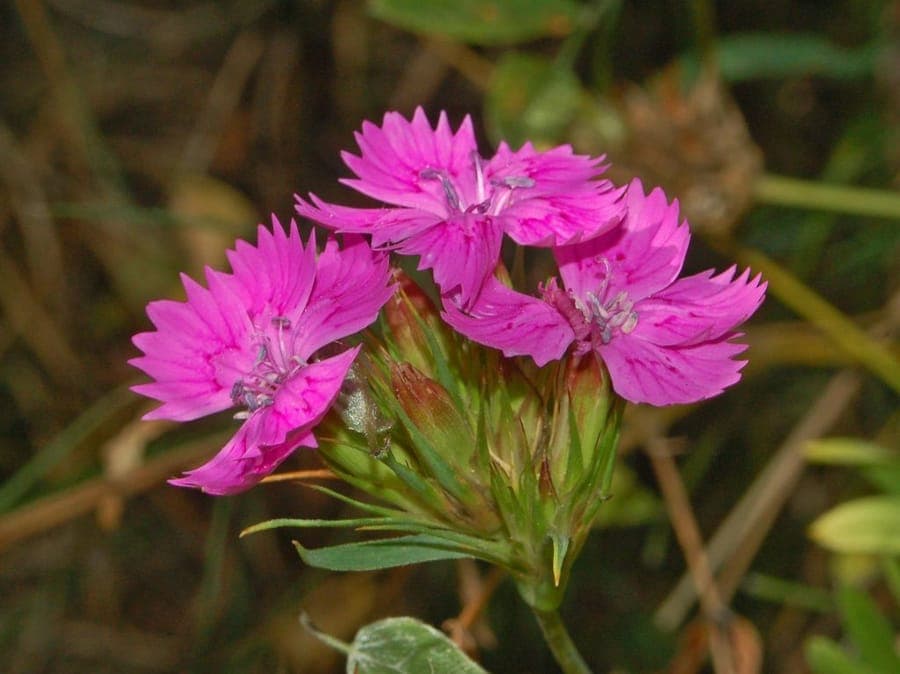
Hectonichus / CC BY-SA 3.0, via Wikimedia Commons
Balbis' pink: complete guide
Dianthus balbisii
¿Quieres ver Balbis' pink: complete guide en tu jardín?
1 minuto, sin tarjeta de crédito
Overview
Balbis' Pink (Dianthus balbisii) is a charming small carnation native to the mountainous regions of southeastern France and Italy. This plant belongs to the more intriguing members of the Dianthus genus and forms a compact, tight clump with grey-green foliage and purple-pink flowers with elegantly fringed petal margins. The plant reaches only 15-30 cm tall and is perfect for alpine troughs, droughty borders, and rock garden projects.
On gardenworld.app you can create a garden design featuring Balbis' Pink as an alpine showstopper. This is a plant for sun-loving gardeners who appreciate minimal watering. The flowering is very extended (June-July) and the plants form sturdy, dense clusters that persist for years with scarcely any maintenance.
Appearance and bloom
Balbis' Pink distinguishes itself through extremely compact growth and small, grey-green foliage that is linear and pleasingly textured. The flowers are purple-pink in hue, approximately 1-1.5 cm across, and appear in clusters at the top of short, sturdy stems. The petals have a characteristic finely-fringed or serrated margin, which is both elegant and delicate in appearance.
Flowering concentrates in June and July, with possible additional bloom in September if you deadhead spent flowers. The flowers carry a pleasant, strong fragrance though less intense than many other Dianthus species. The plant remains compact and grows very densely packed, naturally forming a mounded cushion shape.
Ideal location
Balbis' Pink demands a very sunny position - minimum six to seven hours of direct sun daily. In partial shade the flowering apparatus shuts down and blooms become sparse. This is a plant for full-sun borders, dry, sunny slopes, and rock garden positions where other plants would suffer.
The plant naturally grows on cliff faces and mountainsides with abundant rocks and stone. Recreate these conditions in your garden. Plant on raised terraces or sloping beds for maximum effect. Recommended spacing: 20-25 cm.
Soil requirements
Balbis' Pink makes very modest demands on soil, provided it drains excellently. The ideal soil is poorer than average, even lean, and may be low in humus. Mix gritty sand or gravel into the top 15 cm of the planting hole.
The plant tolerates sparse, stony substrate far better than rich garden soil. This is actually an advantage: plant in a mix of sand, gravel and minimal peat. Garden centres stock special alpine-plant composts suitable for this purpose.
Diseño gratis
¿Quieres ver Balbis' pink: complete guide en tu jardín? Crea un diseño gratis ahora.
Watering
Balbis' Pink is extremely drought-tolerant once established. In the first year after planting, give moderate water - enough for root establishment, but not so much the plant becomes waterlogged. Water every seven to ten days.
From the second year onward, supplementary watering is rarely needed. This plant tolerates dry periods of four to six weeks without flower loss. Overwatering is more damaging than underwatering and leads to rot. In average summers, you will rarely need to water established plants.
Pruning
Balbis' Pink requires minimal pruning. Remove spent flowers after bloom to encourage possible late-season repeat flowering in September. This is optional - you can simply allow the plant to grow as it will.
In autumn you can cut the plant back after flowering to around 5 cm above ground, which encourages compact, well-formed shoots. Remove any dead wood in spring.
Maintenance calendar
April-May: Growing season begins. Plant new specimens. Ensure good drainage.
June-July: Flowering. Deadhead for possible repeat bloom. Monitor for drought stress.
August-September: Possible secondary flowering. Remove spent blooms.
October: Prune to compact form. Check for fungal issues (rare).
November-March: Winter dormancy. Plant is essentially dormant.
Winter hardiness
Balbis' Pink is very hardy (USDA zones 5-8) and tolerates temperatures down to approximately -25 degrees Celsius. The plant survives every British and Central European winter without protection, provided soil drains well. On waterlogged, poorly-drained soil problems may develop.
Companion plants
Balbis' Pink combines beautifully in alpine gardens with other compact, drought-loving plants. Partner with Sempervivum for textural contrast, Pulsatilla for colour and timing, and fine Festuca species for leaf shape. In dry borders combine well with Santolina, Helichrysum, and other Mediterranean herbs.
Closing
Balbis' Pink is an elegant little gem for those who love minimalist, dry gardens. Plant in groups of three to five for stronger effect. On gardenworld.app you can design an alpine or dry border featuring Balbis' Pink. This is a plant that persists for years with virtually no maintenance.
¿Quieres ver Balbis' pink: complete guide en tu jardín? Crea un diseño gratis ahora.
Sube una foto, elige un estilo y obtén un diseño fotorrealista con lista de plantas en menos de un minuto.
Más de 10.000 jardines diseñados
Sin tarjeta de crédito


Plantas similares
Carthusian pink: complete guide
Dianthus carthusianorum
Hardy, drought-tolerant perennial with deep pink flowers. Thrives in full sun and well-drained soil. Ideal for gravel gardens and dry borders. Learn more on gardenworld.app.
Maiden pink: complete guide
Dianthus deltoides
Learn how to grow Dianthus deltoides, a low-maintenance groundcover with pink to purple flowers, perfect for sunny borders and dry garden spots.
Cheddar pink: complete guide
Dianthus gratianopolitanus
Grow Dianthus gratianopolitanus successfully: care, soil, watering, pruning and ideal garden placement. Perfect for rock gardens and borders.