
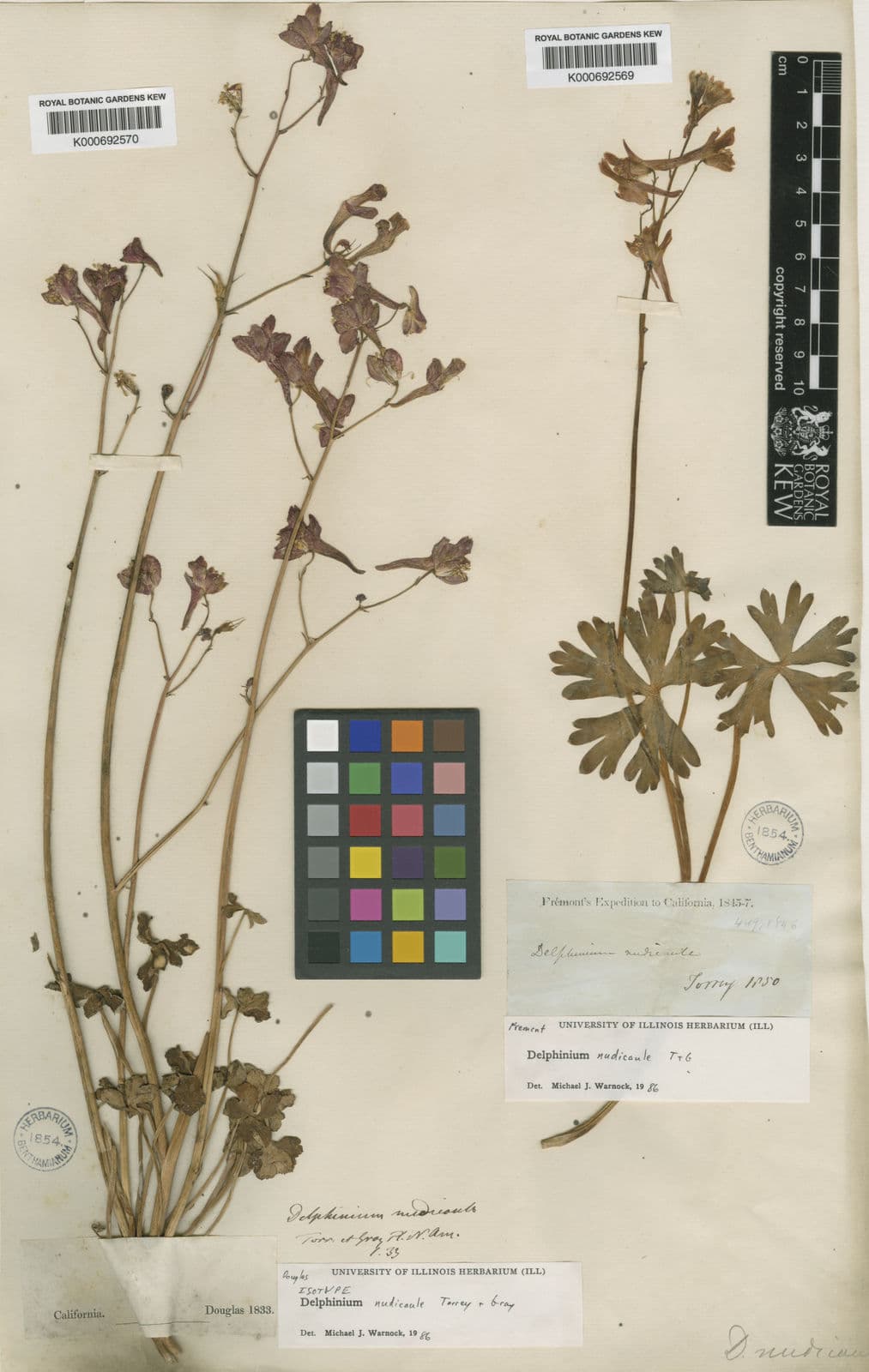
Red Larkspur (Delphinium nudicaule): complete guide
Delphinium nudicaule
¿Quieres ver Red Larkspur (Delphinium nudicaule): complete guide en tu jardín?
1 minuto, sin tarjeta de crédito
Overview
Delphinium nudicaule, commonly known as red larkspur, scarlet larkspur, or California larkspur, is an extraordinary and rare annual to short-lived perennial native to southwestern Oregon and California. Reaching 50 to 100 cm in height, this unique larkspur radically diverges from its blue cousins, displaying vivid red to orange-red flowers in spectacular dense spires. Blooming profusely and supportive of hummingbirds, Delphinium nudicaule is among the most visually striking larkspurs in cultivation. The plant is highly sensitive to moisture and waterlogging, making its cultivation in damp climates challenging but achievable. Once established, it self-seeds reliably, ensuring generation-to-generation presence in the garden.
Appearance and Bloom Cycle
Delphinium nudicaule possesses somewhat hairy, grayish-green foliage grouped at the plant base. The petioles are distinctly glabrous or nearly so (nudicaule means "naked stem"), distinguishing it from related species. Leaves are deeply divided and fern-like, approximately 5 to 10 cm across. Flower stems are strongly upright, glossy, and naturally nearly leafless or very sparsely leafed. From May through July, spectacular flower spikes appear: dense, towering racemes bearing twenty to forty open blooms. Each flower measures approximately 2 to 2.5 cm wide, displaying four red, orange, or yellow petals and a characteristic backward-curving spur. The red form (var. nudicaule) is most common in cultivation, though orange-yellow forms occur. After flowering, seed pods ripen through September. Seeds are tiny, black, and very fine.
Ideal Location
Delphinium nudicaule blooms best in full sun, requiring 6 to 8 hours of direct sunlight daily. This is a mountain plant intolerant of shade. However, in regions with extremely hot summers, afternoon shade provides relief. This is a cool-climate plant thriving best in USDA zones 6 to 9, suitable for many German and Swiss mountain gardens. The plant dislikes hot, humid summers and performs far better in cool, dry mountain climates. In the Netherlands, it thrives in northern German or Swiss alpine gardens. In lowland gardens, it may struggle. Wind is not problematic; the plant is robustly constructed.
Soil Requirements
Delphinium nudicaule demands excellently drained, slightly acidic soils (pH 6.0 to 6.8). Heavy, water-retentive soil is absolutely unsuitable and leads almost certainly to plant loss through root rot. The plant grows naturally in mountainous, stony soils with substantial sand and rock content. For planting, apply a mixture of 60% coarse sand or gravel, 25% peat moss, and only 15% compost. Dig planting holes 25 to 30 cm deep and add extra sand at the bottom for deep drainage. Space plants approximately 30 cm apart. For container cultivation, use very gritty potting medium: alpine or cactus-specific mixes, never standard garden soil.
Watering
Delphinium nudicaule has very moderate water needs and is extremely drought-tolerant once established. This is probably the most drought-enduring larkspur, with waterlogging being far more dangerous than drought. Young plants need some regular watering until developing root systems (approximately four weeks), then watering can be substantially reduced. Mature plants tolerate long dry periods without any loss. In regions with regular rainfall, the plant may receive too much water and rot. Prevent waterlogging and absolutely no stagnant water around the plant base. This is the plant for dry, alpine gardens or special scree gardens with very gritty mixes.
Pruning
Delphinium nudicaule requires minimal pruning. The plant naturally produces neat, upright flower spikes requiring no staking. Dead flowers may be removed or left to produce seed. After blooming (August), the plant can be cut back to approximately 20 cm above ground, sometimes triggering a light third flush in September. Old foliage can be removed in late autumn. Avoid excessive cutting; the plant's short-lived nature prefers minimal disturbance.
Diseño gratis
¿Quieres ver Red Larkspur (Delphinium nudicaule): complete guide en tu jardín? Crea un diseño gratis ahora.
Maintenance Calendar
March to April: Spring growth emerging. Very careful watering; this plant prefers dry conditions in spring. Remove weeds gently. No fertilizer application.
May to June: Blooming period. Minimal watering. Observe hummingbirds and pollinators.
July to August: Blooming peak. Very minimal watering. Observe seed maturation.
September to October: Seed drop. Seed can be collected or self-seeding allowed. Cut stems down.
November to February: Winter dormancy. No watering unless extremely dry. Protect young plants from heavy snow damage.
Winter Hardiness
Delphinium nudicaule is hardy in zones 6 to 9, tolerating temperatures to -15 degrees Celsius. However, winter hardiness is not limiting; intolerance of wet, cold winters is far more critical. In wet regions, protect young plants during winter. Either grow in containers moveable to dry storage, or plant in very well-drained raised beds with gritty compost. In very wet climates, grow as an annual, resown each spring. The plant is remarkably cold-tolerant in dry conditions but susceptible to rot in moist, cold winters.
Companion Plants
Delphinium nudicaule pairs dramatically with other drought-tolerant alpine plants and Mediterranean species. In sunny rock gardens, combine with silver-foliaged plants like Artemisia, low-growing shrubs like helianthemums or salvias, and ornamental grasses such as Festuca or Stipa. Brilliant red flowers create striking contrast with pale, gray-leaved plants and golden foliage. Yellow-flowering plants like rock roses create warm harmonies. Ideal for gravel gardens, scree slopes, and alpine troughs with exceptional drainage. In cottage gardens, reserve for the driest, warmest site. Also excellent as a specimen in carefully planted alpine containers. Visit gardenworld.app for more drought-tolerant plant combinations and alpine design inspiration.
Propagation and Pest Management
Delphinium nudicaule is most reliably propagated from fresh seed, since the plant self-sows readily once established. Sow fresh seed immediately after ripening in September onto a gritty, well-drained seed mix; old seed germinates poorly. A cold stratification period of 4 to 6 weeks in the refrigerator substantially improves germination rates. Propagation by cuttings is uncommon in this species and rarely successful given the plant short lifespan. Transplant young seedlings to their permanent, sunny position only after their first winter, once a sturdy root system has formed.
The plant is largely trouble-free regarding pests when grown in appropriately dry, gritty conditions. Slugs and snails may target young seedlings in spring; beer traps or wool pellets around the base offer effective, low-toxicity control. Powdery mildew occasionally appears in overly humid or shaded sites, but is rare in properly sited, sun-grown specimens. Root rot from waterlogged soil remains the single greatest threat, far outweighing any insect or fungal concern. gardenworld.app users cultivating alpine gardens often pair this species with other scree-garden natives for a cohesive planting scheme.
Conclusion
Delphinium nudicaule is a stunning, unusual larkspur bringing brilliant red flowers and remarkable drought tolerance to alpine and xeric gardens. Not for wet-climate gardeners but an absolute showstopper in dry alpine regions. With careful attention to drainage and minimal watering, this plant rewards cultivation with unforgettable blooms. For mountainous European regions or seekers of unusual colour in alpine gardens, Delphinium nudicaule deserves serious consideration. Explore more drought-tolerant plant suggestions and alpine garden designs at gardenworld.app.
¿Quieres ver Red Larkspur (Delphinium nudicaule): complete guide en tu jardín? Crea un diseño gratis ahora.
Sube una foto, elige un estilo y obtén un diseño fotorrealista con lista de plantas en menos de un minuto.
Más de 10.000 jardines diseñados
Sin tarjeta de crédito


Plantas similares
Drummond's anemone: complete guide
Anemone drummondii
Discover Drummond's anemone (Anemone drummondii): a silvery-grey mountain plant for cool rock gardens and alpine troughs.
Korean clematis: complete guide
Clematis serratifolia
Clematis serratifolia is a hardy climber with fragrant yellow bell flowers in August-September. Pruning group 3, location and care tips.
Aquilegia brevistyla: complete guide
Aquilegia brevistyla
Discover Aquilegia brevistyla, the elegant North American columbine. Growing tips, shade tolerance, and design ideas for woodland and shadowed gardens.