
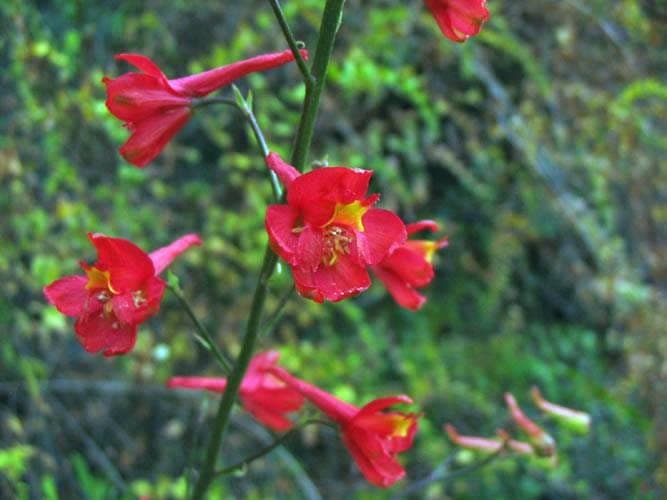
Unknown authorUnknown author / Public domain, via Wikimedia Commons
Scarlet larkspur: complete guide
Delphinium cardinale
¿Quieres ver Scarlet larkspur: complete guide en tu jardín?
1 minuto, sin tarjeta de crédito
The Scarlet larkspur (Delphinium cardinale), also called Cardinal delphinium or Cardinalriddarsporre, is a stunning flowering plant from the Ranunculaceae family. This American wildflower grows naturally in dry mountain regions from California to Mexico. The most striking feature is the brilliant scarlet-red to orange flowers arranged in long, dense spikes.
Overview
Delphinium cardinale is a perennial to short-lived annual plant originating from western North America. Native to southwestern California coasts and Baja California Norte, this plant thrives in warm, dry summers and mild winters. The plant is renowned for its vivid red flowers, a color rare among wild larkspurs, making it exceptionally attractive to garden designers.
Appearance and Bloom
The plant grows upright, typically 60 to 100 centimeters tall, with deeply lobed, palmately-divided leaves growing elegantly from the stem. The flowers are the true star: long, slender spikes with numerous florets in pure scarlet-red, sometimes with orange tint. Each flower has four sepals (two extended into spurs) and two petals with characteristic feathery nectaries. Blooming period runs from May to July, extending to August in optimal conditions.
Ideal Location
Scarlet larkspur prefers warm, sunny climates with well-draining soil. Plant in full sun, at least 6 to 8 hours daily. In warm regions (USDA 8-10), it grows as a perennial. In temperate zones, it functions better as an annual or summer bloomer. Group multiple specimens for visual impact. Ensure standsite has excellent drainage without stagnation.
Soil
Soil must be well-draining, gritty or sandy with some humus. pH can be neutral to slightly acid (6.5-7.5). Delphinium cardinale tolerates calcareous soils well. Add sand and gravel to heavy clay soils. The plant performs better on modest soils; excessive fertility promotes foliage at the expense of flowers. Drainage is critical; waterlogging causes root rot and plant decline.
Diseño gratis
¿Quieres ver Scarlet larkspur: complete guide en tu jardín? Crea un diseño gratis ahora.
Watering
This species prefers dry climate after establishment. Young plants need more moisture: water regularly during the first growing season. Once established, water when the top 5 centimeters feel dry. Winter watering should be sparing. The plant is drought-tolerant once deep-rooted, so overwatering is a greater problem than underwatering. During extreme dry periods, supplemental water may be given.
Pruning
Removing spent flowers promotes continued bloom. Deadhead exhausted spikes back to the next bud or basal knot. No fertilizing usually needed, though light feeding during growing season helps. In zones where it grows as an annual, sow seed directly in ground after frost passes. Seeds germinate better with light cold stratification.
Maintenance Calendar
Spring (March-May): Allow seed to germinate if grown as annual, or ensure perennial growth. Water young plants regularly. Summer (June-August): Peak blooming season. Remove spent flowers. Water when dry. Autumn (September-October): Growth slows. Collect seed for next season. Winter (November-February): Dormancy in temperate zones. Minimal care needed.
Winter Hardiness
Scarlet larkspur is semi-hardy. In USDA zones 8-10, it overwinters as a perennial. In zone 7 and colder, grow as an annual or protected plant. Some years in zone 7 are possible with shelter. In Northern Europe (Netherlands, Belgium, France), it grows as a summer bloom from seed or as a year plant. Many garden centers stock seed and young plants.
Companion Plants
Scarlet larkspur fits well in warm, dry gardens with other Californian wildflowers. Combine with Eschscholtzia californica (California poppy), Clarkia, Gaillardia. In sunny places, it grows well with Salvia greggii and Manfreda. Plant in groups for dramatic visual effect. Low-growing groundcover around plants breaks monotony for interesting contrast.
Closing
The Scarlet larkspur is an unparalleled wildflower that adds beauty and drama wherever it grows. With proper placement in warm, sunny, dry climates, enjoy spectacular scarlet-red blooms from May to August. This is the larkspur for gardeners wanting authentic Californian wildflowers.
This plant represents the wild beauty of Western American mountain and desert flora, and brings its elegance to every garden where it can thrive.
¿Quieres ver Scarlet larkspur: complete guide en tu jardín? Crea un diseño gratis ahora.
Sube una foto, elige un estilo y obtén un diseño fotorrealista con lista de plantas en menos de un minuto.
Más de 10.000 jardines diseñados
Sin tarjeta de crédito


Plantas similares
Drummond's anemone: complete guide
Anemone drummondii
Discover Drummond's anemone (Anemone drummondii): a silvery-grey mountain plant for cool rock gardens and alpine troughs.
Korean clematis: complete guide
Clematis serratifolia
Clematis serratifolia is a hardy climber with fragrant yellow bell flowers in August-September. Pruning group 3, location and care tips.
Aquilegia brevistyla: complete guide
Aquilegia brevistyla
Discover Aquilegia brevistyla, the elegant North American columbine. Growing tips, shade tolerance, and design ideas for woodland and shadowed gardens.