
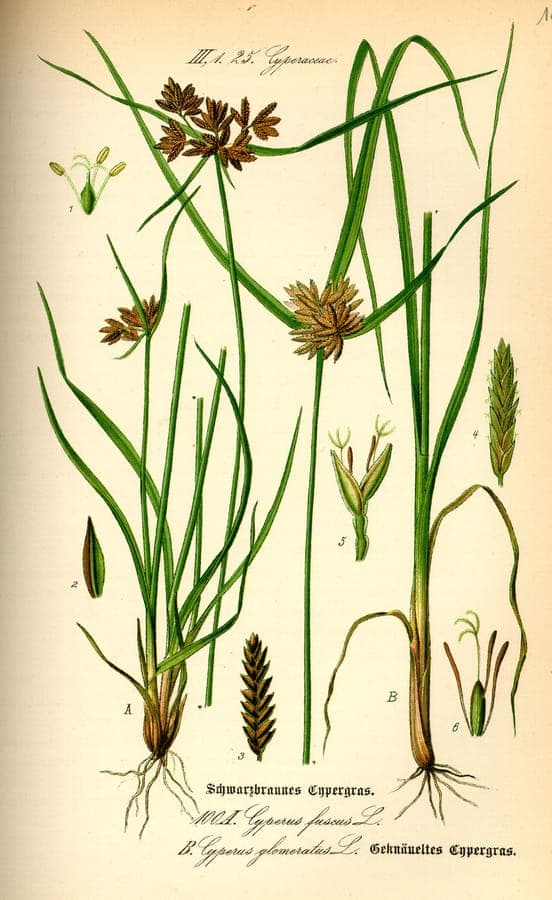
Wikimedia Commons / Public domain, via Wikimedia Commons
Cyperus glomeratus: complete guide
Cyperus glomeratus
¿Quieres ver Cyperus glomeratus: complete guide en tu jardín?
1 minuto, sin tarjeta de crédito
Overview
Cyperus glomeratus, commonly known as clustered sedge or crowded club-rush, is a distinctive wetland plant from the Cyperaceae family (sedges). Native to large areas of Eurasia from France to Japan, this plant is remarkable for its elegant, fine-textured appearance and strong preference for wet habitats.
The plant is renowned for its needle-like foliage and requirement for consistently moist to wet conditions. It is an excellent choice for gardeners seeking to establish authentic wetland or bog gardens.
Appearance and Bloom
Cyperus glomeratus is a striking plant with thin, needle-like stems that grow upright. The plant typically reaches 30-60 centimeters in height. The stems are triangular in cross-section, a characteristic feature of the sedge family.
Flowers appear from July through September in dense, globe-shaped clusters at the stem tips. These clusters are brownish in color and give the plant a unique, architectural appearance. The individual flowers are tiny, grouped into compact flower heads.
The plant lacks true leaves in the conventional sense. Instead, leaves are strongly reduced to small scales at the stem base.
Ideal Location
Cyperus glomeratus grows best in full sun to light shade, thriving with at least 4-6 hours of direct sunlight daily. The plant tolerates light shade acceptably.
The plant is ideal for pond margins, bog gardens, and other semi-aquatic settings. It works beautifully along streams and waterways. It can also be cultivated in shallow water up to approximately 10 centimeters deep.
Soil
Cyperus glomeratus prefers consistently wet to waterlogged, nutrient-rich soils. The plant thrives in bog conditions with periodic flooding. Soils rich in organic matter are suitable.
The plant tolerates both acidic and alkaline conditions. A moisture-retentive, humus-rich soil is ideal, though the plant adapts to poorer substrates as long as they remain wet.
Diseño gratis
¿Quieres ver Cyperus glomeratus: complete guide en tu jardín? Crea un diseño gratis ahora.
Watering
Cyperus glomeratus demands abundant water. In fact, it is difficult to overwater this plant. Always position it where soil remains consistently moist. It can even be cultivated in shallow standing water.
In containers, water frequently or even place the pot in a shallow water basin. The plant must never be allowed to dry out.
Pruning
Cyperus glomeratus requires minimal pruning. The plant grows naturally compact and maintenance is rarely needed. Remove only dead stems in spring or late winter.
The plant naturally forms colonies through underground rhizomes. You may divide the plant if it becomes too dense or invasive.
Maintenance Calendar
March-April: Growing season begins. Remove dead stems from winter.
May-June: Growth accelerates. Plant warms. Water consistently.
July-September: Peak flowering period. Enjoy the distinctive clusters. Maintain moisture.
October-November: Growth slows. Continued watering essential. Winter preparation.
December-February: Dormant period. Plant may die back in cold regions.
Winter Hardiness
Cyperus glomeratus is moderately hardy, suitable for USDA zones 6-9, tolerating temperatures down to approximately -15°C. In northern Europe and North America, it thrives best in milder regions.
In harsh winters, the plant may die back to ground level. However, it typically regenerates from the roots if the rhizomes do not freeze solid.
Companion Plants
Cyperus glomeratus combines beautifully with other aquatic and wetland plants. Try it with Reed, Carex species, and other bog plants. Water Mint, Marsh Marigold, and other moisture-loving plants work well alongside it.
The plant is wildlife-friendly, providing habitat and food for wetland birds, insects, and small animals that depend on marsh vegetation.
Closing Thoughts
Cyperus glomeratus is an excellent choice for gardeners with wet areas or bog gardens. The plant is low-maintenance once established and offers distinctive seasonal interest. This is a true water plant that cannot tolerate dry conditions.
On gardenworld.app, explore designs featuring wetland plants including Cyperus glomeratus. This plant adds authentic character to wet areas and supports local ecology.
¿Quieres ver Cyperus glomeratus: complete guide en tu jardín? Crea un diseño gratis ahora.
Sube una foto, elige un estilo y obtén un diseño fotorrealista con lista de plantas en menos de un minuto.
Más de 10.000 jardines diseñados
Sin tarjeta de crédito


Plantas similares
Flat-stemmed club-rush: complete guide
Bolboschoenus planiculmis
Everything about Bolboschoenus planiculmis: growing conditions, watering, care, and use as a pond margin or wetland plant in garden design.
Great Plains flatsedge: complete guide
Cyperus lupulinus
Everything about Great Plains flatsedge (Cyperus lupulinus): growing conditions, care, garden uses, and ecological value. Tips for pond margins and dry sandy soils.
Golden beak sedge: complete guide
Rhynchospora corymbosa
Everything about golden beak sedge (Rhynchospora corymbosa): a dramatic tropical marginal for pond edges, bog gardens, and wet habitats.