
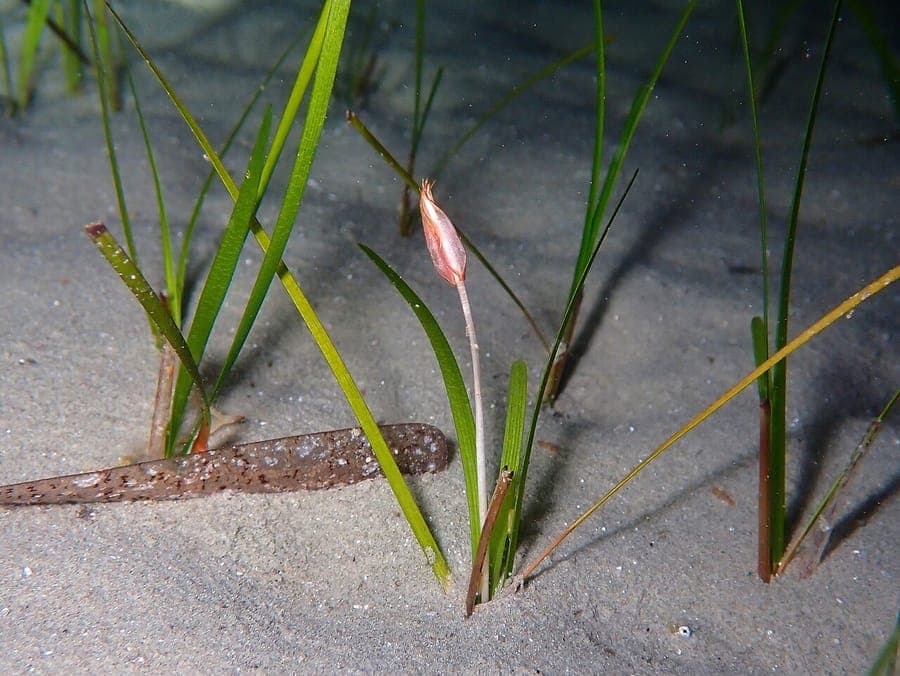
Sylvain Le Bris / CC BY-SA 4.0, via Wikimedia Commons
Slender Seagrass: complete guide
Cymodocea nodosa
¿Quieres ver Slender Seagrass: complete guide en tu jardín?
1 minuto, sin tarjeta de crédito
Overview
Slender Seagrass (Cymodocea nodosa), also known as Little Neptune seagrass, is a vital marine plant inhabiting the Mediterranean Sea and adjacent tropical-subtropical coasts from North Africa to West Africa. This submerged flowering plant plays a critical ecological role and is of significant scientific and conservation importance.
Cymodocea nodosa is not a plant for home gardens, but rather a fascinating subject for ecologists, researchers, and environmental enthusiasts. This seagrass forms underwater meadows that sustain countless marine species and perform crucial ecosystem services.
Note: This article is informational. Seagrass is protected under law in most jurisdictions.
Appearance and growth
Cymodocea nodosa grows entirely submerged, with long, narrow, fine-textured green leaves reaching 10 to 30 centimeters in length. The plant possesses an underground rhizome network that stabilizes sediment and absorbs nutrients.
Flowers are small and inconspicuous, adapted for underwater pollination. Seeds are rarely visible - the plant reproduces primarily via horizontal rhizomes.
Growth is slow, forming extensive meadows on sandy bottoms at depths to 30 centimeters. These underwater "gardens" are remarkably productive ecosystems supporting diverse marine life.
Ecological significance
Cymodocea nodosa is critical to marine health:
- Purifies coastal waters by absorbing excess nitrogen
- Provides essential habitat for fish and invertebrates
- Produces oxygen through photosynthesis
- Stabilizes sediment and prevents erosion via extensive root systems
- Feeds seabirds, seahorses, sea urchins, and crustaceans
- Sequesters carbon in sediments (blue carbon)
Seagrass meadows like those formed by Cymodocea nodosa are increasingly threatened by pollution, dredging, coastal development, and climate change.
Distribution
The plant is found across:
- Mediterranean Sea (primary range)
- Atlantic coast of North Africa (Morocco to Senegal)
- Canary Islands
- Occasional warm-water coasts of southern Europe
- Eastern Atlantic enclaves
Diseño gratis
¿Quieres ver Slender Seagrass: complete guide en tu jardín? Crea un diseño gratis ahora.
Conservation status
Cymodocea nodosa holds protected status:
- EU Habitats Directive (designated important habitat type)
- IUCN: Least Concern, but declining population trend
- National protection laws in most Mediterranean countries
- Harvest and disturbance are ILLEGAL in most jurisdictions
For aquarium cultivation
While tempting, cultivating Cymodocea nodosa in aquaria is inadvisable:
- Extremely slow growth rate
- Rooting is difficult in artificial environments
- Requires intense lighting and stable conditions
- Superior alternatives exist: Caulerpa, Halimeda, other marine algae
- Legal and ethical concerns regarding collection
Scientific research
This plant is subject to ongoing investigation into:
- Climate change impacts on seagrass meadows
- Carbon sequestration in marine ecosystems
- Restoration of degraded seagrass beds
- Sustainable coastal management strategies
- Population genetics and connectivity
- Invasive species impacts
Related species
Other important seagrasses in Mediterranean waters:
- Posidonia oceanica (Neptune seagrass, critically threatened)
- Zostera marina (dwarf eelgrass, northern Europe)
- Halophila stipulacea (invasive species)
Further information
Fascinating aspects worth exploring:
- Seagrass meadow fauna (seahorses, pipefish, nursery fish)
- Blue Carbon (carbon storage in marine plants)
- Coastal restoration projects in Italy, Spain, France, Greece
- Climate change impacts on marine grasslands
- Mediterranean marine protected areas
Closing
While not a plant for home cultivation, Cymodocea nodosa deserves appreciation as a vital component of our marine heritage. When visiting Mediterranean coasts, observe underwater meadows with respect and wonder. This invisible green world exists just beyond our surface.
For more about aquatic plants and sustainable gardening, visit gardenworld.app for inspiration and resources.
¿Quieres ver Slender Seagrass: complete guide en tu jardín? Crea un diseño gratis ahora.
Sube una foto, elige un estilo y obtén un diseño fotorrealista con lista de plantas en menos de un minuto.
Más de 10.000 jardines diseñados
Sin tarjeta de crédito


Plantas similares
Acer pycnanthum: complete guide
Acer pycnanthum
Acer pycnanthum, the Japanese swamp maple, is a fast-growing tree with early red flowers and brilliant autumn color, ideal for damp garden settings.
Freeman maple: complete guide
Acer × freemanii
Everything about the Freeman maple (Acer x freemanii): a fast-growing shade tree with spectacular autumn colour for large gardens.
Silver vine: complete guide
Actinidia polygama
Discover silver vine (Actinidia polygama): a hardy climbing plant with silvery foliage, loved by gardeners and cats alike.