
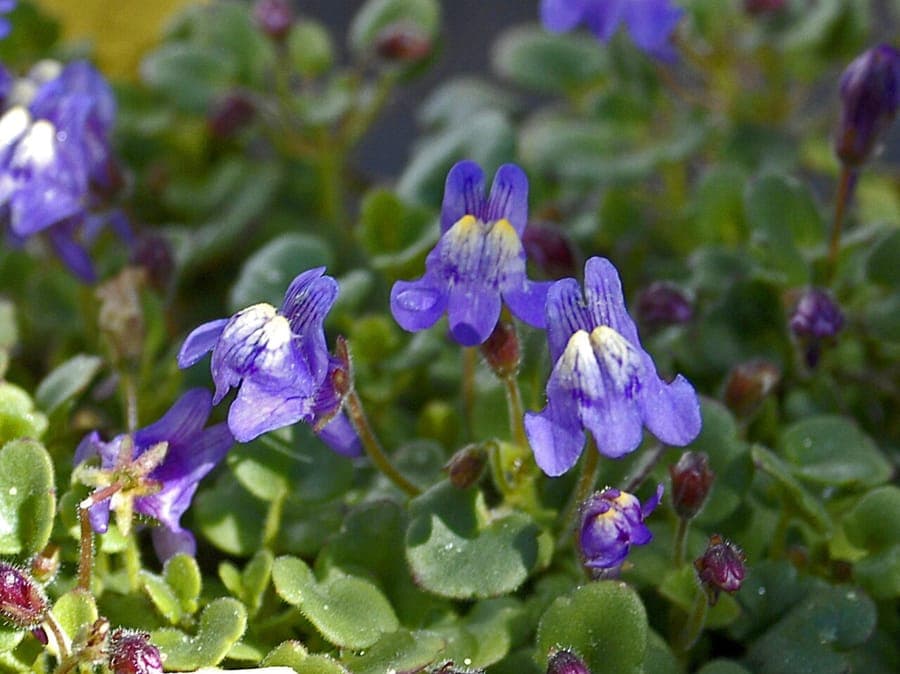
Hectonichus / CC BY-SA 4.0, via Wikimedia Commons
Cymbalaria pallida: complete guide
Cymbalaria pallida
¿Quieres ver Cymbalaria pallida: complete guide en tu jardín?
1 minuto, sin tarjeta de crédito
Overview
Cymbalaria pallida, commonly known as Italian Toadflax or Pale Ivy-leaved Toadflax, is an elegant climbing herb native to central Italy. This species grows as a slender, weakly twining plant that inhabits steep, rocky slopes in mountainous regions.
The plant is appreciated for its fine gray-green foliage and numerous small pale-purple flowers with white throat markings. It propagates readily from seed and can persist for years on rocky terrain, though it proves less robust in harsh climates.
Appearance and Bloom
Cymbalaria pallida grows as a delicate, fine-stemmed climbing herb reaching approximately 20-40 centimeters in height. Foliage comprises small, heart-shaped, gray-green leaves arranged alternately along slender stems.
Flowers are diminutive, measuring roughly 1 centimeter across, appearing in loose racemes. Flower color ranges from pale purple to pink-purple on inner surfaces, with characteristic white blotches at the throat. Outer petal surfaces may display paler coloration.
Blooming extends from May through September, with peak flowering during summer months. Following anthesis, small seed capsules develop containing numerous minute seeds.
The plant exhibits an attractive, fine-branched growth form suitable for vertical wall decoration.
Ideal Location
Select a site receiving bright but diffuse illumination, avoiding intense afternoon solar radiation. East or west-facing walls are optimal, or light-dappled locations beneath deciduous trees.
Suitable placements include:
- Rocky alpine gardens
- Dry stone walls and retaining walls
- Pergolas with dappled shade
- Vertical rock faces
- Roof parapets and guttering
- Stone block interstices
- North-facing walls with bright indirect light
Avoid complete shade where bloom production diminishes severely.
Soil
Cymbalaria pallida thrives in impoverished, freely draining substrates. This is not a plant for nutrient-rich garden soils; in fact, it performs best in rocky, sparse earth.
Ideal soil composition:
- Rocky or sandy substrate
- Excellent drainage
- Low nutrient content
- pH 6.5-8.0
- Minimal water-retention capability
The poorer the soil, the better for this species. In ordinary garden soil, incorporate substantial quantities of coarse sand and gravel.
Diseño gratis
¿Quieres ver Cymbalaria pallida: complete guide en tu jardín? Crea un diseño gratis ahora.
Watering
Cymbalaria pallida proves less drought-tolerant than many Mediterranean climbers, yet flourishes in temperate moisture regimes. Once established, the plant tolerates regular rainfall without distress.
Watering schedule:
- First season: biweekly irrigation
- Established plants (after 2 years): minimal supplementary watering
- Dry periods: supplementary water beneficial
- Winter: minimal irrigation
- Prevent waterlogging
The plant accommodates regular rainfall without complaint.
Pruning
Cymbalaria pallida responds positively to gentle pruning for shaping purposes. Heavy pruning must be avoided.
Pruning guidelines:
- Gently trim excessively vigorous stems
- Remove heavily matted, senescent growth
- Perform in May prior to flowering
- Never remove more than one-third of growth annually
- Avoid major pruning during active growth
The plant recovers well from light trimming.
Maintenance Calendar
- March-April: Gentle pruning if required
- May-June: Flowering initiation
- July-August: Peak flowering
- September: Continued flowering
- October-November: Seed set
- December-February: Dormancy
Winter Hardiness
Cymbalaria pallida exhibits moderate frost sensitivity. It may survive average winters to approximately -10°C with protection, but prolonged freezing proves severely damaging.
In harsh climates:
- Position against south-facing walls
- Provide protective mulch coverage
- Anticipate some winter mortality
- Regeneration from seed possible
- Cultivate in containers for winter relocation indoors
In mild maritime regions, plants persist for years.
Companion Plants
Cymbalaria pallida combines harmoniously with:
- Linaria species
- Ivy-leaved toadflax (Cymbalaria muralis)
- Saxifrages (Saxifraga spp.)
- Stonecrop sedums (Sedum spp.)
- Houseleeks (Sempervivum spp.)
- Dwarf fuchsias
- Other Mediterranean climbers
These associations create attractive rockery compositions.
Closing Remarks
Cymbalaria pallida represents an elegant choice for gardeners in mild maritime climates. Its fine texture and gracile flowers render it an attractive alpine trough resident.
In harsher climates, container cultivation permits winter protection. With appropriate precautions, this elegant Italian plant will provide years of subtle beauty.
Available from specialized plant merchants and botanical garden centers.
¿Quieres ver Cymbalaria pallida: complete guide en tu jardín? Crea un diseño gratis ahora.
Sube una foto, elige un estilo y obtén un diseño fotorrealista con lista de plantas en menos de un minuto.
Más de 10.000 jardines diseñados
Sin tarjeta de crédito


Plantas similares
White Beardtongue: complete guide
Penstemon albidus
Discover white beardtongue (Penstemon albidus) - elegant perennial with white to cream flowers. Drought-resistant, perfect for prairie and dry gardens.
Longsepal Beardtongue: complete guide
Penstemon calycosus
Discover longsepal beardtongue (Penstemon calycosus) - beautiful perennial with lilac-blue flowers. For partial shade and moist soil. Ideal for naturalized.
Penstemon cusickii: complete guide
Penstemon cusickii
Discover Cusick's beardtongue, a compact alpine flowering plant with violet-pink blooms. Perfect choice for rock gardens and water-wise landscaping.