
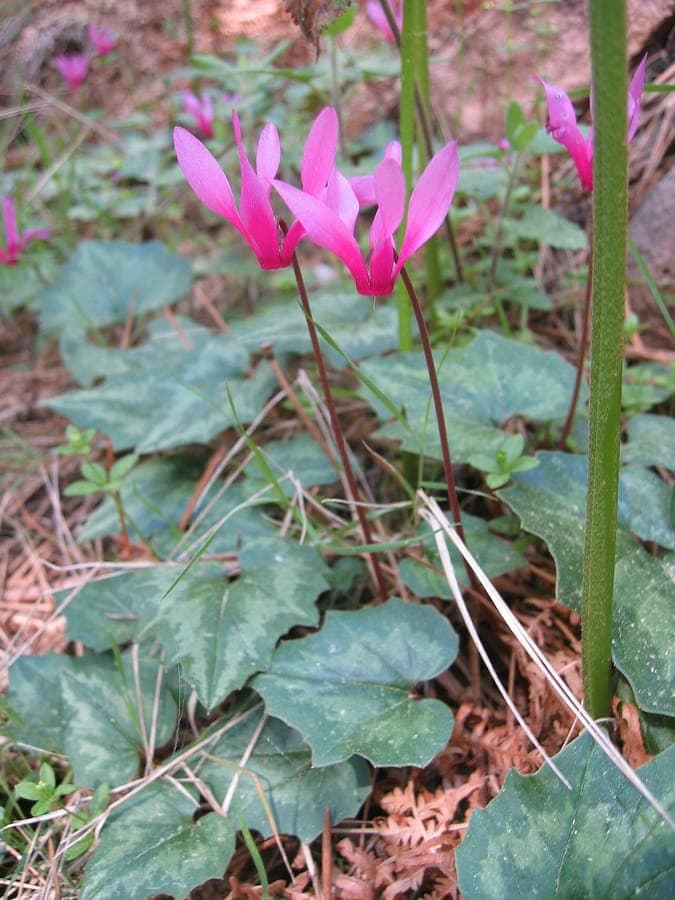
User:Tigerente / CC BY-SA 3.0, via Wikimedia Commons
Spring sowbread: complete guide
Cyclamen repandum
¿Quieres ver Spring sowbread: complete guide en tu jardín?
1 minuto, sin tarjeta de crédito
Overview
Cyclamen repandum, commonly known as spring sowbread, is a charming Mediterranean endemic from the Primulaceae family. This delicate shade-lover blooms from March to May with characteristic pink, reflexed flowers. With its beautifully patterned foliage, it remains attractive even when not in bloom.
The plant grows from small tubers and reaches only 15-25 cm in height. It is ideal for woodland gardens, shady borders, and understory plantings where its subtle beauty is appreciated.
Appearance & Bloom Cycle
Cyclamen repandum blooms March-May with elegant pink flowers featuring distinctly reflexed petals. The blooms have a characteristic sharp form with backswept appearance. Each plant produces numerous flowers throughout its blooming season.
The leaves are heart- to shield-shaped, with very distinctive silvery or whitish patterning on greenish undersides. This attractive patterning persists throughout the growing season.
After blooming, long-stemmed seed capsules form, curling back and settling into debris for self-seeding. The plant is evergreen in mild climates.
Ideal Location
Choose semi-shaded to shaded spots. Suitable under deciduous trees or in light-filtered situations. Afternoon and summer shade are welcome.
In warm, dry areas light shade; in cold, wet areas more sun. Avoid full midday sun in warm climates, but some morning sun helps flowering.
Soil Requirements
Humus-rich, well-draining soil is essential. Add plenty of leaf mold or other organic matter. Slightly acidic (pH 5.5-6.5) is ideal.
Stagnant water must be avoided; improve drainage with sand or perlite. A mulch of fallen leaves helps retain moisture and provides insulation. Cyclamen loves rich, loose soil with abundant humus.
Watering
Gradual watering during growth (March-May). Soil should be moist but not waterlogged. After blooming, gradually reduce watering.
During summer, the tuber sleeps; minimal water. In autumn and winter, some water for established plants. Excessive winter water causes tuber rot.
Diseño gratis
¿Quieres ver Spring sowbread: complete guide en tu jardín? Crea un diseño gratis ahora.
Pruning
Pruning is not necessary. Faded flowers can be removed for tidiness. However, leave seed stalks for natural self-seeding.
Maintenance Calendar
October-November: Plant tubers 2-3 cm deep in rich, humus-rich soil. Water in gently.
December-February: Rest period; minimal water unless very dry.
March-May: Blooming period. Water regularly for peak bloom. Seed capsules form.
June-July: Summer dormancy. Plant slumps. Allow to dry out.
August-September: Preparation for autumn. Plant revives with autumn rains.
Winter Hardiness
Cyclamen repandum is winter-hardy to USDA zone 7 (-18°C). In cold areas, winter protection with thick mulch is recommended. In the Netherlands, usually hardy without protection, especially in maritime climates.
In very cold inland areas, consider lifting tubers and pre-chilling for spring replanting.
Companion Plants
Cyclamen repandum combines beautifully with other shade-loving early bloomers such as snowdrops, spring snowflake, and Hepatica. Also good with ivy and other shade groundcovers.
Perfect in woodland settings; combines well with ferns and other foliage plants. Plant in masses for dramatic effect.
Availability & Purchase
Cyclamen repandum tubers are available through specialized nurseries. Not widely stocked at standard garden centers. Online ordering possible in autumn.
Select large, healthy tubers without damage. Quality is important for success. Tubers are more expensive than some other cyclamens, but very worthwhile.
Summary
Cyclamen repandum is an exquisite addition to shaded woodland gardens. With delicate pink flowers, beautifully patterned foliage, and prolonged blooming, it deserves a special place. Plant in autumn for blooming the following spring in a permanent woodland setting.
Once established, this cyclamen returns year after year in the same spot, perfect for naturalization and self-seeding. Explore more woodland garden advice on gardenworld.app.
¿Quieres ver Spring sowbread: complete guide en tu jardín? Crea un diseño gratis ahora.
Sube una foto, elige un estilo y obtén un diseño fotorrealista con lista de plantas en menos de un minuto.
Más de 10.000 jardines diseñados
Sin tarjeta de crédito


Plantas similares
Primula incana: complete guide to silvery alpine primrose
Primula incana
Silvery primrose (Primula incana), a delicate alpine flower with white blooms and powdered grey-green leaves. Growing, care, and cultivation guide.
Mealy cowslip: complete guide
Primula pulverulenta
Grow the Mealy cowslip (Primula pulverulenta): striking candelabra flowers in red and purple tones, moisture-loving and ideal for shady, damp garden corners.
Cliff dwarf-primrose: complete guide
Androsace laevigata
Full guide to growing Androsace laevigata, a rare Pacific Northwest alpine cushion plant. Planting, care, and garden design tips explained.