
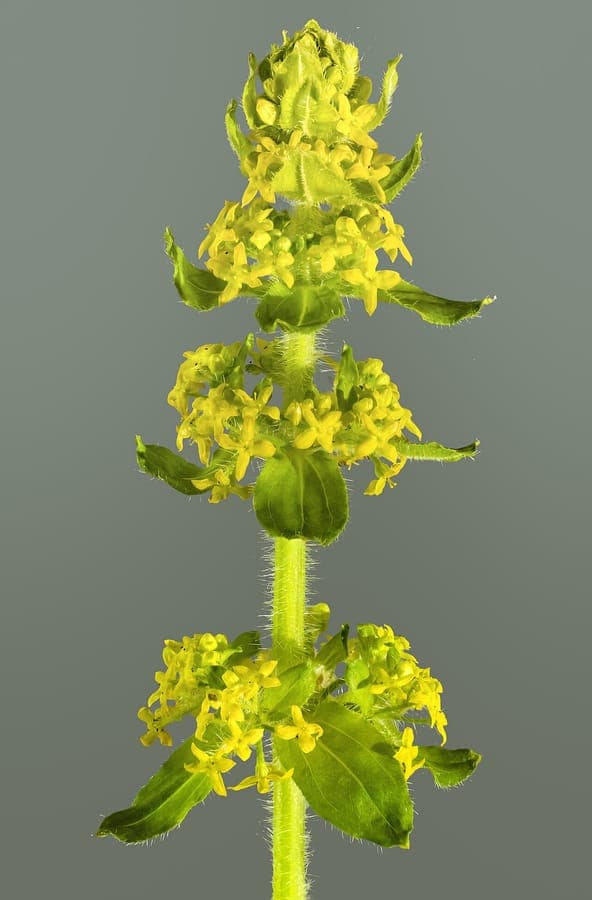
Didier Descouens / CC BY-SA 4.0, via Wikimedia Commons
Smooth Bedstraw (Cruciata laevipes): complete guide
Cruciata laevipes
¿Quieres ver Smooth Bedstraw (Cruciata laevipes): complete guide en tu jardín?
1 minuto, sin tarjeta de crédito
Overview
Smooth Bedstraw, scientifically Cruciata laevipes, is a modest yet valuable woodland ornamental belonging to the Rubiaceae family. This plant functions excellently as groundcover in shaded gardens and along woodland margins. Originally native from Europe through Iran and the western Himalaya, Smooth Bedstraw brings subtle, alluring yellow flowers and outstanding woodland credentials to gardens.
At gardenworld.app, discover how to populate difficult shady areas with natural groundcovers. Smooth Bedstraw combines perfectly with other woodland plants, creating together a thriving, biologically rich understory in your garden.
Appearance & Bloom Cycle
Smooth Bedstraw is a low-growing plant reaching 20-40 cm in height. The plant spreads underground via rhizomes, forming dense mats. Leaves are arranged opposite in whorled patterns, creating the characteristic cross-shaped arrangement. Foliage is smooth and dark green.
Flowers appear in yellow-green, very small but remarkably numerous, assembled in compact flowering clusters. They bloom April through May, marking the plant as a spring harbinger. Flowers emit pleasant fragrance, attracting pollinators.
Ideal Location
Smooth Bedstraw thrives in dappled to full shade. The plant tolerates full sun but performs better in moderate light conditions. This makes it ideal for woodland edges, under shrubs, and in dark garden corners.
Diseño gratis
¿Quieres ver Smooth Bedstraw (Cruciata laevipes): complete guide en tu jardín? Crea un diseño gratis ahora.
Soil Requirements
This plant demands moist, humus-rich soils. Acidic to neutral soil is preferred, though the plant accepts slightly alkaline conditions. The plant grows vigorously in woodland soil enriched with organic matter.
Watering
Smooth Bedstraw requires regular water during the growing season (April-October). Especially in dry periods, supplemental irrigation is necessary. In rainy seasons, natural rainfall suffices. Established plants often thrive independently.
Pruning & Maintenance
The plant requires minimal pruning. You may cut back in September-October to encourage more compact growth. Dead foliage can be removed in spring.
Maintenance Calendar
- April-May: Flowering period
- June-September: Growth and maintenance
- October-November: Autumn pruning
- December-March: Rest period
Winter Hardiness
Smooth Bedstraw is fully hardy in the Netherlands and Belgium (USDA zones 5-7, minimum -18°C). The plant survives harsh winters without difficulty.
Companion Plants
Smooth Bedstraw combines well with other shade plants such as ferns, hellebores, pulmonaria, and compact day lily varieties. Yellow flowers contrast beautifully against purple or silver foliage.
Closing
Smooth Bedstraw represents a valuable addition for those seeking to create shaded woodland gardens. With modest flowers, biological value, and minimal maintenance requirements, it represents a smart choice. Explore gardenworld.app for ideas on transforming dark garden corners into thriving woodland gardens.
¿Quieres ver Smooth Bedstraw (Cruciata laevipes): complete guide en tu jardín? Crea un diseño gratis ahora.
Sube una foto, elige un estilo y obtén un diseño fotorrealista con lista de plantas en menos de un minuto.
Más de 10.000 jardines diseñados
Sin tarjeta de crédito


Plantas similares
Oregon bedstraw: complete guide
Galium oreganum
Everything about Oregon bedstraw (Galium oreganum): shade planting, soil requirements, care and use as a low groundcover in woodland and shade gardens.
Awned woodruff: complete guide
Asperula aristata
Full guide to growing Asperula aristata, the awned woodruff: sunny location, alkaline soil, minimal watering, and companion plants for dry or rock gardens.
Purple woodruff: complete guide
Asperula purpurea
Full guide to Asperula purpurea, purple woodruff: sunny sites, chalky soil, watering, pruning, winter hardiness and companion plants for rock and dry gardens.