
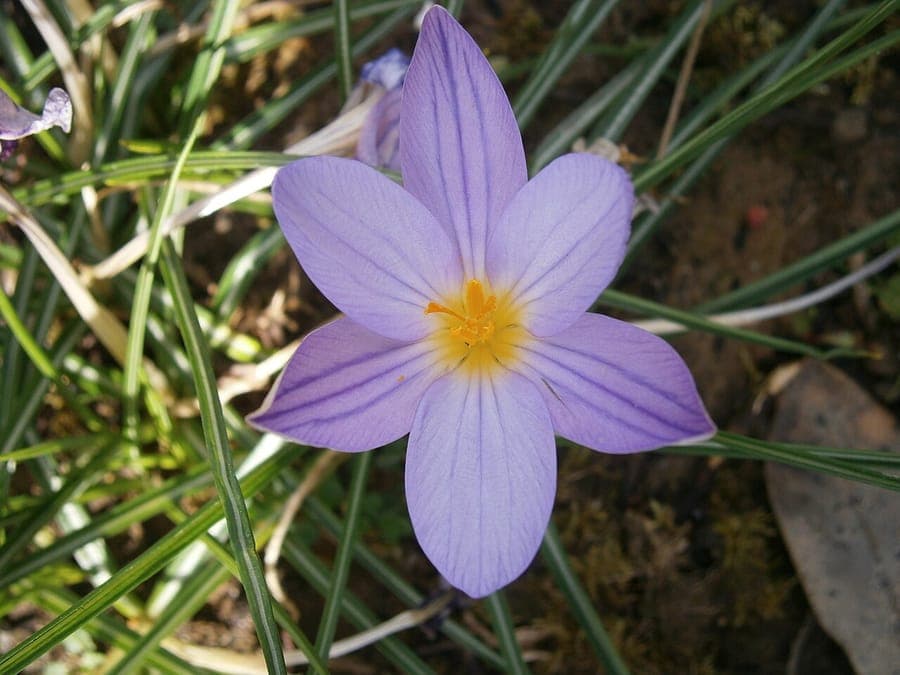
Meneerke bloem / CC BY-SA 3.0, via Wikimedia Commons
Crocus imperati: complete guide
Crocus imperati
¿Quieres ver Crocus imperati: complete guide en tu jardín?
1 minuto, sin tarjeta de crédito
Overview
Crocus imperati, known as Early Crocus or Imperato's Crocus, is a scarce and refined winter-flowering gem native to southwestern Italy, including the island of Capri. This species is distinguished by its remarkably early blooming season, flowering as early as February, considerably ahead of mainstream crocus varieties.
Unlike many prolific crocus species, Crocus imperati resists bird predation and remains uncommonly encountered in cultivation. However, for gardeners appreciating refined bulbous flora, it represents a genuine treasure. Its elegant purple-striped flowers possess genuine botanical allure.
Appearance and Bloom
Crocus imperati attains heights of approximately 10 centimeters. The plant produces long, hairlike, grayish-green leaves that emerge simultaneously with floral displays.
Flowers are proportionally large for Crocus - reaching 4 centimeters in diameter - featuring six tepals. Interior coloration ranges from pale to deep purple-pink with prominent striping. Exterior surfaces display distinctive purplish striations and mottling on each tepal, creating a bicolor appearance.
Blooming duration proves brief, lasting merely two to three weeks during February or March depending on weather and location. Flowers open diurnally, closing at dusk.
Following floral senescence, foliage persists through May, channeling photosynthetic products into the underground corm for subsequent season reserves.
Ideal Location
Position Crocus imperati in dappled light beneath deciduous trees lacking dense summer canopy. Semi-shaded sites receiving morning sunlight and afternoon relief from intense solar radiation prove optimal.
Suitable placements include:
- Deciduous woodland gardens
- Bases of south-facing walls
- Lightly sheltered pergolas
- Naturalized woodland zones
- Northern exposures in protected gardens
- Naturalized grass beneath understory canopies
Avoid intensive afternoon sun and exposed sites, though evening illumination proves beneficial.
Soil
Crocus imperati prefers friable, moisture-retentive substrates enriched with organic material, distinguishing it from drought-tolerant crocus relatives.
Ideal soil composition:
- Humus-rich loam with good porosity
- Organic matter content approximately 15 percent
- Neutral to slightly acidic pH (6.5-7.5)
- Excellent aeration
- Freedom from waterlogging
Amend heavy soils at planting time with compost and leaf mold. This maintains adequate moisture availability during active growth.
Diseño gratis
¿Quieres ver Crocus imperati: complete guide en tu jardín? Crea un diseño gratis ahora.
Watering
Following initial planting, sustain consistent soil moisture until vigorous growth commences. Once established, the subterranean corm permits relative autonomy from supplementary irrigation.
Watering schedule:
- Immediately after planting: thorough irrigation
- Active growth season (February-May): regular moisture if precipitation proves insufficient
- Dormancy (June-January): no supplementary irrigation
- Prevent complete desiccation during growth season
In regions experiencing reliable spring precipitation, initial planting irrigation typically suffices.
Pruning
Crocus imperati demands negligible pruning. Remove spent flower stems exclusively and permit foliage senescence to proceed naturally. Leaves replenish corm reserves for subsequent seasons.
Pruning guidelines:
- Excise only dead or damaged flowers
- Retain foliage through May
- Defer lawn mowing through June in naturalized bulb areas
Maintenance Calendar
- October-November: Optimal corm-planting period
- December-January: Cold stratification promoting flowering
- February-March: Flowering season
- April-May: Foliage senescence and corm replenishment
- June-September: Extended dormancy
- October onward: Planting season
Winter Hardiness
Crocus imperati exhibits exceptional hardiness, tolerating temperatures to -20°C and below. The species actually requires extended cold periods for successful flowering. Unusually mild winters may suppress bloom production.
In exceptionally warm zones (winters above -5°C):
- Plant corms deeper than standard (approximately 10 centimeters)
- Avoid south-facing wall placements
- Accept early flowering as botanical bonus
Companion Plants
Crocus imperati harmonizes beautifully with:
- Snowdrops (Galanthus species)
- Winter aconites (Eranthis hyemalis)
- Liverleaf (Hepatica nobilis)
- Early squill (Scilla bifolia)
- Winter-persistent ferns
- Hellebores (Helleborus species)
- Ivy groundcover (Hedera helix)
These associations create comprehensive early woodland garden floral displays.
Closing Remarks
Crocus imperati merits cultivation by gardeners appreciating refined early-season bloomers. Though flowering proves transient, its elegant appearance justifies the minor temporal investment.
The plant contributes understated charm to woodland garden zones. Once properly sited, it requires minimal ongoing management.
Available from specialized bulb merchants and botanical garden centers.
¿Quieres ver Crocus imperati: complete guide en tu jardín? Crea un diseño gratis ahora.
Sube una foto, elige un estilo y obtén un diseño fotorrealista con lista de plantas en menos de un minuto.
Más de 10.000 jardines diseñados
Sin tarjeta de crédito


Plantas similares
Iris tingitana: complete guide
Iris tingitana
Iris tingitana, the Morocco iris, is the bulb species behind the Dutch iris: early blue-violet blooms that need a sunny, well-drained position.
Iris hookeri: complete guide
Iris hookeri
Hooker's Iris is a compact North American native plant with blue flowers. Low-growing and moisture-loving water plant.
Siskiyou iris: complete guide
Iris bracteata
Complete guide to Iris bracteata, the Siskiyou iris: location, soil, bloom cycle, watering, pruning and companion plants for this rare Pacific Coast iris.