
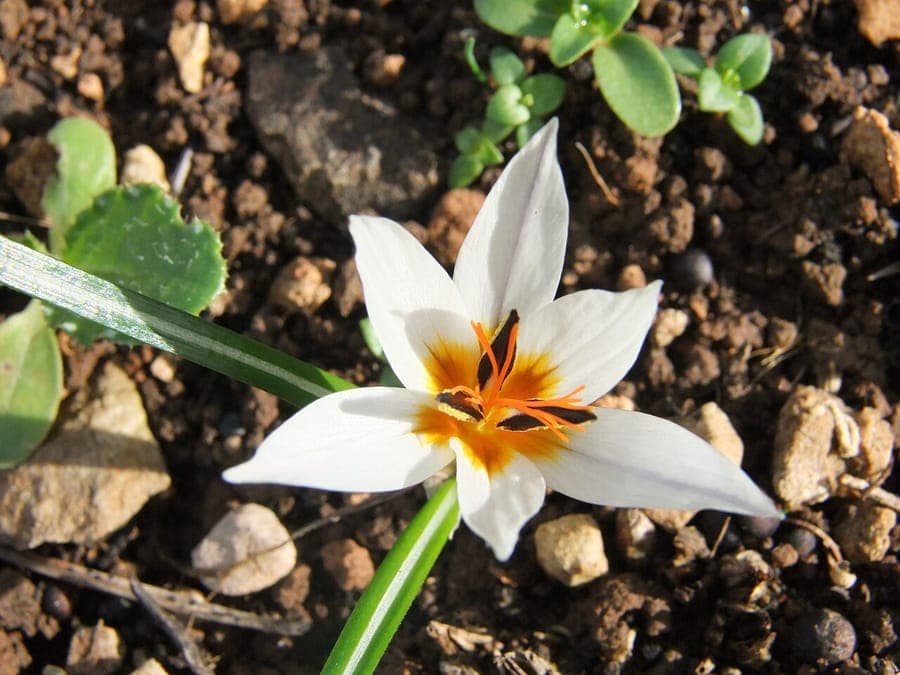
דרור פייטלסון / CC BY 2.5, via Wikimedia Commons
Crocus hyemalis: complete guide
Crocus hyemalis
¿Quieres ver Crocus hyemalis: complete guide en tu jardín?
1 minuto, sin tarjeta de crédito
Overview
Crocus hyemalis, better known as the Winter Crocus, is an enchanting small bulb originally from the Middle East, specifically from South Lebanon and Palestine. Despite its modest size, this crocus offers significant winter-blooming beauty that can be incorporated into many front garden designs. The plant blooms early in winter, sometimes as early as December, providing colour during a season when many other plants are just awakening.
The Winter Crocus is an ideal choice for gardeners wanting to experiment with seasonal colour patterns and early-blooming combinations. With its purple flowers and compact growth, it is a perfect addition to borders, beds, and even lawns.
Appearance and bloom
Crocus hyemalis is a diminutive flower, reaching only 10-15 centimetres tall. The narrow leaves grow upright and have a fine, grass-like texture that is elegant without being obtrusive.
The flowers are the highlight of this plant. They appear in winter, usually December to February (depending on local temperatures), and have a characteristic cup shape. The petals are purple to violet, sometimes with thin white stripes or accents. The yellow stamen inside creates a nice contrast against the purple tones. Each flower opens on warm mornings and closes in the evening or in grey weather.
Multiple flowers can emerge from a single bulb, providing full blooming despite the plant's small size.
Ideal location
Crocus hyemalis grows best in full sun to light shade. Provide at least four to six hours of direct sunlight daily. The plant prefers sunnier positions, especially for full blooming. In south-facing or protected areas, flowers will be fuller and lighter.
Place in lawn margins, front of borders, or in landscape scenes under low shrubs. The small size makes this plant ideal for spaces where larger flowers would be inappropriate.
Gardenworld.app recommends planting Winter Crocuses en masse in groups of at least 10-20 bulbs for maximum visual impact in winter.
Soil
Crocus hyemalis grows best in well-draining soil. Heavy clay can cause problems through waterlogging, attracting bulb rot. Add sand or perlite to clay-like soils before planting crocuses.
The plant grows well in nutrient-poor to moderately fertile soil. Heavy feeding is unnecessary and can even stimulate unwanted leaf growth at the expense of flowering.
The pH can range from 5.5 to 7.5. The plant tolerates both slightly acidic and neutral soil. What is essential is drainage: ensure water does not stand around bulbs.
Diseño gratis
¿Quieres ver Crocus hyemalis: complete guide en tu jardín? Crea un diseño gratis ahora.
Watering
Crocus hyemalis is fairly drought-tolerant once planted. During the growth phase (autumn and early winter), it needs regular watering to establish roots. After establishment, watering can be substantially reduced.
It prefers drier conditions after blooming. This promotes bulb ripening and dormancy. In regions with normal autumn and winter rainfall, supplemental watering is usually unnecessary.
Since blooming occurs in winter, caution is needed with watering: too much water combined with cold can cause bulb rot. Good drainage is critical.
In summer, when the plant is dormant, do not water.
Pruning
Crocus hyemalis requires virtually no pruning. This is a small bulb that retains its own natural form.
Remove only dead flowers or damaged leaves as noticed. Leave the foliage intact until it fully yellows in spring; it replenishes energy for next season.
After foliage has died (May-June), you can tidy up the former planting areas.
Maintenance calendar
August-September: Plant bulbs in well-prepared soil.
October-November: Leaf growth appears. Light, regular watering.
December-February: Flowering period. Enjoy the colour. Minimal care.
March-May: Blooming finished. Foliage continues growing. Leave intact. Water minimally.
June-July: Foliage disappears completely. Plant dormant. Keep dry.
Winter hardiness
Crocus hyemalis is well-hardy in temperate European climates. Temperatures to -15 degrees Celsius are no problem. This means the plant can grow almost anywhere in the Netherlands, Belgium, and northern France.
The plant actually blooms better in areas with natural winter protection (snow, moist soils) as this provides shelter against extreme cold. In very dry winters, protective mulch layers can help.
The flowers themselves tolerate light frost. Only extremely harsh frost (below -20 degrees) might damage flowering clusters.
Companion plants
Crocus hyemalis pairs nicely with:
- Other winter-blooming bulbs: Galanthus (Snowdrops), Winter Aconite, Spring bulbs
- Low-growing winter evergreens: Helleborus, Bergenia, Carex
- Grasses: Looks elegant in lawn combinations
- Stones: Beautiful in rock gardens and alpine borders
- Shrubs: Under low-growing winter shrubs
Gardenworld.app recommends using Winter Crocuses in large numbers for maximum winter effect.
Closing
Crocus hyemalis offers gardeners a unique opportunity: colour in winter, when outdoors can be grey and gloomy. This small flower with big charm will transform your front garden into a winter wonderland. Plant them generously, ensure good drainage, and enjoy months of winter magic requiring only minimal maintenance.
¿Quieres ver Crocus hyemalis: complete guide en tu jardín? Crea un diseño gratis ahora.
Sube una foto, elige un estilo y obtén un diseño fotorrealista con lista de plantas en menos de un minuto.
Más de 10.000 jardines diseñados
Sin tarjeta de crédito


Plantas similares
Iris tingitana: complete guide
Iris tingitana
Iris tingitana, the Morocco iris, is the bulb species behind the Dutch iris: early blue-violet blooms that need a sunny, well-drained position.
Iris hookeri: complete guide
Iris hookeri
Hooker's Iris is a compact North American native plant with blue flowers. Low-growing and moisture-loving water plant.
Siskiyou iris: complete guide
Iris bracteata
Complete guide to Iris bracteata, the Siskiyou iris: location, soil, bloom cycle, watering, pruning and companion plants for this rare Pacific Coast iris.