
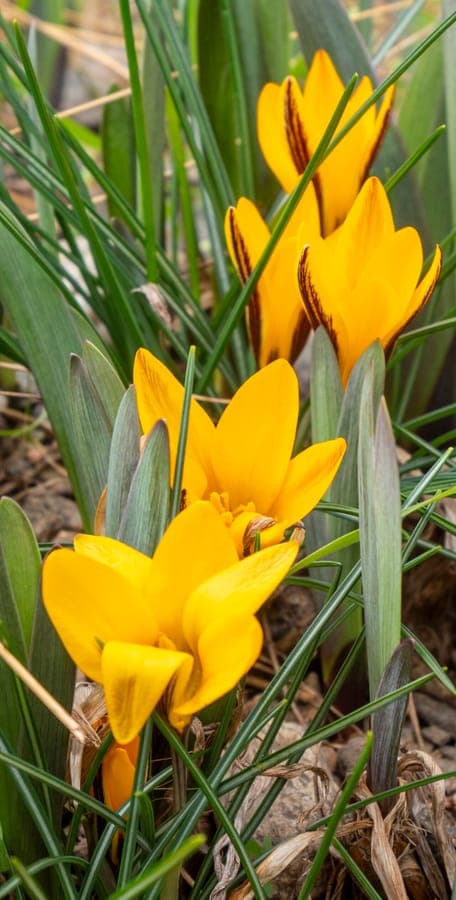
Chrisaliv / CC BY 4.0, via Wikimedia Commons
Crocus angustifolius: complete guide
Crocus angustifolius
¿Quieres ver Crocus angustifolius: complete guide en tu jardín?
1 minuto, sin tarjeta de crédito
Overview
Crocus angustifolius, better known as cloth of gold crocus or narrow-leaved crocus, is a beautiful early spring bloomer from South Ukraine and the Crimea region. This compact-growing crocus distinguishes itself by its intensely golden-yellow flowers and slender, grass-like leaves.
This plant is ideal for gardeners wishing to add early spring colour without much maintenance. It grows quickly, multiplies readily and returns each year with increasing abundance.
Appearance and Bloom
Crocus angustifolius forms slender, grass-like leaves finer than many other crocus species. The plant reaches merely 10-15 cm height and forms compact clumps.
Flowers appear in February and March as golden-yellow blooms sometimes with brownish striping on the back of petals. The flowers are small but numerous and highly decorative.
Following flowering, leaves recede quietly into the ground, with the bulb storing energy for next year.
Ideal Location
Crocus angustifolius thrives best in full sun to light shade. Minimum 4-6 hours of direct sunlight daily promotes the finest blooming. In shade it blooms less abundantly.
Place the plant where water can freely drain in winter - waterlogging can damage bulbs.
Soil Requirements
This species prefers well-draining soils. It grows perfectly well in sandy, loamy or rocky grounds. Heavy clay soils must be improved with sand and gravel.
A pH between 6.0 and 7.5 is ideal. The plant tolerates less fertile soils well, so rich earth is unnecessary.
Watering and Moisture Management
Crocus angustifolius is once planted very drought-tolerant. Watering is only needed if becoming very dry before blooming. After blooming gradually reduce watering.
Ensure good water drainage in winter to prevent root rot. Excessive moisture is more harmful than drought for this Ukrainian species.
Diseño gratis
¿Quieres ver Crocus angustifolius: complete guide en tu jardín? Crea un diseño gratis ahora.
Planting and Propagation
Plant bulbs in autumn (September-October) at approximately 5-8 cm depth and 5-10 cm spacing. They bloom the following spring. Bulbs multiply naturally and form dense clumps after several years.
Divide large clusters and replant them in autumn to thin them out.
Pruning and Maintenance
Crocus angustifolius requires minimal maintenance. Leave leaves after blooming until they naturally yellow and die back - this returns nutrients to the bulb.
Remove withered leaves only after several weeks. Weeding around the plant is the only other maintenance.
Maintenance Calendar
Autumn (September-October): Plant bulbs at correct depth and spacing. Winter (November-January): Minimal maintenance, ensure drainage. Spring (February-March): Enjoy blooms, remove spent flower stems. Summer (April-June): Allow leaves to die back, reduce watering.
Winter Hardiness
Crocus angustifolius is fully hardy to approximately -20 to -25 degrees Celsius. It grows well in all Dutch and German gardens. The plant even requires a cold period for optimal blooming.
Companion Planting
Crocus angustifolius combines beautifully with other early spring bloomers like snowdrops, early crocuses and wild crocuses. Group them in large numbers (at least 10-15 bulbs) for maximum effect.
Perfect under deciduous trees where it receives sunlight for blooming, and beneath shrubs. Also attractive in small pots and saucers on terrace or balcony.
Closing Thoughts
Crocus angustifolius is an indispensable spring bloomer for every garden. With its early, golden-yellow flowers, perfect plant size and effortless growing, it's a top choice for gardeners wanting early colour without complicated maintenance.
Bulbs are available at garden centers and flower bulb merchants. In Germany, consult OBI and Hornbach. For inspiration visit gardenworld.app/en and gardenworld.app/nl.
¿Quieres ver Crocus angustifolius: complete guide en tu jardín? Crea un diseño gratis ahora.
Sube una foto, elige un estilo y obtén un diseño fotorrealista con lista de plantas en menos de un minuto.
Más de 10.000 jardines diseñados
Sin tarjeta de crédito


Plantas similares
Azafrán de primavera: guía completa
Crocus vernus
Cultiva Crocus vernus: los primeros bulbos de primavera, fáciles de plantar para naturalizaciones y color temprano.
Early crocus: complete guide
Crocus tommasinianus
Crocus tommasinianus blooms early in spring and naturalizes easily. Learn how to plant, care for and combine this hardy, low-maintenance bulb.
Saffron: complete guide
Crocus sativus
How to grow Crocus sativus: care, flowering season, soil and ideal site. Suitable for gardens in temperate climates.