
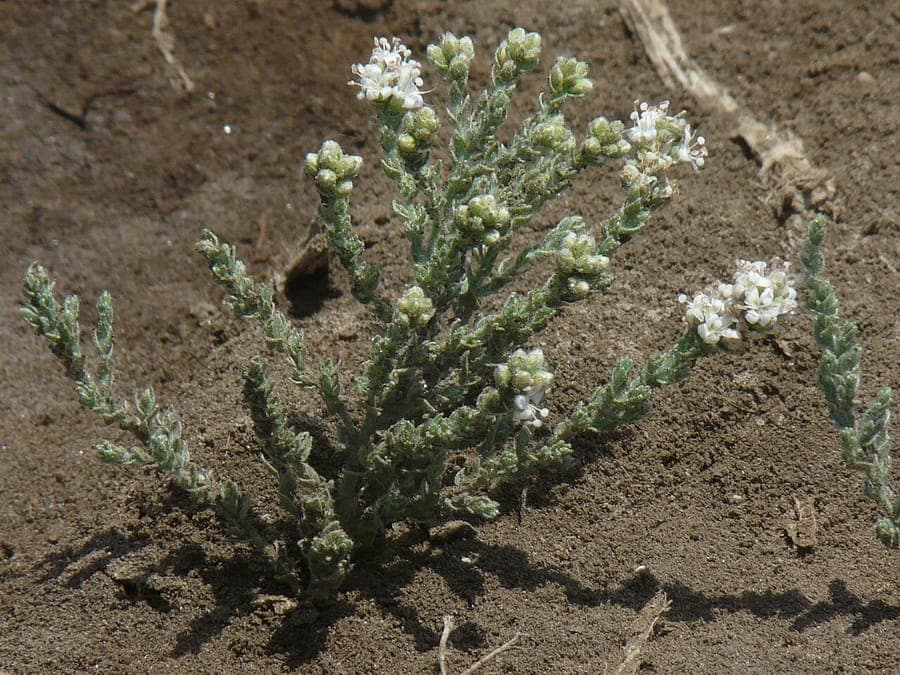
Dinesh Valke from Thane, India / CC BY-SA 2.0, via Wikimedia Commons
Cressa cretica: complete guide
Cressa cretica
¿Quieres ver Cressa cretica: complete guide en tu jardín?
1 minuto, sin tarjeta de crédito
Overview
Cressa cretica, also known as Cretan alkaliweed or rosin weed, is an unusual plant native to the Mediterranean region and surrounding areas, stretching from southern Africa through Asia. This creeping plant belongs to the Convolvulaceae family (bindweed family) and is renowned for its remarkable tolerance of extremely saline and difficult growing conditions. In its natural habitat, it grows on salt marshes, coastal areas, and semi-desert locations.
Cressa cretica is an excellent choice for challenging garden sites where many other plants fail. With its creeping growth and minimal water needs, it's a highly valuable plant for modern gardens.
Appearance & Bloom
Cressa cretica grows as a low, creeping plant, usually no taller than 20-30 cm, but spreading very widely. The plant forms dense, green mats with small, grayish-green, hairy leaves. The leaves are very small, about 1 cm long, giving it a compact appearance.
Flowers appear in summer (May through September) and are small and white, about 0.5-1 cm across. They are scattered along the stems and are not spectacular, but delicate and attractive.
The plant grows very slowly, meaning it can remain in the same form for years without aggressively expanding.
Ideal Location
Cressa cretica grows best in full sun. Place it where it receives at least 6-8 hours of direct sunlight daily. In good sunlight, it will grow dense and compact.
The plant is extremely tolerant of harsh growing conditions. It tolerates windy coasts perfectly, salt spray, and extremely dry conditions. This makes it valuable for front-line coastal gardens. It can also grow on rocky terrain, near cliffs, and on gravel areas.
Due to its creeping growth, it's ideal as a groundcover element or in hanging baskets. It's also suitable for rock gardens and dry borders.
Soil
Cressa cretica tolerates a much broader range of soils than most plants, including highly saline soils. This is indeed where the plant thrives best.
Well-draining soil is, however, important. The plant cannot tolerate waterlogged feet. On heavy, poorly-draining soils, add sand or gravel to improve drainage.
Saline soils are actually preferred. On non-saline soils, it still grows well, but may be somewhat less dense than in salty environments.
Fertilization is not critical. Poor soils are excellent; in fact, nutrient-rich soil can produce unruly growth.
Watering
Cressa cretica has extremely low water requirements, especially once established. It tolerates drought exceptionally well thanks to its small leaves that minimize water loss.
During the first month after planting, provide some watering to help roots establish a foundation. After that, you can leave it mostly dry.
In very dry climates, summer watering can be beneficial, but generally rainfall will suffice. In many temperate climates, Cressa cretica will need virtually no supplemental water beyond rainfall.
In pots, more regular watering will be needed, but still much less than typical plants.
Diseño gratis
¿Quieres ver Cressa cretica: complete guide en tu jardín? Crea un diseño gratis ahora.
Maintenance
Cressa cretica requires virtually no maintenance. The plant grows slowly and creeps naturally. You don't need to prune or shape it.
The only maintenance might be removing dead branches in spring (though this is rarely needed) or removing neighboring plants that might overgrow it.
Annual repotting is not needed. This plant can remain in the same pot for years.
Maintenance Calendar
Spring: Check for winter damage (though rarely needed). Start light watering if very dry.
Summer: Water only in extremely dry periods. Watch how the plant spreads.
Fall: Normal watering practices as temperature drops. No special maintenance.
Winter: Plant is dormant in cold climates. Minimal water. In mild climates, it may continue growing.
Winter Hardiness
Cressa cretica is not fully hardy in many temperate climates. In the Netherlands, Belgium, and France, it can remain outdoors if planted in very well-draining soil and in mild winters, but may suffer damage during extreme frost.
The plant grows best in USDA zones 9-11 (winter temperatures -5°C to 10°C). In colder regions, it can be overwintered in pots indoors or in a protected, frost-free location.
In coastal cities and milder regions, it can remain outdoors year-round.
Propagation
Cressa cretica can be propagated from seed. Seed germination is supported by light and warm temperature. It can also be propagated from cuttings - simply take cuttings and place in dry soil until they form roots.
Under favorable conditions, the plant will also self-seed.
Companion Plants
Cressa cretica combines well with other salt-tolerant and drought-tolerant plants:
- Sea Thrift (Armeria) - Same salt-tolerant preference
- Hottentot Fig - Same succulent-like needs
- Coastal Rosemary - Same coastal hardiness
- Other Convolvulaceae - Similar family needs
- Lamb's Ear (Stachys) - Similar grayish foliage
Closing
Cressa cretica is a special plant for difficult conditions. Where many other plants fail because they cannot tolerate salt, this plant thrives. With its low water requirements, hardy nature, and creeping growth, it's an excellent choice for coastal gardens, dry locations, and challenging terrain.
Search for it at specialized nurseries and native plant suppliers. Intratuin and similar stores occasionally carry it. With gardenworld.app you can easily integrate this salt-tolerant plant into coastal garden and dry garden designs. Through gardenworld.app you'll also receive designs specifically adapted to your location and conditions.
¿Quieres ver Cressa cretica: complete guide en tu jardín? Crea un diseño gratis ahora.
Sube una foto, elige un estilo y obtén un diseño fotorrealista con lista de plantas en menos de un minuto.
Más de 10.000 jardines diseñados
Sin tarjeta de crédito


Plantas similares
Spreading alkaliweed: complete guide
Cressa truxillensis
Full growing guide for Cressa truxillensis, the salt-tolerant groundcover of alkaline flats: location, soil, watering, pruning and winter care.
Betony-leaved bindweed: complete guide
Convolvulus betonicifolius
Full guide to betony-leaved bindweed (Convolvulus betonicifolius): origin, appearance, ideal site, soil, watering and garden uses.
Ivyleaf morning glory: complete guide
Ipomoea hederacea
Everything about Ipomoea hederacea: location, soil and climbing care. A fast-growing annual vine with blue funnel flowers for sunny walls and pergolas.