
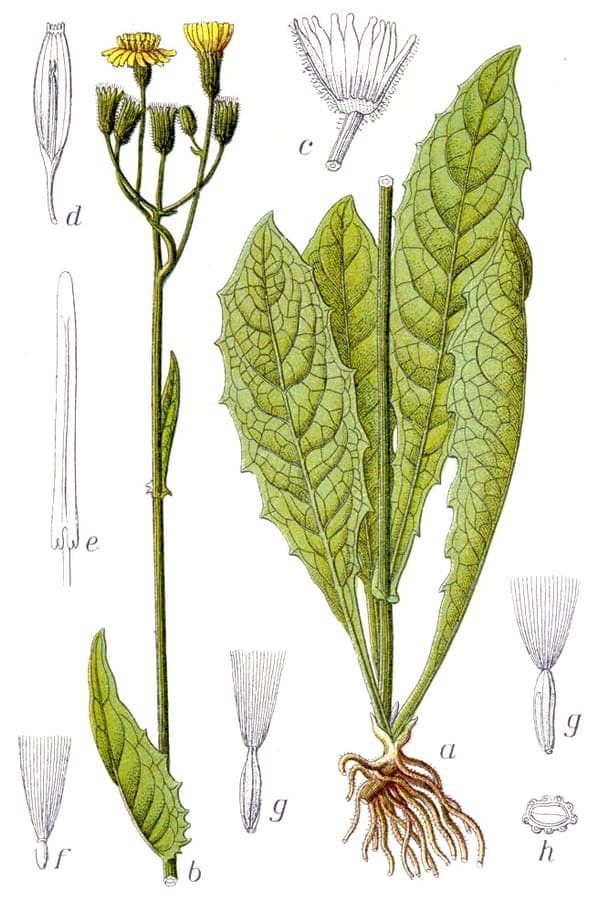
Johann Georg Sturm (Painter: Jacob Sturm) / Public domain, via Wikimedia Commons
Marsh Hawk's-beard (Crepis paludosa): complete guide
Crepis paludosa
¿Quieres ver Marsh Hawk's-beard (Crepis paludosa): complete guide en tu jardín?
1 minuto, sin tarjeta de crédito
Overview
Marsh Hawk's-beard, scientifically Crepis paludosa, is a robust semi-evergreen plant belonging to the Asteraceae family. Native to moist, wild areas from Europe through West Siberia and extending to mountain regions and boggy valleys, Marsh Hawk's-beard represents an excellent choice for gardeners in the Netherlands and Belgium seeking to populate moist, shaded areas without extensive maintenance demands.
At gardenworld.app, discover how to transform moist, shadowy corners into dynamic, flowering habitats. Marsh Hawk's-beard combines well with other moisture-loving species and provides reliable interest year-round.
Appearance & Bloom Cycle
Marsh Hawk's-beard is a strawberry-like plant reaching 40-80 cm in height. The plant grows in loose rosettes with elongated flowering stems. Leaves are oblong with rounded apexes and possess a slightly rough texture. At flowering time, an upright flowering stem emerges bearing multiple flowers.
Flowers appear in bright yellow, clustered in umbel-like panicles from June through August. These flowers face upward, distinguishing them from other Crepis species. Following blooming, delicate seed heads develop and disperse via wind.
Ideal Location
Marsh Hawk's-beard thrives in dappled to full shade. While tolerating some sun exposure, the plant performs optimally in locations avoiding intense midday sun. It excels along woodland edges, beneath shrubs, and in moist valley settings.
Diseño gratis
¿Quieres ver Marsh Hawk's-beard (Crepis paludosa): complete guide en tu jardín? Crea un diseño gratis ahora.
Soil Requirements
This plant demands humus-rich, moisture-retentive soils. Acidic to neutral conditions are optimal. Incorporate generous organic matter before planting. Marsh Hawk's-beard accepts slightly alkaline soils provided they remain consistently moist.
Watering
Consistency is essential. Marsh Hawk's-beard requires uniformly moist soil throughout the growing season (May-October). Never allow the soil to dry completely. During dry spells, water generously. Rainwater is preferred to tap water.
Pruning & Maintenance
Marsh Hawk's-beard requires minimal pruning. Remove spent flowering stems to maintain neatness and limit seed dispersal. Dead foliage from previous seasons can be cleared in spring when new growth emerges.
Maintenance Calendar
- April: Site preparation and planting
- June-August: Flowering period
- August-September: Seed development
- October-November: Autumn cleanup
Winter Hardiness
Marsh Hawk's-beard is fully hardy in Northern Europe (USDA zones 4-7). The plant overwinters as semi-evergreen and emerges vigorously in spring.
Companion Plants
Marsh Hawk's-beard combines well with other moisture-loving species such as purple meadow rue, marsh marigold, and shade-tolerant ferns. Yellow flowers provide striking contrast against purple sedge flowers.
Closing
Marsh Hawk's-beard represents a reliable choice for brightening moist, half-shady locations. With its extended flowering period and minimal maintenance requirements, it offers tremendous value to any semi-wild garden. Explore gardenworld.app for inspiration on transforming wet areas into stunning garden spaces.
¿Quieres ver Marsh Hawk's-beard (Crepis paludosa): complete guide en tu jardín? Crea un diseño gratis ahora.
Sube una foto, elige un estilo y obtén un diseño fotorrealista con lista de plantas en menos de un minuto.
Más de 10.000 jardines diseñados
Sin tarjeta de crédito


Plantas similares
Calendula stellata: complete guide
Calendula stellata
Complete guide to Calendula stellata, the star-flowered marigold from Sicily: location, soil, watering and companion planting tips.
Korean chrysanthemum: complete guide
Chrysanthemum x rubellum
Chrysanthemum x rubellum is a hardy autumn perennial with single pink to copper flowers from August to November. Care and combinations.
Helianthus divaricatus: complete guide
Helianthus divaricatus
Helianthus divaricatus is a North American woodland sunflower with yellow summer blooms, ideal for naturalistic borders and shady edges.