
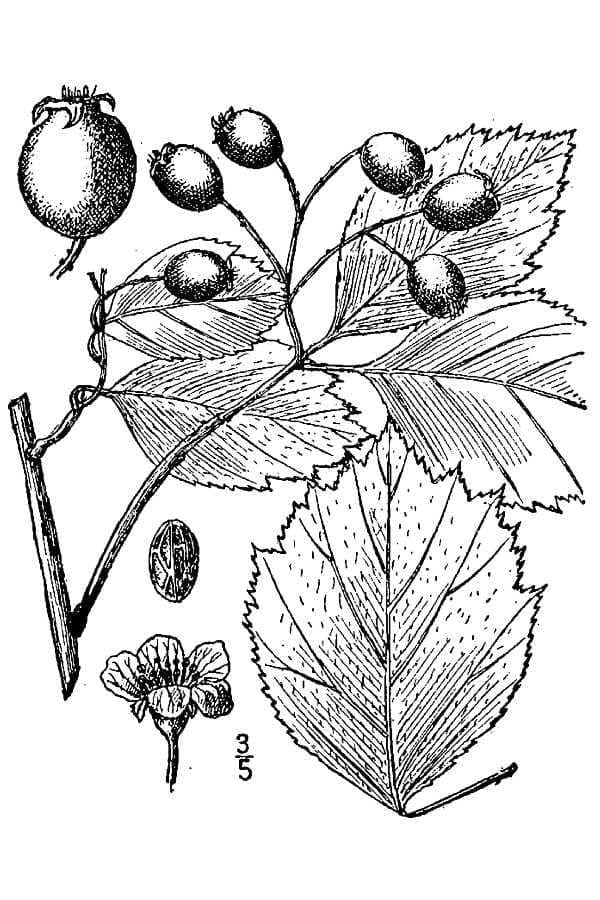
The original uploader was G716 at English Wikipedia. / Public domain, via Wikimedia Commons
Crataegus douglasii: complete guide
Crataegus douglasii
¿Quieres ver Crataegus douglasii: complete guide en tu jardín?
1 minuto, sin tarjeta de crédito
Overview
Crataegus douglasii, better known as River hawthorn, Oregon hawthorn, or Black hawthorn, is a North American shrub from the Rosaceae family (Rose family). Although native to the northwestern United States, this hawthorn performs excellently in European gardens. With its white spring flowers and black autumn fruits, it's a practical choice for hedges, natural screens, and bird-friendly borders.
Appearance and Bloom
Crataegus douglasii grows to 5-8 meters tall and forms a dense, thorny shrub or small tree. The plant bears simple, narrowly lobed leaves with a grey-green appearance. From May to June, white flowers appear in clusters. The blooms are small (circa 1 cm) but numerous, creating spectacular white flowering. Between August and October, dark purple to black berries appear that are highly attractive to birds.
Ideal Location
Crataegus douglasii is not a fussy plant. It grows well in full sun to half-shade. At least 4-6 hours of direct sun daily ensures optimal growth and flowering. The plant tolerates windy locations well and can be used as a windbreak. Ensure sufficient space around the plant due to its thorny branches.
Soil Composition
This is an extremely adaptable plant that grows in many soil types. Both poor and fertile soils are fine. Heavy clay soils, light sandy soils, acidic or neutral - everything is accepted. Well-draining soil is important. Waterlogging can lead to disease.
Diseño gratis
¿Quieres ver Crataegus douglasii: complete guide en tu jardín? Crea un diseño gratis ahora.
Watering
Once established, Crataegus douglasii is very drought-tolerant. After the first growing season it rarely needs additional water. Young plants should receive regular water until established. In dry summers, preferably water occasionally, but the plant can survive long periods without supplemental water.
Pruning and Maintenance
Crataegus douglasii maintenance is minimal. The plant needs little or no cutting back. Dead branches can be removed in spring. For hedges, the plant can be trimmed in June and August to maintain compact growth. Annual maintenance is usually unnecessary.
Maintenance Calendar
March-April: remove dead branches. May-June: enjoy blooming, no maintenance. July-August: optionally trim for hedges. August-October: enjoy black fruits attracting birds. November-January: no maintenance needed.
Winter Hardiness
Crataegus douglasii is extremely winter-hardy and tolerates temperatures to -25 degrees Celsius. This makes it suitable for all Dutch and German climates. Even very cold winters present no problem for established plants.
Companion Plants
Crataegus douglasii combines well with other native or bird-friendly plants: blackthorn, privet, bramble, elderberry, and dogwood. It works excellently as a component of mixed hedging.
Conclusion
Crataegus douglasii is ideal for bird-friendly gardens, natural hedges, and landscape screens. Buy your plant from a nursery center. Place it in a sunny spot with space. You'll get annually attractive bird fruits and flowers with zero maintenance. For more inspiration about bird-friendly hedges, visit gardenworld.app. Gardenworld.app also offers tips for integrating native species into your front yard.
¿Quieres ver Crataegus douglasii: complete guide en tu jardín? Crea un diseño gratis ahora.
Sube una foto, elige un estilo y obtén un diseño fotorrealista con lista de plantas en menos de un minuto.
Más de 10.000 jardines diseñados
Sin tarjeta de crédito


Plantas similares
Siberian crab apple: complete guide
Malus x robusta
Complete guide to the Siberian crab apple (Malus x robusta): location, soil, pruning, winter hardiness and the best companion plants for your garden.
Chinese flowering crabapple (Malus x spectabilis): complete guide
Malus x spectabilis
Meet the Chinese flowering crabapple (Malus x spectabilis): a classic spring bloomer with carmine buds and pink blossom.
Potentilla crassinervia: complete guide
Potentilla crassinervia
Potentilla crassinervia, the Corsican cinquefoil, grows wild on Corsica and Sardinia's peaks. Discover how to grow this hardy alpine rock garden gem.