
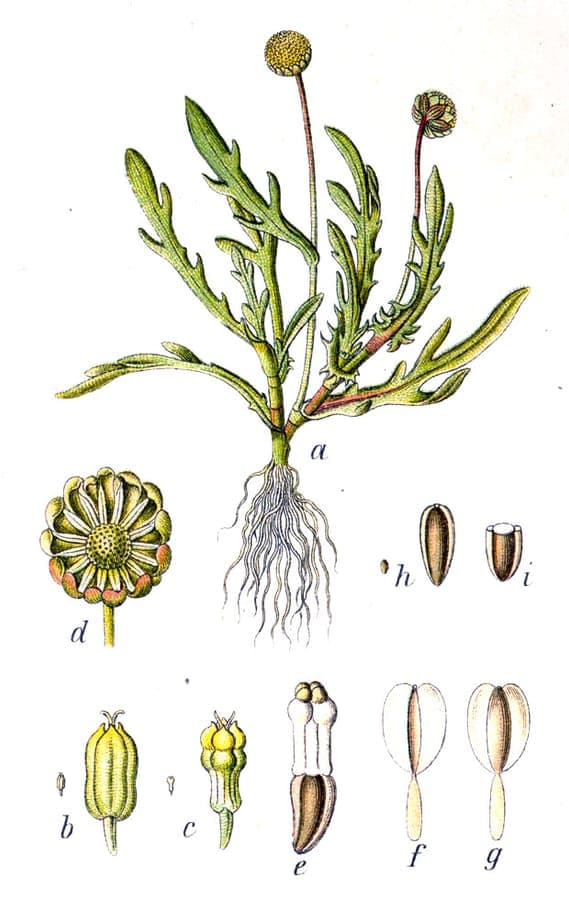
Johann Georg Sturm (Painter: Jacob Sturm) / Public domain, via Wikimedia Commons
Brass Buttons (Cotula coronopifolia): complete guide
Cotula coronopifolia
¿Quieres ver Brass Buttons (Cotula coronopifolia): complete guide en tu jardín?
1 minuto, sin tarjeta de crédito
Overview
Brass Buttons, scientifically known as Cotula coronopifolia, is a charming low-growing plant belonging to the Asteraceae family. Native to southern Africa, this versatile species excels in moist and wet habitats, making it an excellent choice for gardeners seeking to fill boggy areas with ornamental interest. The plant's tiny, gleaming golden flowers arranged in button-like clusters are the source of its common name and provide delightful texture in garden displays.
At gardenworld.app, discover how to transform waterlogged areas into stunning features. By incorporating moisture-loving plants like Brass Buttons alongside complementary species, you'll create a functional and beautiful water garden that thrives in European climates.
Appearance & Bloom Cycle
Brass Buttons forms a prostrate mat rarely exceeding 15-30 cm in height. The foliage is finely dissected and feathery, creating an airy, delicate impression despite the plant's robust nature. The stems creep along the soil surface, making this species excellent for ground cover in wet situations.
Flowers appear from June through October, creating an extended display of tiny golden buttons. These button-shaped flower heads, typically 5-8 mm in diameter, attract small insects and provide reliable color throughout the growing season.
Ideal Location
Brass Buttons thrives in consistently moist conditions, whether in boggy garden areas, along pond margins, or near streams. While the plant tolerates full sun to partial shade, flowering is most prolific in full sun (minimum 6 hours daily). The open, sunny position also encourages more compact growth.
Diseño gratis
¿Quieres ver Brass Buttons (Cotula coronopifolia): complete guide en tu jardín? Crea un diseño gratis ahora.
Soil Requirements
This plant succeeds in fertile, moisture-retentive soil enriched with organic matter. While adaptable to pH ranges, it performs best in neutral to slightly acidic conditions. The key requirement is consistent moisture rather than specific nutrient demands.
Watering
Consistent moisture is essential. During the growing season (May-October), water deeply when the top 2 cm of soil becomes dry. In wet seasons, natural rainfall usually provides sufficient moisture. In dry spells, daily watering may be necessary to maintain optimal growth and flowering.
Pruning & Maintenance
Brass Buttons requires minimal pruning. Remove dead flower heads to encourage continued blooming and maintain a neat appearance. At season's end, clear away frost-damaged foliage in autumn for a tidy appearance.
Maintenance Calendar
- March-April: Soil preparation and planting
- May-October: Regular watering and monitoring
- June-October: Peak bloom period
- November: End-of-season cleanup
Winter Hardiness
Brass Buttons is not reliably hardy in Central Europe. It's best grown as an annual in most of the Netherlands, Belgium, and Germany. In warmer microclimates, it may persist through mild winters.
Companion Plants
Pair Brass Buttons with other moisture-loving species such as marsh marigold (Caltha palustris), water iris (Iris pseudacorus), and purple loosestrife (Lythrum salicaria) for striking color combinations and textures.
Closing
Brass Buttons deserves a place in any water garden or boggy area needing ornamental interest. Its extended flowering period and ability to thrive in perpetually moist conditions make it invaluable for European gardeners. Explore gardenworld.app for wetland garden designs and discover how Brass Buttons can elevate your water features.
¿Quieres ver Brass Buttons (Cotula coronopifolia): complete guide en tu jardín? Crea un diseño gratis ahora.
Sube una foto, elige un estilo y obtén un diseño fotorrealista con lista de plantas en menos de un minuto.
Más de 10.000 jardines diseñados
Sin tarjeta de crédito


Plantas similares
Calendula stellata: complete guide
Calendula stellata
Complete guide to Calendula stellata, the star-flowered marigold from Sicily: location, soil, watering and companion planting tips.
Korean chrysanthemum: complete guide
Chrysanthemum x rubellum
Chrysanthemum x rubellum is a hardy autumn perennial with single pink to copper flowers from August to November. Care and combinations.
Helianthus divaricatus: complete guide
Helianthus divaricatus
Helianthus divaricatus is a North American woodland sunflower with yellow summer blooms, ideal for naturalistic borders and shady edges.