
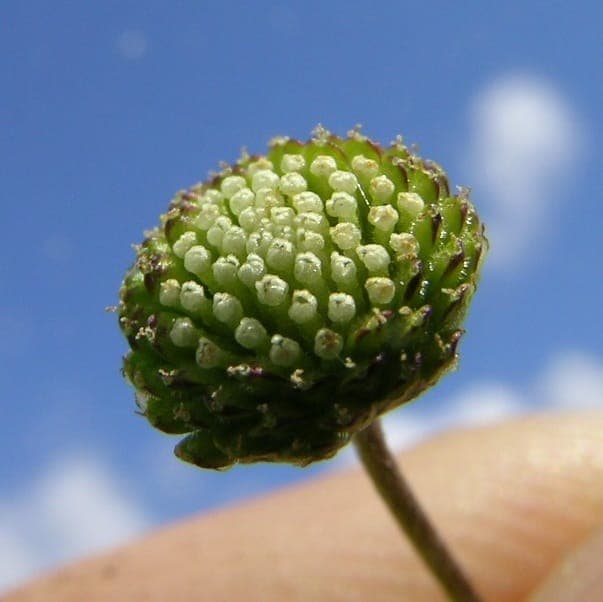
Macleay Grass Man / CC BY 2.0, via Wikimedia Commons
Annual Buttonweed: complete guide
Cotula australis
¿Quieres ver Annual Buttonweed: complete guide en tu jardín?
1 minuto, sin tarjeta de crédito
Overview
The Annual Buttonweed (Cotula australis) is a versatile small herb from the Asteraceae family, native to Australia, New Zealand and South Africa. This compact, creeping herb is valued for its fine, moss-like foliage and numerous tiny yellow flowers. The plant reaches a height of only 10-15 cm and spreads as groundcover with a span up to 30 cm.
Appearance & bloom
The Annual Buttonweed is a very fine, creeping herb with extremely delicate, fennel-like leaves that look almost moss-like. The leaves are bright green and have a subtle fragrance. Tiny button-shaped flowers appear from April to October in yellow to yellowish-brown. The flowers resemble small buttons and are only several millimeters in size. The entire plant maintains a very compact, neat appearance.
Ideal location
This plant thrives in full sun to half-shade and is very light tolerant. In very shaded spots the plant grows weaker. Ideal for rocks, borders, paths and as crevice filler. The plant grows excellently between steps or paving stones. Also very suitable for containers and hanging baskets.
Soil
The Annual Buttonweed is very tolerant of various soil types but prefers well-draining, not overly rich soil. Sandy, gritty or light gravel soil works best. pH can vary from 6.5 to 7.5. Heavy clay soils should be lightened with sand or gravel. The plant tolerates salt-containing water better than many other plants.
Diseño gratis
¿Quieres ver Annual Buttonweed: complete guide en tu jardín? Crea un diseño gratis ahora.
Watering
Once established, the plant tolerates drought exceptionally well. Water regularly in the first weeks after planting. Later only water in extremely dry periods. The plant prefers dry feet and protection against water excess. Too much moisture can lead to rot.
Pruning
Minimal pruning is required. The plant forms a neat, compact shape naturally. Remove only wilted or damaged plant parts. No serious pruning needed. The plant can be gently pinched to encourage compactness.
Maintenance calendar
March: Check overwintering and slowly begin watering. April-May: Full growing season begins with increasing light and warmth. June-October: Blooming and growth; very low maintenance. November-February: Plant dies back in cold areas; minimal care.
Winter hardiness
The Annual Buttonweed is hardy to about -5 degrees Celsius. In southern European gardens winter protection is not needed. In northern climates the plant can be grown in containers and kept indoors for winter. Originally from warm climates, winter tolerance is moderate.
Companion plants
Combine with other fine groundcovers such as rupica, veronica and phlox. Also beautiful in combination with succulents and sedums. Rockery partners are stonecrops and small aster species. As crevice filler, plant together with thyme and oregano.
Closing
The Annual Buttonweed is a low-maintenance, drought-tolerant herb for rock gardens and borders. Available from specialized plant nurseries and online herb seed suppliers throughout Europe.
¿Quieres ver Annual Buttonweed: complete guide en tu jardín? Crea un diseño gratis ahora.
Sube una foto, elige un estilo y obtén un diseño fotorrealista con lista de plantas en menos de un minuto.
Más de 10.000 jardines diseñados
Sin tarjeta de crédito


Plantas similares
Calendula stellata: complete guide
Calendula stellata
Complete guide to Calendula stellata, the star-flowered marigold from Sicily: location, soil, watering and companion planting tips.
Korean chrysanthemum: complete guide
Chrysanthemum x rubellum
Chrysanthemum x rubellum is a hardy autumn perennial with single pink to copper flowers from August to November. Care and combinations.
Helianthus divaricatus: complete guide
Helianthus divaricatus
Helianthus divaricatus is a North American woodland sunflower with yellow summer blooms, ideal for naturalistic borders and shady edges.