
Stephen James McWilliam / CC0, via Wikimedia Commons
Cotoneaster rehderi: complete guide
Cotoneaster rehderi
¿Quieres ver Cotoneaster rehderi: complete guide en tu jardín?
1 minuto, sin tarjeta de crédito
Overview
Cotoneaster rehderi, commonly known as bullate cotoneaster or Rehder's cotoneaster, is a more vigorous and characterful shrub from the Cotoneaster genus. This variety originates from West Sichuan in China and is named after American botanist Alfred Rehder. In gardens, it is valued for its striking crinkled leaves, abundant flower production and bird fruits.
The plant typically reaches 1.5-3 metres in height and can be used as a standalone shrub or hedge screen. It is robust and tolerates variable conditions well. Winter hardiness is excellent, with the ability to withstand temperatures down to -20 degrees Celsius. This species is notably less subtle than cotoneaster nitens, but conversely very striking and bird-friendly.
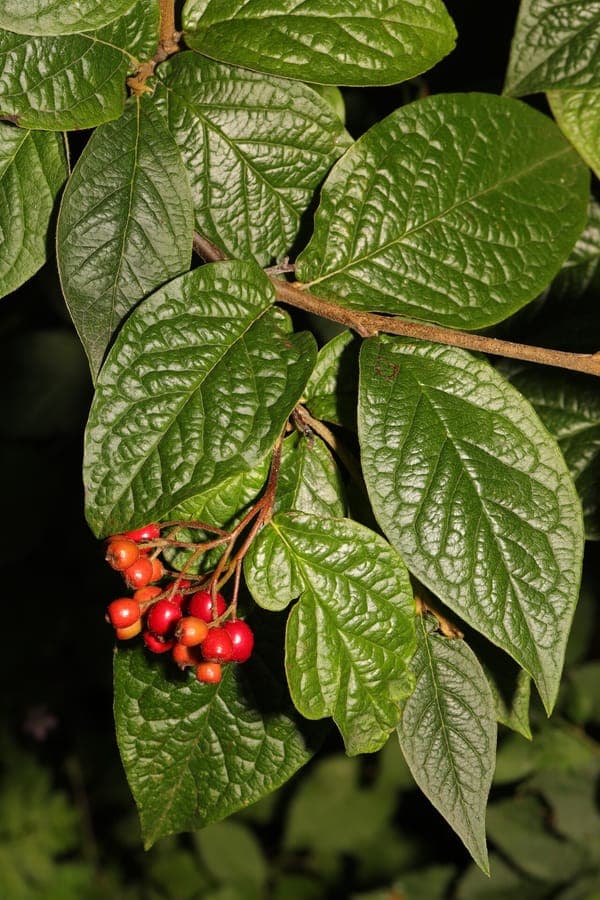
The bullate cotoneaster is renowned for its extremely distinctive foliage. The name bullate refers to the characteristic depressions or bubble-like structure of the leaf. This pattern is caused by the way the leaf grows, with deeper-lying veins creating pockmarks throughout the surface. This gives the plant a rich texture pattern that is particularly striking in winter when other plants are bare. Alfred Rehder, after whom this plant is named, was a highly influential botanist at the Arnold Arboretum who brought many plants from Asia to Western gardens during the early twentieth century. His work has enriched gardens worldwide and this cotoneaster stands as a testament to his legacy.
Appearance and bloom
The most striking feature of cotoneaster rehderi is the wrinkled, bullate-like leaf texture. The leaves are approximately 3-6 cm long, broadly oval to nearly round, with deep wrinkles that create an interesting relief pattern. Colour ranges from dark green in summer to purple-red in autumn, providing dramatic visual impact.
Flowers appear in April and May in large, dense clusters. They are cream-white to pink in colour and extraordinarily prolific, giving the plant a cloud-like appearance during the flowering period. After bloom, fruits develop, first turning orange, later deep scarlet to red. These fruits persist well into winter and form a bird paradise.
Ideal location
Cotoneaster rehderi thrives best in a sunny to partially shaded position. Minimum 4-6 hours of direct sun daily is needed for optimal growth, flowering and fruiting. In full shade, the plant grows more sparsely and produces fewer flowers.
The plant tolerates various positions well, including exposed and windy locations. In very hot climates, partial shade, particularly in the late afternoon, may be beneficial. The plant accepts both front-facing and side exposures without problems.
Soil requirements
Cotoneaster rehderi grows in virtually all soil types but prefers well-draining, neutral or chalky soil. Like other cotoneasters, it tolerates dry conditions better than many alternative shrubs. Heavy clay soil can be used provided drainage is improved with sand or gravel.
The plant tolerates pH values from 6.0 to 8.5 without problems. In very acidic soils (below pH 5.5), leaf yellowing may occur, but this is rare. When planting, add compost or garden mould for improved structure and moisture retention.
Diseño gratis
¿Quieres ver Cotoneaster rehderi: complete guide en tu jardín? Crea un diseño gratis ahora.
Watering
During the first growing season, water regularly - approximately twice weekly. Ensure the plant does not become waterlogged, as this can cause root rot. Once established (after 1-2 seasons), the plant is extremely drought tolerant and only needs extra water during periods of extreme drought.
Water preferably in the morning or late afternoon. This reduces evaporation and gives the plant time to absorb water before intense heat strikes. During rainy seasons, no supplementary watering is needed.
Pruning
Cotoneaster rehderi can be minimally pruned for a natural form. For hedges, pruning twice yearly (May/June and August/September) suffices. Avoid very aggressive pruning, as this reduces flowering and fruiting.
Older shrubs can be rejuvenated by removing approximately one-third of the oldest wood at ground level. This stimulates new, vital shoots. Damaged and dead wood should always be removed. When used as a hedge, this species responds well to light clipping immediately after flowering to tidy the growth and encourage branching. Unlike some shrubs that resent hard pruning, Cotoneaster rehderi will regenerate vigorously from old wood, making it suitable for renewal pruning when neglected shrubs need rehabilitation. If you have an overgrown specimen, you can cut it back to 30-50 cm height in early spring and it will regenerate within one growing season, though you will lose one year's flowering.
Maintenance calendar
March: Check for winter damage, clean pruning wounds. April-May: Massive flower production, observe for insects. May: First formative trim for hedges. June-July: Fruits change from green to orange. August: Second formative trim for hedges. September-October: Fruits colour deep red, birds feeding. November-December: Plant rests, winter preparation complete. January-February: Heavy pruning if needed.
Winter hardiness
Cotoneaster rehderi is very winter hardy and tolerates temperatures down to -20 degrees Celsius without damage. The plant requires no winter protection in the Netherlands, Belgium, France or Germany. Snow loading may break young wood, but this recovers quickly in spring.
The plant retains its foliage well into winter, providing ornamental value during winter months.
Companion plants
Cotoneaster rehderi combines well with other sturdy shrubs such as Ilex (holly), Euonymus, boxwood and other low-growing cotoneasters. With larger background plantings, forsythia, weigela and kernels create interesting layering schemes. In borders it works well within structural plantings with grasses and bulbs.
For bird attraction, combine with other fruit-bearing plants such as rowan, hawthorn and elderberry.
Closing thoughts
Cotoneaster rehderi is an extremely versatile plant that can be used both as a solitary shrub and in hedges. The combination of dramatic foliage, massive flower production and persistent bird fruits makes it a highly valuable addition to any garden. Robustness and low maintenance requirements make it suitable for virtually all garden situations.
Order via gardenworld.app/en. For more information on design and selection, visit gardenworld.app/en.
¿Quieres ver Cotoneaster rehderi: complete guide en tu jardín? Crea un diseño gratis ahora.
Sube una foto, elige un estilo y obtén un diseño fotorrealista con lista de plantas en menos de un minuto.
Más de 10.000 jardines diseñados
Sin tarjeta de crédito


Plantas similares
Siberian crab apple: complete guide
Malus x robusta
Complete guide to the Siberian crab apple (Malus x robusta): location, soil, pruning, winter hardiness and the best companion plants for your garden.
Chinese flowering crabapple (Malus x spectabilis): complete guide
Malus x spectabilis
Meet the Chinese flowering crabapple (Malus x spectabilis): a classic spring bloomer with carmine buds and pink blossom.
Potentilla crassinervia: complete guide
Potentilla crassinervia
Potentilla crassinervia, the Corsican cinquefoil, grows wild on Corsica and Sardinia's peaks. Discover how to grow this hardy alpine rock garden gem.