
MPF (talk) (Uploads) / Cc-by-sa-3.0, via Wikimedia Commons
Entire-leaved Cotoneaster: complete guide
Cotoneaster integrifolius
¿Quieres ver Entire-leaved Cotoneaster: complete guide en tu jardín?
1 minuto, sin tarjeta de crédito
Overview
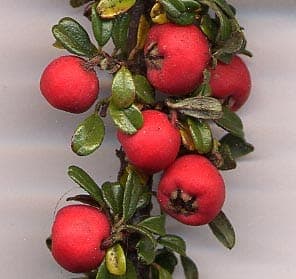
The Entire-leaved Cotoneaster (Cotoneaster integrifolius) is an elegant ornamental shrub from the Rosaceae family, native to the Himalayas and China. This compact shrub is valued for its fine foliage, white flowers and especially its striking red berries that continue developing from summer through autumn. Mature plants reach a height of 0.5 to 1.5 meters.
Appearance & bloom
The Entire-leaved Cotoneaster is a densely branched shrub with small, opposite leaves that are dark green and glossy. The plant is characterized by its slender, wavy branches. Small white flowers appear in June-July, followed by numerous small red berries that remain on the plant well into winter. The foliage changes in autumn from green to red-orange.
Ideal location
This plant grows optimally in full sun to half-shade. Place in locations with good light for abundant red berry speckles. The plant is very tolerant of windy conditions and can be used in open gardens, garden borders and as hedge-like dividers. Support the plant in northern Europe in a sheltered microclimate.
Soil
The Entire-leaved Cotoneaster is very tolerant of various soil types. It grows well in normal garden soil, sandy soil and gravel soil. Optimal is moderately rich soil with pH 6.0-7.5. The plant tolerates drought better than many other ornamental shrubs and therefore prefers moderately well-draining soil. Planting holes should be 30x30 cm.
Watering
After the first year of planting, extra watering is usually unnecessary. The plant tolerates dry periods well and grows in normal rainfall. Water only in very dry summers and provide regular water for young plants for the first two years. In pot culture, water regularly during growth.
Diseño gratis
¿Quieres ver Entire-leaved Cotoneaster: complete guide en tu jardín? Crea un diseño gratis ahora.
Pruning
Minimal pruning is needed. The plant forms a beautiful compact shape naturally. Remove only dead, damaged or diseased branches. Form pruning can be done after flowering in August, but don't disturb the fruit production too much. Cotoneaster is tolerant of regular pruning and can be used as hedges.
Maintenance calendar
March: Form pruning and winter damage inspection. April-May: Growth period with regular feeding recommended. June-July: Flowering period; minimal care needed. August-September: Red berries develop; no pruning needed. October-November: Enjoy autumn color; prepare for winter. December-February: Winter dormancy; only water in dry weather.
Winter hardiness
The Entire-leaved Cotoneaster is hardy to about -15 degrees Celsius. In southern and central Europe no protection needed. In northern Europe choose a sheltered location. The plants originally grew in the Himalayas up to 3000 meters altitude, so are very cold tolerant.
Companion plants
Combine with other red berry-bearing shrubs such as hawthorn, rowan and scarlet berry-bush. Foliage combinations work well with alternating autumn-colored shrubs and grasses. Also effective in groups of three to five for dramatic effects.
Closing
The Entire-leaved Cotoneaster is a versatile, low-maintenance ornamental shrub with long-lasting red berries. Available at garden centers and tree nurseries in the Netherlands, Belgium, France and Germany under trade names such as thyme-leaved cotoneaster.
¿Quieres ver Entire-leaved Cotoneaster: complete guide en tu jardín? Crea un diseño gratis ahora.
Sube una foto, elige un estilo y obtén un diseño fotorrealista con lista de plantas en menos de un minuto.
Más de 10.000 jardines diseñados
Sin tarjeta de crédito


Plantas similares
Siberian crab apple: complete guide
Malus x robusta
Complete guide to the Siberian crab apple (Malus x robusta): location, soil, pruning, winter hardiness and the best companion plants for your garden.
Chinese flowering crabapple (Malus x spectabilis): complete guide
Malus x spectabilis
Meet the Chinese flowering crabapple (Malus x spectabilis): a classic spring bloomer with carmine buds and pink blossom.
Potentilla crassinervia: complete guide
Potentilla crassinervia
Potentilla crassinervia, the Corsican cinquefoil, grows wild on Corsica and Sardinia's peaks. Discover how to grow this hardy alpine rock garden gem.