
Stickpen / Public domain, via Wikimedia Commons
Cotoneaster glaucophyllus: complete guide
Cotoneaster glaucophyllus
¿Quieres ver Cotoneaster glaucophyllus: complete guide en tu jardín?
1 minuto, sin tarjeta de crédito
Overview
Cotoneaster glaucophyllus, commonly known as the glaucous cotoneaster or gray-leafed cotoneaster, is a remarkable evergreen shrub originating from central and southeastern China. This versatile plant combines structural design with practical utility, making it an excellent choice for both modern and traditional gardens. First scientifically described in 1890, it has since become a valued ornamental across the globe.
The most distinctive feature of Cotoneaster glaucophyllus is its frosted gray foliage, which gives the plant a unique aesthetic that stands out against dark green backgrounds. The combination of texture, foliage styling, and bird-attracting red berries makes this an outstanding choice for gardens requiring year-round interest.
Appearance & Bloom
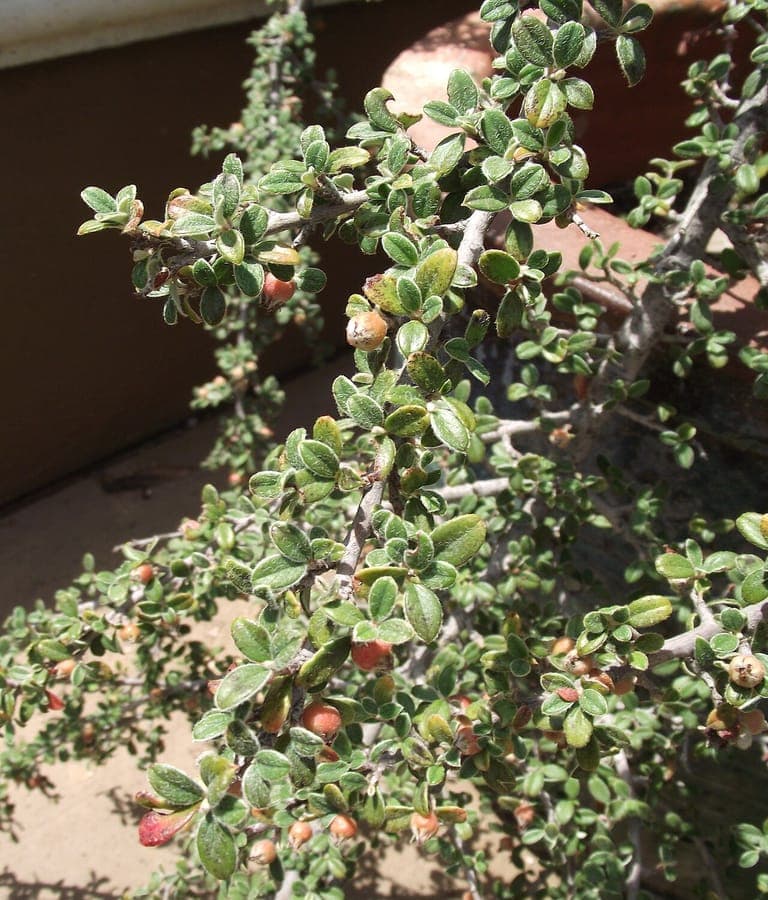
This cotoneaster grows as a medium to large evergreen shrub with a dense, spreading growth habit. The leaves are notably distinctive: relatively large for a cotoneaster, with a dense waxy coating that gives them a blue-gray appearance. This glaucousness (the gray powdery coating) is what the scientific name references.
Flowers appear in early summer (May-June) in small white to pale pink flower clusters along the stems. Though not spectacular, they are elegantly subtle and provide a beautiful backdrop for the later-emerging fruits.
The fruits are the true highlight of the growth cycle. In autumn and early winter, the branches become laden with small bright red berries that pop against the gray foliage. These berries persist long on the plant, attracting birds during months when food is scarce. This extended ornamental value makes Cotoneaster glaucophyllus a genuine asset in the winter landscape.
Ideal Location
Cotoneaster glaucophyllus is remarkably tolerant of site preferences, but thrives best in full sun to partial shade. In full sun (at least 6 hours of direct sunlight daily), the plant will achieve maximum compactness and berry production. In partial shade, the plant remains healthy, though growth may be slightly more open and berry production may decrease.
The plant suits diverse garden settings: it works as a groundcover element in larger compositions, as a solitary specimen in borders, or even as a low screen. The compact, spreading form works well in beds, along walls, or on slopes where its natural growth habit can be appreciated.
Wind characteristics are not problematic - this cotoneaster is quite wind-resistant thanks to its dense foliage. In windy coastal regions, it will also perform well.
Soil
Regarding soil requirements, Cotoneaster glaucophyllus is highly flexible. The plant tolerates a wide range of soils, as long as drainage is adequate. Standing water can cause root rot, so ensure water doesn't linger after rain or irrigation.
Ideal is a well-draining loamy or sandy soil with neutral to slightly acidic pH (5.5-6.5 is optimal). The plant accepts alkaline soils without issue. Nutrient properties are of moderate importance - a medium-nutrient-rich soil is fine. Poor soils require supplemental feeding, while overly rich soils can cause excessive vegetative growth with limited berry production.
When planting, add compost or garden peat to improve soil structure. This helps both water and nutrient availability long-term.
Diseño gratis
¿Quieres ver Cotoneaster glaucophyllus: complete guide en tu jardín? Crea un diseño gratis ahora.
Watering
Once established, Cotoneaster glaucophyllus is less dependent on irrigation than many ornamental shrubs. It has moderate moisture requirements and tolerates drought spells better than many alternatives.
During the first growing season after planting, regular watering is essential - the root system must establish well. Water deeply and regularly throughout the first year, especially if dry conditions occur.
Once established, water only during extended dry periods. In temperate climates, rainfall will usually suffice. In drier regions, summer irrigation may be needed, especially on light soils.
Ensure water is given at the base, not on foliage - this reduces disease. Morning irrigation is better than evening.
Pruning
Cotoneaster glaucophyllus requires minimal pruning because it has a naturally attractive form. Leave its spreading growth mostly intact.
You can prune lightly after flowering (July-August) to maintain shape or keep growing stems in check. Remove dead or diseased wood as soon as you notice it. Major pruning is rarely needed and can damage the plant's natural elegance.
If you wanted to train the plant into a more formal shape, you could, but this goes against its natural inclination. This is better left for gardens with classical styles.
Maintenance Calendar
Spring: Check for winter damage. Add mulch around the plant base. Light pruning for shape if needed.
Summer: Water regularly during hot, dry periods. After flowering (July-August), light pruning can occur.
Autumn: Observe the berry display. No active maintenance needed, enjoy the birds eating the fruit.
Winter: The plant is fully hardy. No special protection needed in temperate zones.
Winter Hardiness
Cotoneaster glaucophyllus is hardy in USDA zones 6 to 9, meaning it can tolerate temperatures down to -23°C. In colder regions, it may be grown in containers for protected locations, or you might choose alternatives.
In milder climates (zones 9-10) it thrives even better, though light damage is possible during extreme cold snaps. In temperate climates like the Netherlands, Belgium, and most of France, it grows excellently.
Companion Plants
Cotoneaster glaucophyllus works well with diverse other plants:
- Lavender (Lavandula) - Perfect in size, bloom time, and water preference
- Rudbeckia - Yellow flowers contrast beautifully on gray foliage
- Sage (Salvia) - Similar climate needs, interesting flower texture
- Sedum - Perfect for providing underplanting, shares dry location preferences
- Ornamental grasses - Provide rhythmic movement beside the fixed form of cotoneaster
Avoid heavy feeders that cast too much shade on the glaucous cotoneaster, as this can diminish its characteristic foliage styling.
Closing
Cotoneaster glaucophyllus is a true chameleon - elegant enough for contemporary gardens, yet equally at home in traditional settings. Its gray foliage, summer flowers, and winter red berries provide continuous interest through all seasons. With minimal care once established, it's a plant that gives back generously: striking appearance combined with low maintenance demands.
Whether you're creating a bird-friendly garden or seeking structure in your borders, Cotoneaster glaucophyllus deserves serious consideration. Hunt for it at local nurseries - try Intratuin or garden centers. Through gardenworld.app you can easily integrate this ornamental shrub into your garden. With gardenworld.app, you'll also receive designs perfectly tailored to your front yard.
¿Quieres ver Cotoneaster glaucophyllus: complete guide en tu jardín? Crea un diseño gratis ahora.
Sube una foto, elige un estilo y obtén un diseño fotorrealista con lista de plantas en menos de un minuto.
Más de 10.000 jardines diseñados
Sin tarjeta de crédito


Plantas similares
Siberian crab apple: complete guide
Malus x robusta
Complete guide to the Siberian crab apple (Malus x robusta): location, soil, pruning, winter hardiness and the best companion plants for your garden.
Chinese flowering crabapple (Malus x spectabilis): complete guide
Malus x spectabilis
Meet the Chinese flowering crabapple (Malus x spectabilis): a classic spring bloomer with carmine buds and pink blossom.
Potentilla crassinervia: complete guide
Potentilla crassinervia
Potentilla crassinervia, the Corsican cinquefoil, grows wild on Corsica and Sardinia's peaks. Discover how to grow this hardy alpine rock garden gem.