
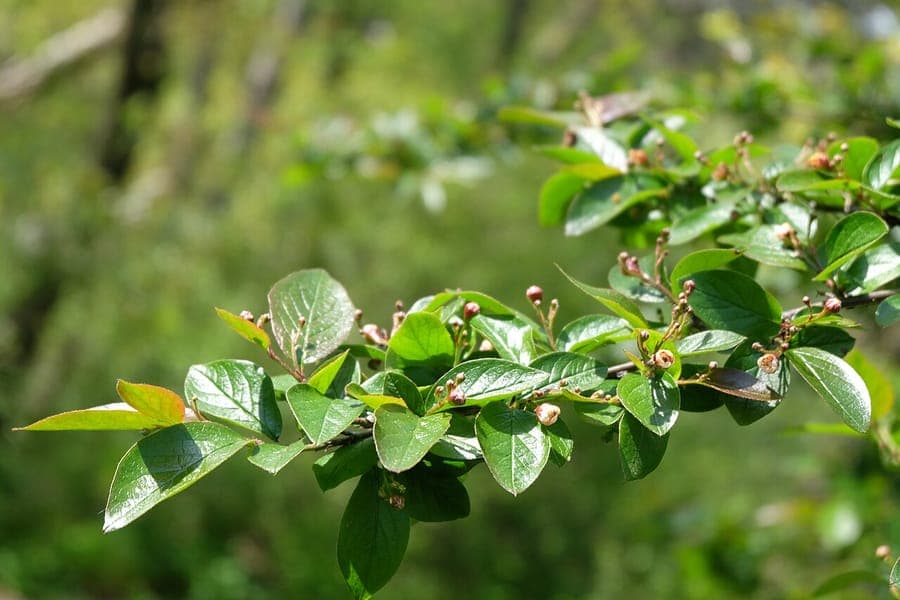
Katrin Schneider / korina.info / CC BY-SA 4.0, via Wikimedia Commons
Peking cotoneaster: complete guide
Cotoneaster acutifolius
¿Quieres ver Peking cotoneaster: complete guide en tu jardín?
1 minuto, sin tarjeta de crédito
Overview
Peking cotoneaster (Cotoneaster acutifolius), also called 'shiny cotoneaster' or 'wild cotoneaster,' is a versatile, hardy shrub from southern Siberia and China. This tough, reliable plant grows almost anywhere and is invaluable for wildlife and garden structure.
In gardens, it's a classic choice for hedges, borders, and windbreaks. The plant offers green summer leaves, white spring flowers, red berries in autumn and winter, and semi-evergreen foliage.
Appearance & bloom cycle
Peking cotoneaster grows 200-300 cm tall and wide (sometimes taller), depending on pruning. Growth is dense and compact without maintenance.
Leaves are small, fine, and glossy dark green. In autumn, they turn reddish-orange before dropping.
Small white or pale pink flowers appear May-June in dense clusters. Inconspicuous but numerous and bee-friendly.
Glossing red berries appear August-October and persist through winter - invaluable bird food. A single plant can produce thousands of berries.
Ideal location
Peking cotoneaster is flexible, growing nearly everywhere:
- Full sun: Best for berry production and autumn color
- Half shade: Grows well, fewer berries
- Full shade: Grows but sparse berries
Extremely wind-tolerant. Thrives on exposed sites.
Excellent in urban settings; tolerates pollution.
Soil requirements
Peking cotoneaster is not fussy. It grows in sand, loam, clay, and heavy soils. The only absolute requirement: no waterlogging in winter.
- pH: Tolerates acid to alkaline (5.0-8.0)
- Fertility: Poor to rich soil; grows almost anywhere
- Drainage: Moderate to good; tolerates some moisture but not stagnation
- Texture: Sand to clay; flexible
Watering
Once established (after 1-2 seasons), Peking cotoneaster is extremely drought-tolerant. Young plants benefit from regular water the first year.
Watering schedule:
- Year 1: Water weekly in dry periods
- Year 2+: Minimal water; only during extreme drought
- Container-grown: More frequent water; check daily in summer
- After establishment: No watering needed
Overwatering causes poor growth and root rot.
Diseño gratis
¿Quieres ver Peking cotoneaster: complete guide en tu jardín? Crea un diseño gratis ahora.
Pruning
Peking cotoneaster tolerates heavy pruning and can be cut into any form.
- Hedges: Trim 2-3x per season for compact form
- Freeform: Minimal pruning; let it determine its own shape
- Rejuvenation: Can be cut back hard; recovers well
- Flowers/Berries: Leave unpruned for maximum flowers and berries
Use sharp shears; avoid tearing.
Maintenance calendar
March: Remove dead wood. Shape if needed.
April: Growth begins. Water regularly if young plant.
May-June: Flowering. Don't prune if berries desired.
July-August: Berries forming. Minimal pruning.
September-October: Autumn color. Berries full. Bird food ready.
November-February: Winter. Trim hedges if needed. No other maintenance.
Winter hardiness
Peking cotoneaster is very hardy to -25°C (USDA zone 4). No frost damage in most regions. Heavy snow can cause branch breakage; gently shake off snow.
Companion plants
Peking cotoneaster pairs well with:
- Privet (Ligustrum): For mixed hedges
- Hornbeam (Carpinus): Formal combination
- Spirea: For spring interest
- Birch: For structural contrast
- Ivy: For underplanting
- Barberry (Berberis): For wildlife hedge
Closing
Peking cotoneaster is essential for any garden. It offers year-round interest, wildlife food, and minimal maintenance. Find it at most garden centres and tree nurseries.
On gardenworld.app, design a garden with Peking cotoneaster perfectly positioned for wildlife and visual impact. See how it combines with other shrubs in your scheme. Discover how to best use it for hedges or specimen planting.
On gardenworld.app, visualize your complete garden composition with Peking cotoneaster and other shrubs, creating the perfect wildlife-friendly garden.
¿Quieres ver Peking cotoneaster: complete guide en tu jardín? Crea un diseño gratis ahora.
Sube una foto, elige un estilo y obtén un diseño fotorrealista con lista de plantas en menos de un minuto.
Más de 10.000 jardines diseñados
Sin tarjeta de crédito


Plantas similares
Siberian crab apple: complete guide
Malus x robusta
Complete guide to the Siberian crab apple (Malus x robusta): location, soil, pruning, winter hardiness and the best companion plants for your garden.
Chinese flowering crabapple (Malus x spectabilis): complete guide
Malus x spectabilis
Meet the Chinese flowering crabapple (Malus x spectabilis): a classic spring bloomer with carmine buds and pink blossom.
Potentilla crassinervia: complete guide
Potentilla crassinervia
Potentilla crassinervia, the Corsican cinquefoil, grows wild on Corsica and Sardinia's peaks. Discover how to grow this hardy alpine rock garden gem.