
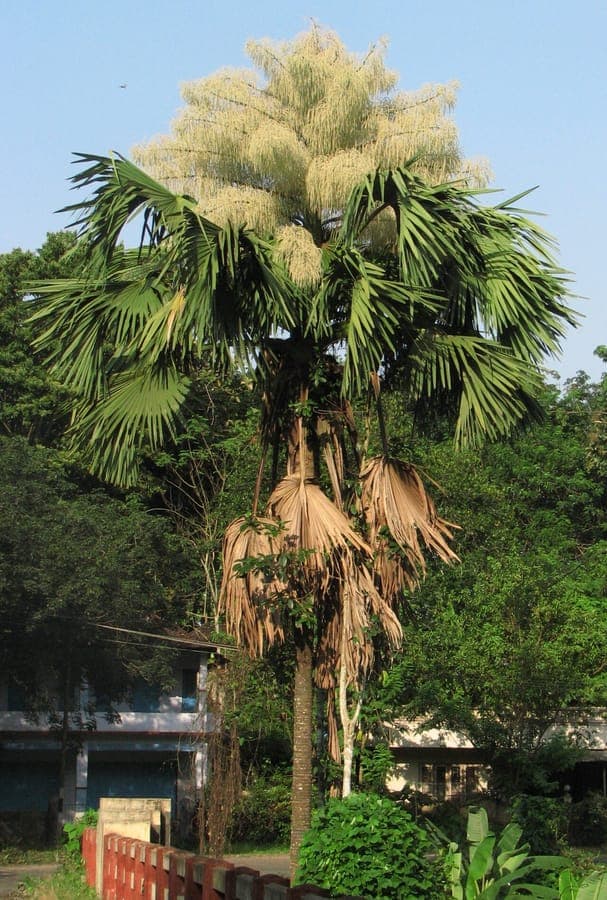
PraveenP / Public domain, via Wikimedia Commons
Corypha umbraculifera: complete guide
Corypha umbraculifera
¿Quieres ver Corypha umbraculifera: complete guide en tu jardín?
1 minuto, sin tarjeta de crédito
Overview
Corypha umbraculifera, commonly known as the Talipot Palm or Umbrella Palm, is one of the world's most spectacular palms from the Arecaceae family. Native to southwestern India and Sri Lanka, this magnificent tree commands attention with its colossal, perfectly umbrella-shaped leaves that can exceed six meters in diameter.
Appearance & Bloom
The Talipot Palm grows as an imposing, unbranched solitary stem reaching impressive heights. Its most distinctive feature is undoubtedly the enormous, deeply lobed leaves that form a complete spherical dome, perfectly justifying the common name. The leaf segments create an intricate geometric pattern when viewed from above. Flowers appear as massive, densely-packed inflorescences, typically after the tree reaches 40-60 years of age.
Ideal Location
The Talipot Palm requires a sunny, spacious location with protection from strong winds. Its enormous size demands considerable space - plant away from buildings and power lines. In temperate climates, this palm is suitable only for heated greenhouses or conservatories.
Soil
Well-draining, fertile soil enriched with organic matter is essential. The ideal pH range is 6.0 to 7.5. Ensure consistent moisture availability without waterlogging.
Diseño gratis
¿Quieres ver Corypha umbraculifera: complete guide en tu jardín? Crea un diseño gratis ahora.
Watering
Maintain consistently moist soil during the growing season without allowing stagnation. Reduce watering during cooler months. Proper drainage is critical to prevent root rot.
Pruning
Remove dead or damaged fronds regularly. Maintain cleanliness by removing older fronds as they deteriorate. Protect the growing bud at the apex, as damage here is fatal. Minimal intervention is preferable.
Maintenance Calendar
Spring: Resume regular watering and fertilizing. Summer: Maintain consistent moisture and warmth. Autumn: Gradually reduce watering. Winter: Minimal watering, maintain warmth above 15 degrees Celsius.
Winter Hardiness
The Talipot Palm is highly frost-sensitive and cannot tolerate temperatures below 15 degrees Celsius. Extended exposure to 10-12 degrees causes damage. In temperate regions, year-round greenhouse cultivation is necessary.
Companion Plants
Underscan with tropical groundcovers like ferns or bromeliads. Surround with smaller tropical trees to create forest-like ambiance while protecting from wind.
Closing Thoughts
The Talipot Palm is an unforgettable showpiece that transforms any tropical setting into a botanical marvel. Its impressive stature and unique form make it the ultimate tropical statement plant. For inspiration on incorporating exotic plants into your space, visit gardenworld.app/en.
¿Quieres ver Corypha umbraculifera: complete guide en tu jardín? Crea un diseño gratis ahora.
Sube una foto, elige un estilo y obtén un diseño fotorrealista con lista de plantas en menos de un minuto.
Más de 10.000 jardines diseñados
Sin tarjeta de crédito


Plantas similares
Needle palm: complete guide
Rhapidophyllum hystrix
Everything about the needle palm: the world's hardiest palm, suitable for gardens in temperate climates down to USDA zone 7b.
Saw palmetto: complete guide
Serenoa repens
A complete guide to saw palmetto (Serenoa repens), the iconic fan palm from Florida and the southeastern United States, prized for its toughness.
Puerto Rican hat palm: complete guide
Sabal causiarum
Grow Puerto Rican hat palm successfully. A majestic fan palm with tropical presence suited to sheltered Mediterranean-style gardens.