
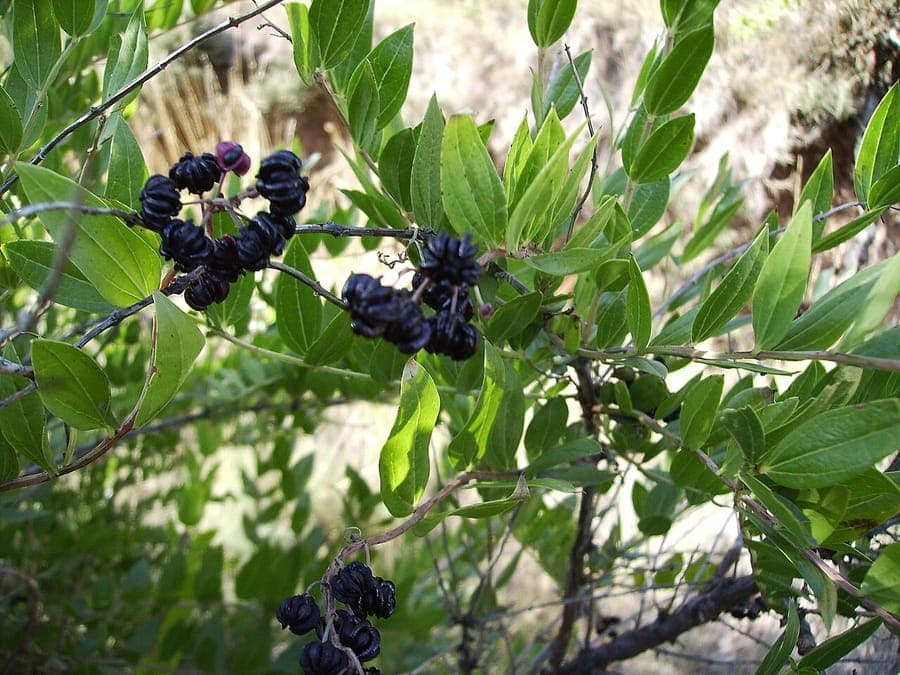
No machine-readable author provided. Victor M. Vicente Selvas assumed (based on copyright claims). / Public domain, via Wikimedia Commons
French sumac: complete guide
Coriaria myrtifolia
¿Quieres ver French sumac: complete guide en tu jardín?
1 minuto, sin tarjeta de crédito
Overview
Coriaria myrtifolia, commonly known as French sumac, tanner's tree, or redoul, is a fascinating Mediterranean shrub from the Coriariaceae family. This plant naturally occurs in the western Mediterranean region, particularly in southern France, Spain, Italy, and North Africa. French sumac is an excellent choice for warm gardens and climates. This distinctive shrub offers not only decorative foliage but also beautiful berries.
Appearance and Bloom
French sumac is a compact shrub that typically reaches 1-2 meters in height and can spread to 1.5 meters wide. The plant has narrow, dark green leaves resembling myrtle, hence the botanical name Myrtifolia. The leaves have fine texture and glossy appearance.
Small green flowers appear from May to July and are not very conspicuous but important for berry production. However, the plant is renowned for its spectacular berries that undergo a fascinating color transformation. After flowering, green fruits form, turning dark red and eventually black in large quantities. These berries persist long on the plant and are highly decorative, providing much interest and bird food.
Ideal Location
French sumac grows best in sunny locations with plenty of direct sunlight. Plant it where it can become warm, ideally against a warm wall or on a sunny slope. The plant tolerates some shade but berry production and form will be significantly better in full sun.
This is an ideal shrub for Mediterranean gardens, steep slopes, sunny borders, and as a specimen plant. It tolerates wind well, making it suitable for coastal gardens.
Soil
French sumac grows in well-draining soils and has a strong preference for dry, stony soils. The plant is extremely drought-tolerant and tolerates poor soils very well. Heavy clay soils can be improved by adding sand or gravel in a ratio of approximately 1 part sand to 2 parts garden soil.
A slightly acidic to neutral soil is ideal, but the plant is not very particular. It also grows in alkaline soils.
Diseño gratis
¿Quieres ver French sumac: complete guide en tu jardín? Crea un diseño gratis ahora.
Watering
Once established, French sumac is very drought-tolerant and requires minimal watering. Young plants need regular water until established. Mature plants can survive long without supplementary water.
During extreme drought, light watering promotes flowering and berry production. Avoid waterlogged conditions absolutely as these damage the plant.
Pruning
French sumac requires minimal pruning and requires little maintenance. You can shape the plant in early spring for more compact growth. Remove dead branches and weak growth. Pruning after flowering can promote formation of a more compact, fuller shrub.
However, it is also beautiful to retain berries for their decorative value and bird food.
Maintenance Calendar
March-April: Spring pruning, preparation for growth May-July: Flowering period, minimal watering August-October: Berry development and ripening, color change November-February: Winter rest, berries remain attractive
Winter Hardiness
Coriaria myrtifolia is hardy to approximately -10 to -15 degrees Celsius. In colder climates, it is better grown in containers that can be brought indoors in winter. In very warm Mediterranean regions it thrives best and can even become larger.
Companion Plants
French sumac forms beautiful combinations with other Mediterranean plants. Combine with lavender, rosemary, santolina, and other drought-tolerant shrubs. The dark berries create lovely contrast with silver foliage and yellow flowers. Plant also with other berry plants.
The berries attract birds in winter providing valuable food.
Conclusion
Coriaria myrtifolia is an excellent choice for Mediterranean gardens and warm climates. The combination of ornamental foliage and decorative berries makes it highly attractive. Request French sumac from garden centers specializing in Mediterranean plants. Gardenworld.app helps you create the perfect design for this plant. Gardenworld.app makes it easy to incorporate Mediterranean plants in your garden design.
¿Quieres ver French sumac: complete guide en tu jardín? Crea un diseño gratis ahora.
Sube una foto, elige un estilo y obtén un diseño fotorrealista con lista de plantas en menos de un minuto.
Más de 10.000 jardines diseñados
Sin tarjeta de crédito


Plantas similares
Acer pycnanthum: complete guide
Acer pycnanthum
Acer pycnanthum, the Japanese swamp maple, is a fast-growing tree with early red flowers and brilliant autumn color, ideal for damp garden settings.
Freeman maple: complete guide
Acer × freemanii
Everything about the Freeman maple (Acer x freemanii): a fast-growing shade tree with spectacular autumn colour for large gardens.
Silver vine: complete guide
Actinidia polygama
Discover silver vine (Actinidia polygama): a hardy climbing plant with silvery foliage, loved by gardeners and cats alike.