
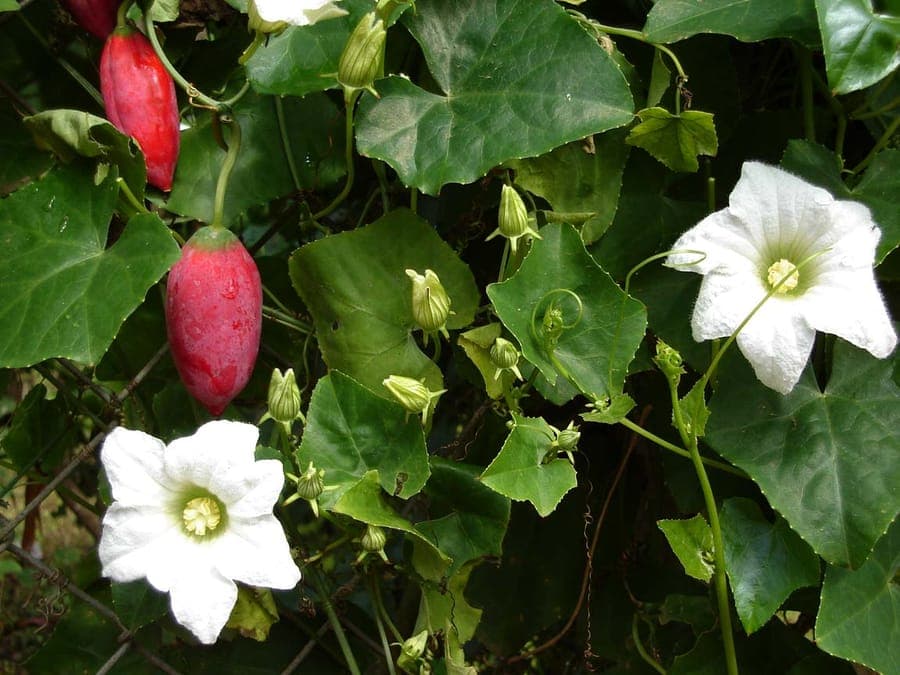
Tauʻolunga / CC BY-SA 3.0, via Wikimedia Commons
Coccinia grandis: complete guide
Coccinia grandis
¿Quieres ver Coccinia grandis: complete guide en tu jardín?
1 minuto, sin tarjeta de crédito
Overview
Coccinia grandis, commonly known as ivy gourd or scarlet gourd, is a fast-growing climber from tropical Africa and Asia. This climbing plant belongs to the Cucurbitaceae family and is grown both for its decorative value and for its nutritious fruits. The plant produces delicate white flowers followed by bright red, edible fruits that mature with size.
In warm climates, Coccinia grandis grows as a perennial climber, while in temperate zones it is grown as a summer annual. The plant can reach up to 3 meters in a single growing season, making it ideal for rapid coverage of trellises and pergolas.
Appearance and Bloom
Coccinia grandis forms a lush canopy of deep, lobed leaves. Each leaf is approximately 5-10 centimeters wide with characteristic indentations. The leaves grow densely along slender, tendril-bearing stems, creating a festive green display.
The flowers are small, white to yellow, approximately 1 centimeter in diameter, and appear in small clusters from early summer onward. They are lightly fragrant and attract pollinators. After pollination, fruits develop rapidly. These are coral to dark red colored, approximately 3-5 centimeters long and oval-shaped. Fresh fruits are light and crisp when eaten raw.
Ideal Location
Coccinia grandis flourishes in full sun. Ensure your plant receives at least 6-8 hours of direct sunlight daily. This promotes abundant growth and fruiting. The plant can also grow in partial shade but will produce fewer fruits.
The climber needs support in the form of a trellis, pergola, or wire. Provide good ventilation to prevent diseases. Avoid windy locations that can damage young growth.
Soil
Coccinia grandis grows well in well-draining, fertile soil rich in organic matter. The plant prefers neutral to slightly acidic terrain (pH 6-7). Add plenty of compost or decomposed plant material before planting.
The soil must remain consistently moist but not waterlogged. Heavy clay soil must be improved with sand and organic material. A 5-centimeter mulch layer helps retain moisture.
Diseño gratis
¿Quieres ver Coccinia grandis: complete guide en tu jardín? Crea un diseño gratis ahora.
Watering
Coccinia grandis is thirsty and requires consistently moist soil, especially during the growing season. Water when the top 2 centimeters of soil feel dry. Regular watering is essential for good fruiting.
During periods of heat and drought, daily watering may be necessary. Under-watering can lead to poor fruiting and leaf drop. Avoid afternoon spraying to prevent diseases.
Pruning
Coccinia grandis requires minimal pruning. Dead or damaged leaves and vines can be removed year-round. To promote neater growth patterns, lateral vines can be shortened after the main harvest.
Pruning certain flowers can redirect energy to fruiting. In cold climates, the plant can be cut back to the main framework at the end of the growing season.
Maintenance Calendar
Spring: Sow seeds in warm conditions. Feed regularly during strong growth. Summer: Watering, monitoring flowering and fruiting. Harvest ripe fruits. Fall: Harvesting continues until first frost. Stop feeding. Winter: In temperate climates plant dies back. Collect seed for next year.
Winter Hardiness
Coccinia grandis is not winter-hardy. It dies back at temperatures below 10 degrees Celsius. In temperate climates it is grown as a summer annual. In tropical and subtropical regions it can persist as a perennial plant. Seeds can be stored for the following season.
Companion Plants
Coccinia grandis combines beautifully with:
- Other climbers: Passiflora, Thunbergia
- Flowering plants: Calendula, Zinnia, Cosmos
- Herbs: Basil, Oregano, Thyme
- Ornamental grasses: Panicum, Miscanthus
Closing Thoughts
Coccinia grandis is a remarkably productive climbing plant for warm seasons. With its elegant growth and nutritious fruits, it adds both beauty and harvest to gardens. For gardeners in temperate climates, the seed can be replanted year after year, while tropical gardeners get a permanent decorative vegetable plant.
Visit gardenworld.app for more ideas. Order seeds today from major retailers and start growing this tasty climbing plant.
¿Quieres ver Coccinia grandis: complete guide en tu jardín? Crea un diseño gratis ahora.
Sube una foto, elige un estilo y obtén un diseño fotorrealista con lista de plantas en menos de un minuto.
Más de 10.000 jardines diseñados
Sin tarjeta de crédito


Plantas similares
Kiwano: complete guide
Cucumis metuliferus
Everything about growing kiwano: location, soil, watering, and harvesting this striking African horned cucumber with spiny orange fruits.
Sponge gourd: complete guide
Luffa aegyptiaca
Full guide to growing sponge gourd (Luffa aegyptiaca): sowing, care, harvesting edible fruits and drying natural loofah sponges in your garden.
Cucumis prophetarum: complete guide
Cucumis prophetarum
Wild cucumber is a fascinating climbing plant with remarkable spiky fruits. Learn how to grow this exotic annual from seed to harvest for decorative interest.