
A. Barra / CC BY 3.0, via Wikimedia Commons
Cistus populifolius (Poplar-leaved Cistus): complete guide
Cistus populifolius
¿Quieres ver Cistus populifolius (Poplar-leaved Cistus): complete guide en tu jardín?
1 minuto, sin tarjeta de crédito
Overview
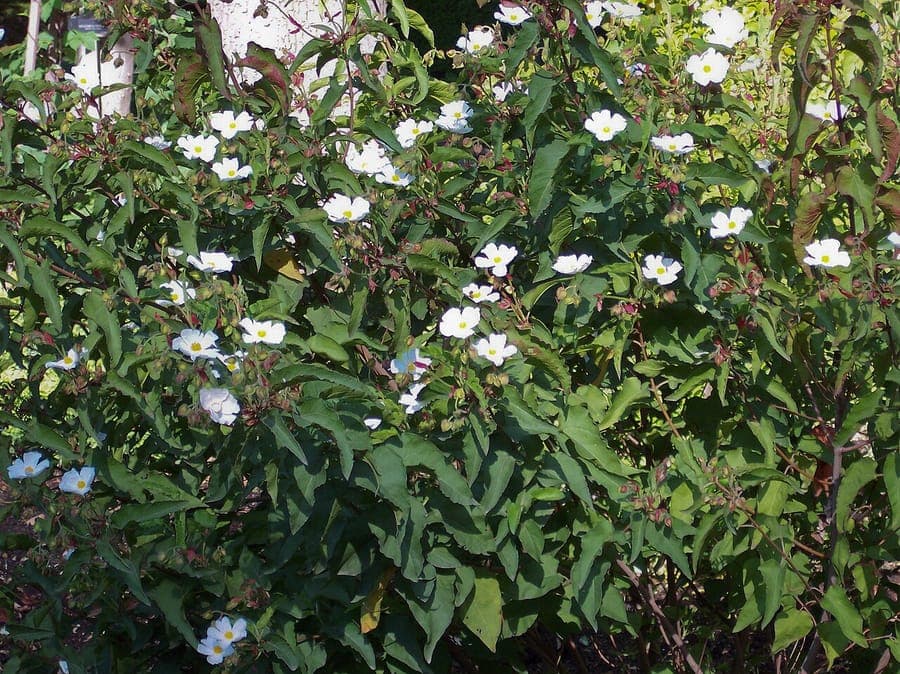
Cistus populifolius, also known as Poplar-leaved Cistus or Poplar-leaved Rockrose, is a beautiful Mediterranean shrub from the Cistaceae family. This plant from Southwestern Europe distinguishes itself through its white flowers with crinkled tissue-paper texture and foliage resembling poplar leaves. With its compact, rounded growth form and drought tolerance, it is ideal for dry, sunny borders.
Appearance and Bloom
Cistus populifolius grows to about 24-40 inches tall and forms a compact, ball-shaped mound. The leaves are elongated with a heart-shaped base and have a slightly glossy surface - they truly look like small poplar leaves. They are dark green on top and lighter green underneath. In spring and early summer (May-June), lovely white flowers appear with tissue-paper-like petals and yellow stamens in the center. Each flower lasts just one day, but the plant continuously produces new flowers over several weeks.
Ideal Location
Cistus populifolius thrives best in very sunny locations. This is a plant for full sun - it needs 6-8 hours of direct sunlight per day. In partial shade it grows but becomes less dense and flowers less profusely. This is not a hardy plant in northern Europe and must therefore be grown in containers or only planted in very mild coastal areas.
Soil
This plant must grow in well-draining, poor soil. Sandy, loamy, or rocky substrate is ideal. Heavy clay is unsuitable - add sand if you have this. The plant prefers sparse nutrients. Moderate feeding makes the plant stronger and flowers better. A pH value between 6 and 7 is optimal, though it also grows in slightly acidic soil.
Watering
Once established, Cistus populifolius is very drought-tolerant. In container culture, water minimally, especially in winter months. Even in dry summers, it doesn't need more than watering thoroughly once every two weeks. Overwatering is more dangerous than underwatering. Ensure the soil dries out between waterings. In ground in very dry locations, it can get by entirely without supplemental water.
Diseño gratis
¿Quieres ver Cistus populifolius (Poplar-leaved Cistus): complete guide en tu jardín? Crea un diseño gratis ahora.
Pruning
Minimal maintenance. Don't prune the plant too much - it stays naturally compact. After blooming (June-July), you can remove some faded flowers, but this isn't essential. A yearly, light shaping in spring helps maintain form, but don't prune hard.
Maintenance Calendar
Spring (March-May): Check plant for frost damage, light shaping, start watering Summer (June-July): Blooming in full swing, minimal water, very ornamental Autumn (August-October): Plant becomes dormant, don't fertilize, reduce water Winter (November-February): Frost protection needed in containers, virtually no water
Winter Hardiness
Cistus populifolius is NOT hardy in northern Europe. This is a plant for Mediterranean climates. It's only a plant for very mild coastal areas if grown in ground. Make sure to grow this plant in containers in sunny, protected locations against walls. In winter, provide protection with burlap. Freezing can be damaging.
Companion Plants
In containers, combine this well with other Mediterranean, drought-tolerant plants. Think of lavender, sage, thyme, or artemisia. For contrast, you can add some gray sage. The white flowers work well with purple lavenders.
Closing Thoughts
Cistus populifolius is a true Mediterranean beauty for northern European gardens in container culture. With its white tissue-paper flowers, pleasantly fragrant foliage, and minimal water needs, it is an excellent choice for dry, sunny spots. Grow in large terracotta pots for an authentic Mediterranean effect. Find this plant at specialty Mediterranean plant nurseries.
Online you can design your garden with Mediterranean plant species via gardenworld.app!
¿Quieres ver Cistus populifolius (Poplar-leaved Cistus): complete guide en tu jardín? Crea un diseño gratis ahora.
Sube una foto, elige un estilo y obtén un diseño fotorrealista con lista de plantas en menos de un minuto.
Más de 10.000 jardines diseñados
Sin tarjeta de crédito


Plantas similares
Curled-leaf rock rose: complete guide
Cistus crispus
Everything you need to grow Cistus crispus, the curled-leaf rock rose from the western Mediterranean. Siting, soil, pruning, and winter care fully explained.
Marjoram-leaved sun rose: complete guide
Helianthemum marifolium
Everything about Helianthemum marifolium, the marjoram-leaved sun rose: location, dry soil, flowering season and care for this Mediterranean rock plant in your garden.
Beach-heath: complete guide
Hudsonia tomentosa
Complete guide to Hudsonia tomentosa: growing this woolly sand-heath on poor sandy soils, its care needs, companions and garden uses.