
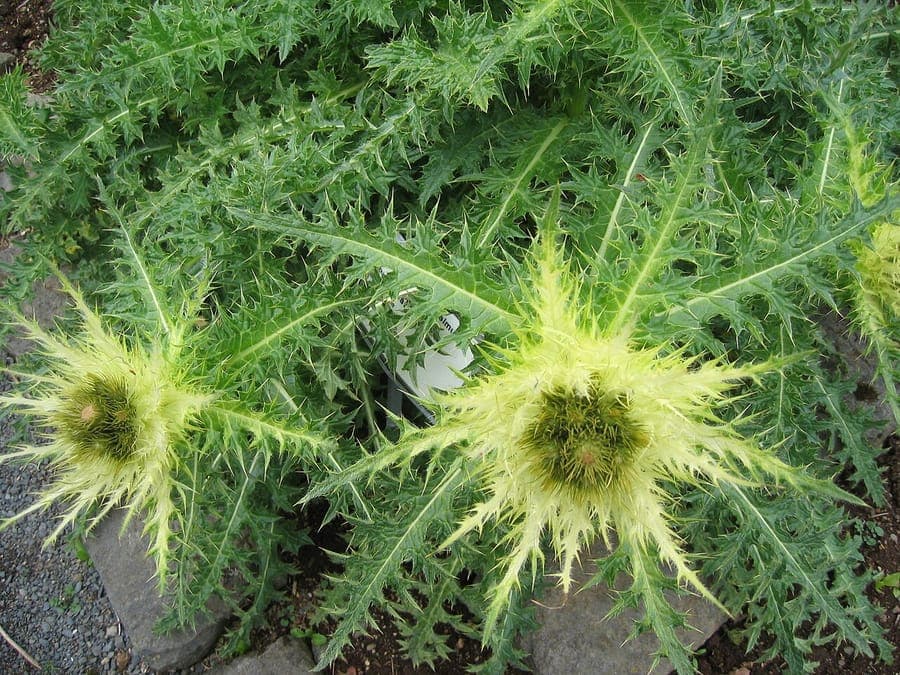
Salvör Gissurardóttir / Public domain, via Wikimedia Commons
Cirsium spinosissimum: complete guide
Cirsium spinosissimum
¿Quieres ver Cirsium spinosissimum: complete guide en tu jardín?
1 minuto, sin tarjeta de crédito
Overview
Cirsium spinosissimum, commonly known as Spiny Thistle or Alpine Thistle, is a striking wildflower native to the mountain regions of Central Europe. Belonging to the Asteraceae family (daisy family), this plant is renowned for its extremely thorny foliage and stunning purple flowers that attract numerous insects and birds.
As a native alpine plant of the Alps and surrounding mountain areas, this thistle is perfectly adapted to cool, well-drained terrain. In gardens, it is increasingly used in natural mountain gardens, wild borders, and for erosion control on slopes, because it develops deep roots and improves soil quality.
Appearance and Bloom
Cirsium spinosissimum forms a dense rosette of leaves in the first year, with extremely thorny foliage reaching up to 30 cm long. The leaves are highly pointed with fine thorns along all edges. In the second year, an upright, unbranched stem emerges reaching 30-80 cm tall.
Flowers appear July to August in magnificent purple-pink to deep purple colors. The flowers grow in dense heads at the stem tip reaching 2 cm wide. After flowering, seed pods develop providing valuable bird food and wind dispersal.
Ideal Location
Cirsium spinosissimum thrives in full sun. A location receiving at least 7-8 hours of direct sunlight daily produces rich flowering and compact growth. In shadier spots, the plant still grows but becomes less compact and produces fewer flowers.
The plant tolerates windy locations well and can even thrive on very exposed mountain terrain. This makes it ideal for rooftop gardens or other ventilated garden spaces. Avoid full shade and damp valleys.
Soil
Cirsium spinosissimum makes high demands on drainage and prefers lean soils. The plant grows best in well-drained, moderately nutrient-poor soil. Heavy clay soils or wet soils should be avoided as they cause root rot.
The plant tolerates acidic to neutral soil readily and even grows on very poor soils. For a good root system, some sand or gravel can be added. A pH of 6.0-7.5 is ideal, but the plant tolerates outside this range.
Watering
After planting, young plants require regular watering until well-established (4-6 weeks). Once established, Cirsium spinosissimum is extremely drought-tolerant thanks to its deep root system. In wet regions, the plant typically requires no supplemental watering.
Ensure water does not pool around the plant as this causes root rot. During very dry summers, some water can help, but this is usually unnecessary. The plant is ideal for dry mountain terrain.
Diseño gratis
¿Quieres ver Cirsium spinosissimum: complete guide en tu jardín? Crea un diseño gratis ahora.
Pruning
Cirsium spinosissimum is a biennial plant requiring minimal pruning. In the first year, the plant forms only leaves. After flowering in the second year, the plant naturally disappears.
If you desire self-seeding, allow some faded flowers to produce seed. Otherwise, deadhead faded flowers to prevent self-seeding. The extremely thorny foliage requires care when pruning; always wear gloves.
Maintenance Calendar
May-June: Seedlings grow rapidly. Check moisture supply. July-August: Flowering period. Peak season. September-October: Seed formation. Leave faded flowers for birds. November-December: Plants die back or go dormant. January-March: Minimal activity. New seedlings may emerge. April-May: Plants grow at full speed.
Winter Hardiness
Cirsium spinosissimum is extremely hardy, tolerating temperatures to -30 to -35 degrees Celsius. This is a perfect mountain plant for harsh winter conditions. Thorny foliage provides frost protection.
Young seedlings can overwinter in their first year and will flower the following year. In mild winters, the plant may return as a short-lived perennial.
Companion Plants
Cirsium spinosissimum works well in combination with other alpine mountain plants. Good planting combinations include:
Edelweis (Leontopodium) - both alpine with similar bloom time. Gentiana (Gentian) - for blue flower contrast. Pulsatilla (Anemone) - for early spring bloom. Achillea (Yarrow) - for yellow flowers. Artemisia (Wormwood) - for silvery foliage contrast.
Use this thistle in groups of 3-5 for maximum effect.
Closing
Cirsium spinosissimum is a unique wildflower offering considerable appeal to insects and birds. The striking purple flowers, extremely thorny foliage, and long-lasting seed provision make this a perfect plant for natural mountain gardens. This is a true alpine beauty requiring little maintenance.
Available from specialized seed suppliers and alpine plant nurseries, this Alpine Thistle will transform your garden with wild beauty. If you seek a true mountain plant attracting pollinators and providing bird food, Cirsium spinosissimum is an excellent choice.
Visit gardenworld.app for more plant tips and designs. When you want to transform your mountain or natural garden with authentic alpine plants, gardenworld.app offers inspiration and guidance.
¿Quieres ver Cirsium spinosissimum: complete guide en tu jardín? Crea un diseño gratis ahora.
Sube una foto, elige un estilo y obtén un diseño fotorrealista con lista de plantas en menos de un minuto.
Más de 10.000 jardines diseñados
Sin tarjeta de crédito


Plantas similares
Calendula stellata: complete guide
Calendula stellata
Complete guide to Calendula stellata, the star-flowered marigold from Sicily: location, soil, watering and companion planting tips.
Korean chrysanthemum: complete guide
Chrysanthemum x rubellum
Chrysanthemum x rubellum is a hardy autumn perennial with single pink to copper flowers from August to November. Care and combinations.
Helianthus divaricatus: complete guide
Helianthus divaricatus
Helianthus divaricatus is a North American woodland sunflower with yellow summer blooms, ideal for naturalistic borders and shady edges.