
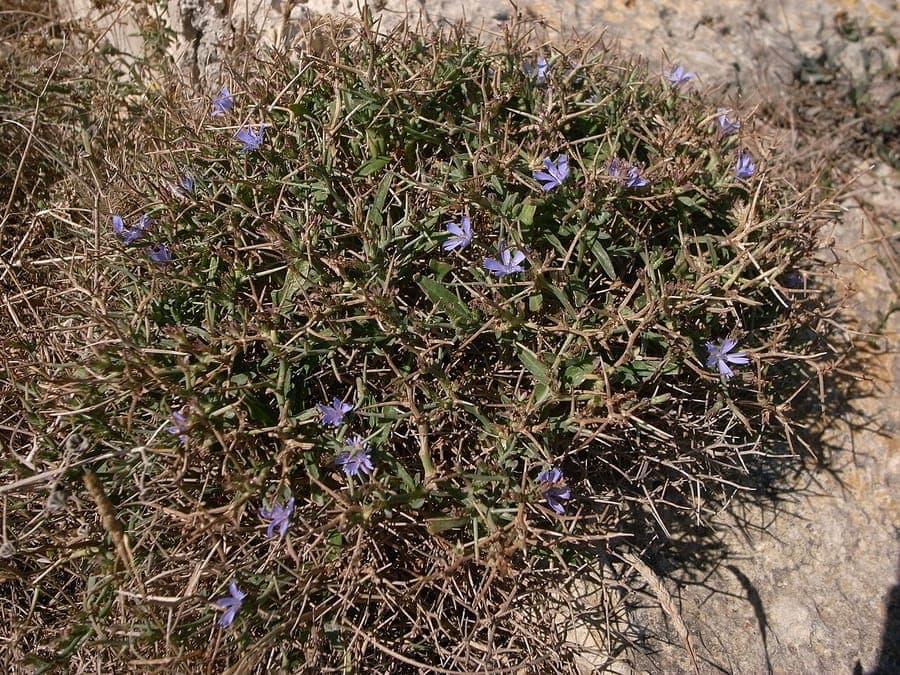
Denis Barthel (talk) / CC BY-SA 3.0, via Wikimedia Commons
Cichorium spinosum (Spiny Chicory): complete guide
Cichorium spinosum
¿Quieres ver Cichorium spinosum (Spiny Chicory): complete guide en tu jardín?
1 minuto, sin tarjeta de crédito
Overview
Cichorium spinosum, known as Spiny Chicory, is an attractive Mediterranean plant from the Asteraceae (Daisy) family. This plant from the Mediterranean region distinguishes itself through its spiny foliage and delicate blue flowers. With its compact growth and drought tolerance, it is perfect for dry, sunny gardens.
Appearance and Bloom
The plant grows to about 12-20 inches tall and forms a compact, somewhat ball-shaped clump. The foliage is fine and finely branched, with characteristic small spines along the margins - hence the name "spinosum" (spiny). The leaves have a gray-green to olive-green color. In spring and early summer (April-June), beautiful blue flowers appear on delicate stalks. These flowers are about 0.4-0.8 inches across and form excellent nectar sources for wild bees.
Ideal Location
Cichorium spinosum thrives best in very sunny locations. This is not a plant for shade - it needs a minimum of six to eight hours of sun per day. In warm, dry Mediterranean climates, it can even withstand full, intense sun during the hottest part of the day. The plant is not frost-hardy in harsh winters and must therefore be grown in containers, or only in very mild regions in the ground.
Soil
Very important: this plant must grow in well-draining soil. Sandy, loamy, or rocky substrate is ideal. Heavy clay is absolutely unsuitable - add sand and gravel if you have heavy loam. The plant prefers poor, nutrient-poor soils and actually grows better in lean ground. No rich compost needed! pH value doesn't matter much; both acidic and alkaline work.
Watering
Once established, Cichorium spinosum is very drought-tolerant. In fact, problems usually occur with too much water rather than too little. In container culture, water minimally, especially in winter months. In wet seasons, you can go several weeks without water. Even in dry summers, you don't need to water more than once every two weeks. In ground in very dry locations, you can get by entirely without supplemental water.
Diseño gratis
¿Quieres ver Cichorium spinosum (Spiny Chicory): complete guide en tu jardín? Crea un diseño gratis ahora.
Pruning
Minimal maintenance needed. Don't prune the plant too much - it stays naturally compact and ball-shaped. After blooming (June-July), you can remove faded flowers, but this isn't essential. In spring, you can roughly check the plant and remove dead branches, but not much more is needed.
Maintenance Calendar
Spring (March-May): Check plant for frost damage, start feeding when growth begins, water minimally Summer (June-August): Minimal water, blooming ends toward late June, very little care needed Autumn (September-October): Plant becomes dormant, don't fertilize, very little water Winter (November-February): Frost protection needed in containers, virtually no water, protection against frost
Winter Hardiness
Cichorium spinosum is NOT frost-hardy in northern Europe! This is a Mediterranean climate plant. Even mild winters can be harmful. Make sure to grow this plant in containers in sunny, protected locations against walls. In winter, provide protection with burlap or glass cloches. Only in very mild coastal areas might it be able to overwinter outside.
Companion Plants
In containers, combine this well with other Mediterranean, drought-tolerant plants. Think of lavender, sage, thyme, or artemisia. For contrast, you can add some gray-green sedges. Don't combine with moisture-loving plants - they have totally different needs.
Closing Thoughts
Cichorium spinosum is a true Mediterranean rarity for northern European gardens. With its spiny foliage, delicate blue flowers, and low water requirements, it is an excellent choice for dry, sunny container culture. In mild winter areas, it can also grow in the ground. Grow in pots for flexibility! Find this plant at specialty nurseries and Mediterranean plant specialists.
Online you can design your garden with Mediterranean plant species via gardenworld.app!
¿Quieres ver Cichorium spinosum (Spiny Chicory): complete guide en tu jardín? Crea un diseño gratis ahora.
Sube una foto, elige un estilo y obtén un diseño fotorrealista con lista de plantas en menos de un minuto.
Más de 10.000 jardines diseñados
Sin tarjeta de crédito


Plantas similares
Calendula stellata: complete guide
Calendula stellata
Complete guide to Calendula stellata, the star-flowered marigold from Sicily: location, soil, watering and companion planting tips.
Korean chrysanthemum: complete guide
Chrysanthemum x rubellum
Chrysanthemum x rubellum is a hardy autumn perennial with single pink to copper flowers from August to November. Care and combinations.
Helianthus divaricatus: complete guide
Helianthus divaricatus
Helianthus divaricatus is a North American woodland sunflower with yellow summer blooms, ideal for naturalistic borders and shady edges.