
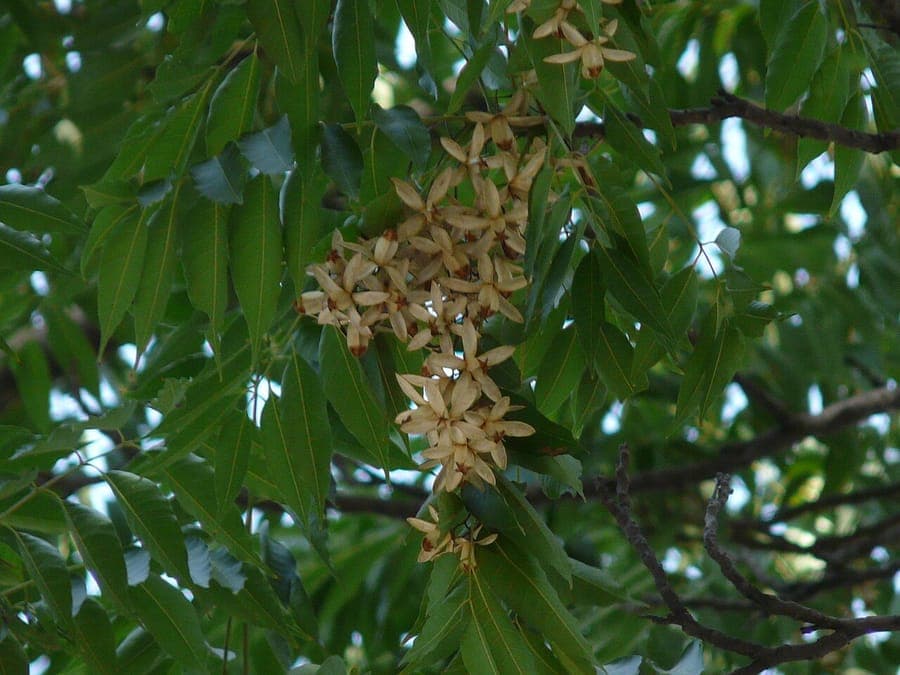
Dinesh Valke from Thane, India / CC BY-SA 2.0, via Wikimedia Commons
Chukrasia tabularis: complete guide
Chukrasia tabularis
¿Quieres ver Chukrasia tabularis: complete guide en tu jardín?
1 minuto, sin tarjeta de crédito
Overview
Chukrasia tabularis, commonly known as Burmese almondwood or East Indian mahogany, is a majestic tree native to the tropical forests of the Indian subcontinent and Southeast Asia. This impressive specimen is renowned for its durable hardwood and is locally valued for its versatile applications. In temperate climates, this tree can only be successfully cultivated in greenhouse conditions or very mild zones.
The tree occurs naturally in the mountain regions of Assam, Bangladesh, and throughout southern China. Chukrasia tabularis belongs to the Meliaceae family, the same family as mahogany, and shares many characteristics with other tropical hardwoods.
At GardenWorld, we recommend tropical trees primarily as greenhouse or indoor plants for temperate regions. This is not suitable for outdoor growing in the UK, Germany, or northern Europe.
Appearance and bloom
Chukrasia tabularis grows into a large tree reaching 20-30 meters in height with a slender, columnar crown. The bark is striking red-brown to grey, with vertical fissures that characterize the heartwood. The leaves are compound (pinnate) and create an airy, tropical appearance.
Flowers are small, yellowish-green florets arranged in panicles. The flowering period is not well documented for cultivars, but in the wild the tree typically blooms in spring. The fruits are distinctive woody seed capsules with characteristic splitting patterns.
In tropical environments, this tree grows relatively quickly. Winter buds are inconspicuous, since the tree is tropical and does not experience a true winter dormancy.
Ideal location
Chukrasia tabularis requires full sun to thrive. In tropical environments, it grows in open forest or agricultural settings. For greenhouse or conservatory cultivation:
Choose a warm location with abundant light. South- or west-facing windows are ideal. The tree will suffer if light levels are inadequate.
In greenhouse cultivation, ventilation is crucial. A constant warm temperature of at least 18-20 degrees Celsius is essential.
This is absolutely not a suitable outdoor tree for temperate climates. Protection from frost is critical - any frost will be damaging.
Soil
In its natural habitat, Chukrasia tabularis grows in fertile, well-drained soils in mountain forests. For container cultivation we recommend:
Use a high-quality potting mix with substantial organic material. A blend of coir, peat, and coarse perlite works well. Ensure excellent drainage - waterlogging must be avoided at all costs.
The tree tolerates a pH between neutral and slightly acidic (pH 6.0-7.0). Regular feeding during the growing season supports healthy development.
For outdoor cultivation (not recommended): sandy to clay soils with good drainage are best.
Diseño gratis
¿Quieres ver Chukrasia tabularis: complete guide en tu jardín? Crea un diseño gratis ahora.
Watering
During the growing season (spring through summer), this tree requires regular watering. The potting mix should not dry out completely, but must never become waterlogged. Water when the top 2-3 cm of soil feels dry.
In winter, water requirements are lower. Allow the potting mix to dry slightly between waterings, but never let the plant completely desiccate.
In greenhouse or indoor cultivation: maintain a consistent humidity level of around 60-70%. This helps prevent disease and supports healthy growth.
Regular misting, especially in dry indoor spaces or during warm periods, is beneficial.
Pruning
Pruning is not essential but can be useful for shaping. This tree can be trained as a single trunk or multi-stemmed specimen.
Remove any dead or damaged branches as soon as you notice them. This stimulates new growth and maintains plant health. Major pruning operations are best performed at the end of winter or early spring.
In a greenhouse setting, you can prune regularly to keep the size manageable and encourage a full, attractive form.
As a precaution: pruning wounds can be sealed with tree wound dressing, though this is not always necessary.
Maintenance calendar
Spring: Inspect regularly for pest insects (particularly thrips and spider mites). Late spring: Begin regular watering and feeding schedule. Summer: Increase watering frequency, monitor regularly for disease. Autumn: Gradually reduce watering. Winter: Minimal watering, no feeding. Ensure adequate heat and light.
Winter hardiness
Chukrasia tabularis is absolutely not winter hardy. It is extremely sensitive to frost and temperatures below 10 degrees Celsius. This tree must always remain in a heated greenhouse or indoors.
In tropical and subtropical zones (USDA zones 11-12) it may be possible to grow this outdoors with frost protection.
For the UK, Germany, and all temperate regions: this is unsuitable for outdoor cultivation.
Companion plants
No traditional companion plants are recommended, as this is primarily a greenhouse tree. However, in greenhouse settings you can combine it with other tropical plants requiring similar conditions: other Meliaceae species, begonias, or select orchids.
Closing
Chukrasia tabularis is a fascinating tropical tree with significant potential for exotic plant enthusiasts. In the UK and northern Europe it can only be successfully cultivated as a greenhouse or houseplant. The investment in proper growing conditions is rewarding for those who wish to experience this remarkable specimen.
We recommend contacting specialized nurseries for young plants. General garden centers rarely stock tropical seedlings, and information about this specific species is uncommon in mainstream retail.
¿Quieres ver Chukrasia tabularis: complete guide en tu jardín? Crea un diseño gratis ahora.
Sube una foto, elige un estilo y obtén un diseño fotorrealista con lista de plantas en menos de un minuto.
Más de 10.000 jardines diseñados
Sin tarjeta de crédito


Plantas similares
Muskwood: complete guide
Guarea guidonia
Everything about muskwood (Guarea guidonia): tropical origins, appearance, cultivation in conservatories and warm gardens, care and companions.
Trichilia dregeana: complete guide
Trichilia dregeana
Trichilia dregeana is an African tree with beautiful foliage and striking flowers. Learn how to care for this exotic plant in your garden.
Swietenia macrophylla: complete guide
Swietenia macrophylla
Discover Honduran mahogany - a tropical timber tree with architectural beauty. Growing requirements, care guide and sustainability for warm climates.