
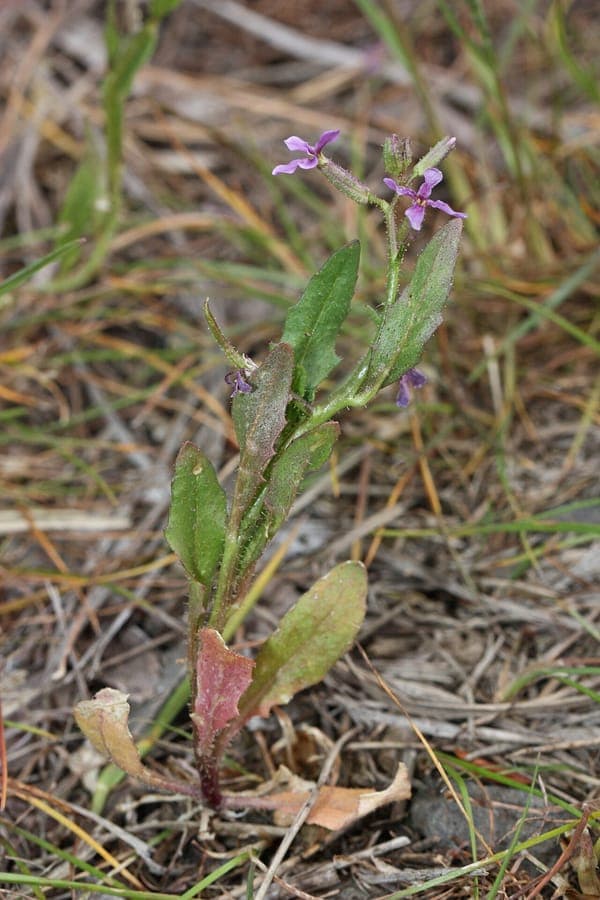
Walter Siegmund (talk) / CC BY-SA 3.0, via Wikimedia Commons
Blue mustard: complete guide
Chorispora tenella
¿Quieres ver Blue mustard: complete guide en tu jardín?
1 minuto, sin tarjeta de crédito
Overview
Chorispora tenella, popularly known as blue mustard, musk mustard or chicken weed, is an annual to short-lived herbaceous plant from the Brassicaceae family originating in Central Asia and Eastern Europe with preference for open terrain naturally. This plant reaches 30-60 centimeters tall and blooms April to June with small purple to pink flowers in dense racemes. After blooming, characteristic upright pod-like seed capsules of 2-5 centimeters develop becoming highly ornamental and attracting birds substantially. The plant grows rapidly, self-seeds and can become invasive in some regions without management control.
Appearance and bloom
Blue mustard is a delicate growing plant with slender greenish stems and finely fragmented, somewhat grayish leaves in basal rosettes. Flowers are small but numerous, approximately 0.5 centimeters across, purple, pink or white shaded hues in dense clusters. After blooming, long upright seed pods of 2-5 centimeters length develop becoming highly ornamental and attracting birds substantially. The plant dies completely at season end entirely.
Ideal location
Choose sunny to partially shaded position with good moisture level for optimal growth. The plant thrives in open, airy locations with adequate light extensively. Full sun works best for dense blooming abundance. The plant is not fussy about location as long as soil is not chronically waterlogged. In warm years, the plant grows vigorously producing significantly more seed.
Soil
Chorispora tenella is highly adaptable to various soil types successfully. Sandy loam, clay to heavy soils are all acceptable well. Good drainage is however preferred for disease-free growth. The plant grows even in poor, neglected soil without serious problem. Neutral to slightly acidic pH is acceptable universally. For garden cultivation, no special soil preparation is needed specifically.
Diseño gratis
¿Quieres ver Blue mustard: complete guide en tu jardín? Crea un diseño gratis ahora.
Watering
Moderate water requirements overall. In dry periods, regular watering helps promote growth substantially, but the plant tolerates drought reasonably well. Waterlogging must be avoided absolutely. Rainwater is sufficient in most Dutch seasons normally. Rarely will supplemental irrigation be needed chronically.
Pruning
Minimal maintenance. The plant needs no pruning normally, but removing dead flowers promotes continued blooming clearly. Leave seed pods to feed birds and for self-seeding next year. If the plant becomes too large, it can be entirely removed without serious harm.
Maintenance calendar
Spring: Plant blooms April to May period. Regular watering helps growth substantially. Check nutrient needs. Summer: Seed pod stages develop. Let seed capsules ripen completely. Water less frequently after seed formation. Autumn: Seed disperses naturally wild. Plant dies back. Later flowering blooms may appear. Winter: Plant is finished entirely. Surface seeds may overwinter for next spring.
Winter hardiness
Chorispora tenella is an annual to short-lived plant in the Netherlands standard. The plant blooms as annual in spring and dies in summer quickly. Seed can overwinter in soil and germinate next spring automatically. The plant is not winter hardy in the sense of persistent growth long-term.
Companion plants
Chorispora tenella combines with other wildflowers: Wild mustard species for color contrast effects Flower bulbs like Tulipa simplex for foreground Perennial grasses like Stipa pennata for structure Poppy varieties for contrast
Intratuin and Gamma occasionally offer blue mustard seed. Online seed companies have available seed packets. Gardenworld.app advises on wildflower gardens extensively. Gardenworld.app helps plan flower timing for continuous bloom.
Closing
Blue mustard is a charming annual plant for gardeners wanting wildflower effects authentically. The rapid growth, beautiful purple flowers and ornamental seed capsules make it a bird-friendly choice. In warm years it can become invasive, so caution is recommended.
¿Quieres ver Blue mustard: complete guide en tu jardín? Crea un diseño gratis ahora.
Sube una foto, elige un estilo y obtén un diseño fotorrealista con lista de plantas en menos de un minuto.
Más de 10.000 jardines diseñados
Sin tarjeta de crédito


Plantas similares
Brassica cretica: complete guide
Brassica cretica
Brassica cretica, the Cretan cabbage, grows wild on Aegean cliffs. Discover how to grow this drought-tolerant, yellow-flowered Mediterranean perennial.
Corsican cabbage: complete guide
Brassica insularis
Corsican cabbage is a rare Mediterranean rock cabbage with white flowers and blue-green leaves. Location, soil and winter protection.
Prostrate cabbage: complete guide
Brassica procumbens
Prostrate cabbage is a creeping North African cliff plant with yellow flowers. Discover location, soil type and winter protection.