
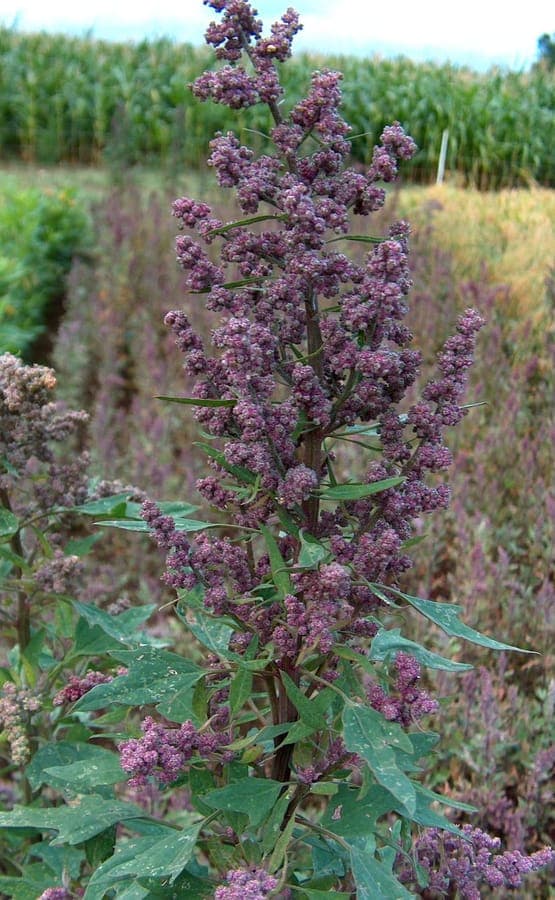
User:MarkusHagenlocher / CC BY-SA 3.0, via Wikimedia Commons
Chenopodium quinoa: complete guide
Chenopodium quinoa
¿Quieres ver Chenopodium quinoa: complete guide en tu jardín?
1 minuto, sin tarjeta de crédito
Overview
Chenopodium quinoa, better known as quinoa, is a nutritious grain crop with a rich history in Andean culinary culture. This plant was cultivated for centuries in Peru, Bolivia, and Ecuador as a staple food. In the past two decades, quinoa has gained popularity as a gluten-free superfood.
The plant is relatively easy to grow and can be cultivated even in temperate climates. It grows best in well-drained soil with minimal intervention. This makes it perfect for self-sufficient gardeners.
Appearance and bloom
Chenopodium quinoa grows to a height of 0.5 to 1.5 metres with an upright, much-branched structure. The leaves are green to red-purple, triangular-oval, and can be up to 8 cm long. They have a characteristic powdery coating on the surface.
The flowers are small and inconspicuous, blooming in August and September. They grow in dense, pyramidal flower clusters. The real attraction is the large, colourful seed heads in red, orange, yellow, white or black. These seed heads are what we harvest and eat.
Ideal location
Chenopodium quinoa grows best in full sun. Ensure the plant receives at least 6-8 hours of direct sunlight daily. The plant can tolerate partial shade, but yields will be lower. The plant grows well in open locations with good air circulation.
Soil
Chenopodium quinoa grows in well-drained soil. The plant is not very fussy and can grow in moderate to nutrient-rich soil. A pH of 6.0 to 8.5 is acceptable. Ensure you prepare the soil by working in compost. Good drainage is essential.
Diseño gratis
¿Quieres ver Chenopodium quinoa: complete guide en tu jardín? Crea un diseño gratis ahora.
Watering
Chenopodium quinoa is a fairly drought-tolerant plant. Ensure the plant receives regular water, especially during early growth. Water approximately 1-2 times per week. Excessive moisture can lead to fungal problems.
Pruning
Chenopodium quinoa requires no pruning. The plant naturally grows into a nice shape. You can remove some lower leaves when they wilt or become damaged.
Maintenance calendar
April: Sow seeds directly in the ground. May-June: Thin seedlings to 30 cm apart. Water regularly. July-August: Flowering. Adjust feeding if needed. September-October: Seed setting. Ensure moisture balance. November: Harvest when seed heads are dark and dry.
Winter hardiness
Chenopodium quinoa is not winter hardy. It is an annual plant that cannot tolerate frost temperatures. Harvesting must take place before the first frost. In temperate climates, the plants will die after the first frost.
Companion plants
Phaseolus, Solanum, Capsicum, Cucurbita and Amaranthus grow well with quinoa. These crops share the same preference for warmth and sun.
Closing
Chenopodium quinoa is a nutritious, interesting crop to grow in your own garden. With minimal intervention and good position in full sun, the plant will produce a full harvest of nutritious seed. This seed can be cooked as a grain porridge or ground into flour. It is a valuable food that no health-conscious home garden should be without. Find more information at gardenworld.app. Garden centres have quinoa seeds available.
¿Quieres ver Chenopodium quinoa: complete guide en tu jardín? Crea un diseño gratis ahora.
Sube una foto, elige un estilo y obtén un diseño fotorrealista con lista de plantas en menos de un minuto.
Más de 10.000 jardines diseñados
Sin tarjeta de crédito


Plantas similares
Bassia laniflora (woolly summer-cypress): complete guide
Bassia laniflora
Full guide to Bassia laniflora: origin, appearance, ideal location, soil, watering and care for this drought-tolerant annual.
Suaeda spicata: complete guide
Suaeda spicata
Everything about Suaeda spicata (spiked seablite): a rare salt-tolerant coastal succulent from the western Mediterranean and Macaronesia.
California amaranth: complete guide
Amaranthus californicus
Full guide to California amaranth (Amaranthus californicus): growing tips, ideal location, soil needs, watering, and garden design ideas.