
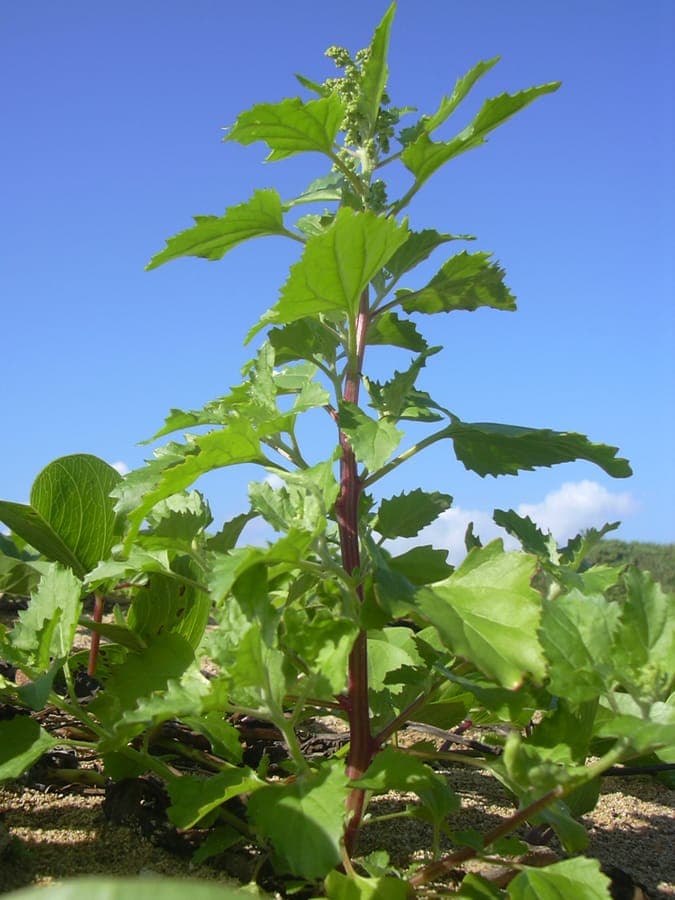
Forest & Kim Starr / CC BY 3.0, via Wikimedia Commons
Chenopodiastrum murale: complete guide
Chenopodiastrum murale
¿Quieres ver Chenopodiastrum murale: complete guide en tu jardín?
1 minuto, sin tarjeta de crédito
Overview
Chenopodiastrum murale, commonly known as nettleleaf goosefoot or wall goosefoot, is a robust annual herb from the Amaranthaceae family. This widely distributed plant grows from the Mediterranean to Northeast Tropical Africa and Sri Lanka. With its strikingly veined leaves and sturdy growth, it's ideal for difficult growing spots like walls, paving, and wastelands.
Appearance & Bloom Cycle
This annual reaches 20–60 cm in height with a spreading growth pattern. The leaves are characteristically rhomboid to triangular with serrated, nettle-like appearance, hence the name. The foliage shows sharp green veining against a lighter green background. The stems are red or green with robust growth. The flowers are tiny, greenish in dense, upright to spreading spikes from July to October.
Ideal Location
Chenopodiastrum murale grows almost anywhere but thrives best in full sun to partial shade on wasteland, walls, paving, and hard-surfaced terrain. It tolerates extremely neglected spots where other plants struggle. Ideal for spontaneous vegetation between tiles and at wall bases. Plant along path sides and in wild corners.
Soil Requirements
This plant grows on virtually all soils - sand, silt, clay, gravel, lots of stones. It prefers alkaline soil (pH 7.0–8.5) but accepts acidic ground. Very lean soils, even contaminated soils are no problem. Drainage is preferred but not critical - the plant grows even in compacted soils.
Diseño gratis
¿Quieres ver Chenopodiastrum murale: complete guide en tu jardín? Crea un diseño gratis ahora.
Watering
Minimal water needed - once established, it thrives without guidance. Water young plants until rooted but then minimal care is needed. In extremely dry summers, water for better growth. This plant tolerates waterlogging poorly in very wet winters but otherwise handles neglect well.
Pruning
No pruning needed - this is an annual that determines its own form. Let it grow naturally for maximum bird food. When seed dispersal is unwanted: pull out for prevention. Toward season's end (October–November) remove plant debris.
Maintenance Calendar
- April–June: Allow seedlings to grow from natural seed production last year
- July–September: Water only in extreme drought, monitor for pests
- October: Seed production complete - leave for birds
- November–March: Plant dead, wasteland prepares for new season
Winter Hardiness
Not winter-hardy - this is purely annual. It grows only from April to October. Seed survives cold winters fairly easily outdoors to germinate next spring. Perfect for annual seed production and cycle change.
Companion Plants
Wall goosefoot grows well with other wall plants like Cymbalaria muralis (ivy-leaved toadflax) and Linaria cymbalaria. Also good with other annuals in wasteland: Chenopodium album, Amaranthus retroflexus. For bird food, combine with Stellaria media (chickweed) and other bird plants.
Closing
Wall goosefoot is a robust pioneer in neglected garden corners. With its minimal requirements, resilience, and value as bird food, it offers ecological support. For more inspiration on tough growers and wasteland vegetation: consult gardenworld.app. Plant this robust species for natural, low-maintenance gardens via gardenworld.app.
¿Quieres ver Chenopodiastrum murale: complete guide en tu jardín? Crea un diseño gratis ahora.
Sube una foto, elige un estilo y obtén un diseño fotorrealista con lista de plantas en menos de un minuto.
Más de 10.000 jardines diseñados
Sin tarjeta de crédito


Plantas similares
Bassia laniflora (woolly summer-cypress): complete guide
Bassia laniflora
Full guide to Bassia laniflora: origin, appearance, ideal location, soil, watering and care for this drought-tolerant annual.
Suaeda spicata: complete guide
Suaeda spicata
Everything about Suaeda spicata (spiked seablite): a rare salt-tolerant coastal succulent from the western Mediterranean and Macaronesia.
California amaranth: complete guide
Amaranthus californicus
Full guide to California amaranth (Amaranthus californicus): growing tips, ideal location, soil needs, watering, and garden design ideas.