
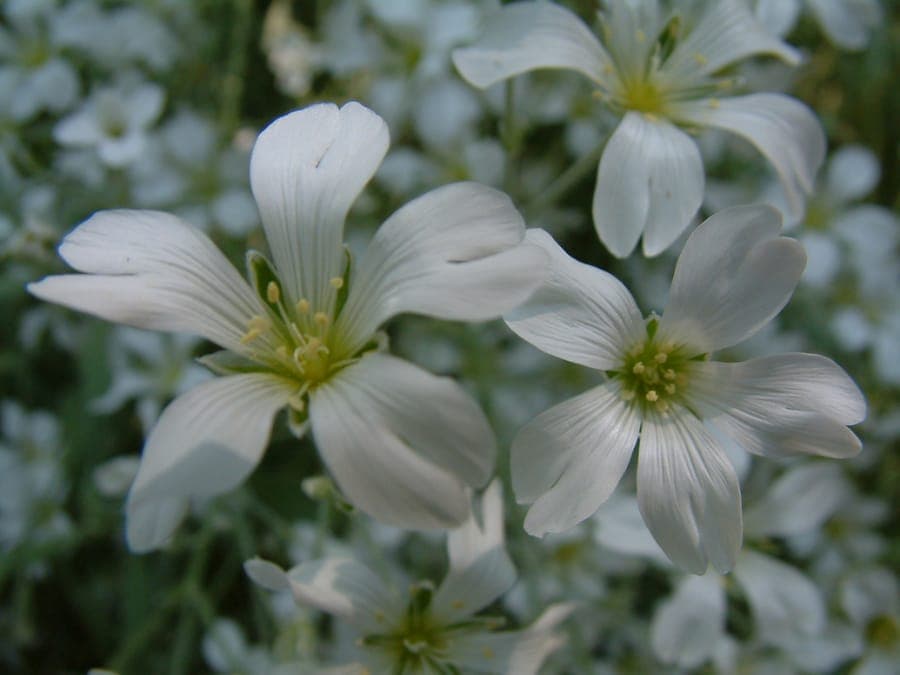
Wikimedia Commons / CC BY-SA 3.0, via Wikimedia Commons
Cerastium biebersteinii: complete guide
Cerastium biebersteinii
¿Quieres ver Cerastium biebersteinii: complete guide en tu jardín?
1 minuto, sin tarjeta de crédito
Snow-in-summer (Cerastium biebersteinii) is a spectacular, silver-green ground cover plant with white flowers. This plant grows as a compact mat only 15-30 cm tall and spreads slowly to form a broad, dense carpet. The silver-green foliage is attractive year-round, and in May-June white flowers appear that attract bees.
This plant is ideal for dry, sunny spots where other plants struggle. Once established, it requires virtually no maintenance and is fully hardy. It grows fine in poor, deep soil, in rock gardens, and along paths. The plant spreads via underground rhizomes, so it naturally forms a larger carpet.
Cerastium biebersteinii is perfect for gardeners seeking something reliable and low-maintenance. With minimal water needed (once established) and no pest problems, this is a very dependable choice for modern, minimalist gardens.
Appearance and Bloom
Snow-in-summer forms a compact, silver-green carpet with broad leaves that stay green year-round. The foliage is dense, felty and gives the plant a woolly, soft appearance. The plant grows slowly but gradually spreads to 45-60 cm wide.
In May and June numerous snow-white flowers appear that cover the entire carpet. This creates a spectacular effect as if snow lies on summer days (from which the name originates). The flowers have five petals and are approximately 1-1.5 cm across.
After blooming, small seed pods form, but usually the seeds do not germinate and the plant spreads via underground runners instead of seed. This makes it more controllable than many self-seeding plants.
Ideal Location
Choose a spot in full sun for Cerastium biebersteinii. At least 6-8 hours of direct sunlight daily is ideal. In partial shade the plant grows but becomes less dense and blooms less.
The plant thrives in dry, warm spots: rock gardens, gravel borders, along paths, on dry slopes. It grows well between paving stones, in green roofs, and along garden edges. Protection from excessive moisture and wet winters helps, especially in northern regions.
Avoid low spots where water collects. This causes root rot. The plant performs best on dry, well-draining sites.
Diseño gratis
¿Quieres ver Cerastium biebersteinii: complete guide en tu jardín? Crea un diseño gratis ahora.
Soil
Cerastium biebersteinii grows in practically all soils, but performs best in dry, poor, well-draining soil. Heavy clay must be amended with gravel or sand (30-40% by volume) to improve drainage.
The plant accepts acidic, neutral and alkaline. pH 5.5 to 8.0 is fine. Add no compost when planting - poor soil is better for this plant. Once established, you need not fertilize.
The plant grows fine even in lean, nutrient-poor soil. Actually it performs worse in fertile soil where it becomes imbalanced.
Watering
Once established (after 4-6 weeks), Cerastium biebersteinii is extremely drought-tolerant. Water regularly during the first month after planting, then only during prolonged droughts.
In normal summers you need scarcely water after the first month. In pots the plant dries out somewhat faster, requiring more moisture monitoring.
Avoid heavy watering, this leads to root rot. The plant prefers dry to moderately moist rather than wet.
Pruning
Pruning is usually unnecessary. The plant grows slowly and maintains its compact form naturally. After blooming (June) you can lightly trim the plant to maintain full form, but this is optional.
Old, dead or damaged foliage can be carefully removed, but usually the plant looks good year-round.
Maintenance Calendar
April: Planting time. Water well the first month. May/June: Bloom period, looks spectacular with white flowers. July through October: Growth and spread, minimal maintenance. November through March: Plant retains silver foliage, does not die back.
Winter Hardiness
Cerastium biebersteinii is fully hardy to zone 3. Dutch winters are no problem. The plant retains its silver-green foliage year-round, making it winter-attractive.
Snow does not harm the plant. Wet-frost can be problematic in very wet winters, but this is rare because the plant thrives in dry conditions.
Companion Plants
Snow-in-summer works well with:
- Lavender for height and fragrance
- Dianthus for flowers and scent
- Sedum for succulent foliage contrast
- Santolina for silver and round form
- Cistus for larger scale
- Juniperus for evergreen structure
All these plants love the same warm, dry, sunny locations.
Closing
Snow-in-summer is a beautiful, low-maintenance ground cover plant for dry, sunny gardens. With year-round silver-green foliage and spectacular white blooms in May-June, it is a valuable addition. Plant from garden centers near you. GardenWorld can help create designs with xeriscapes and drought-tolerant plants. GardenWorld delivers premium garden plans.
¿Quieres ver Cerastium biebersteinii: complete guide en tu jardín? Crea un diseño gratis ahora.
Sube una foto, elige un estilo y obtén un diseño fotorrealista con lista de plantas en menos de un minuto.
Más de 10.000 jardines diseñados
Sin tarjeta de crédito


Plantas similares
Dianthus karami: complete guide
Dianthus karami
Dianthus karami is a rare Lebanese mountain pink with fringed pink blooms on limestone cliffs, ideal for rock gardens and troughs.
Sicilian pink: complete guide
Dianthus siculus
Discover Dianthus siculus, an elegant purple bloomer from Sicily. Cultivation, June-September flowering and garden combinations.
Alpine mouse-ear chickweed: complete guide
Cerastium pedunculatum
Full growing guide for Cerastium pedunculatum: ideal location, soil, watering, winter hardiness, and companion plants for rock gardens.