
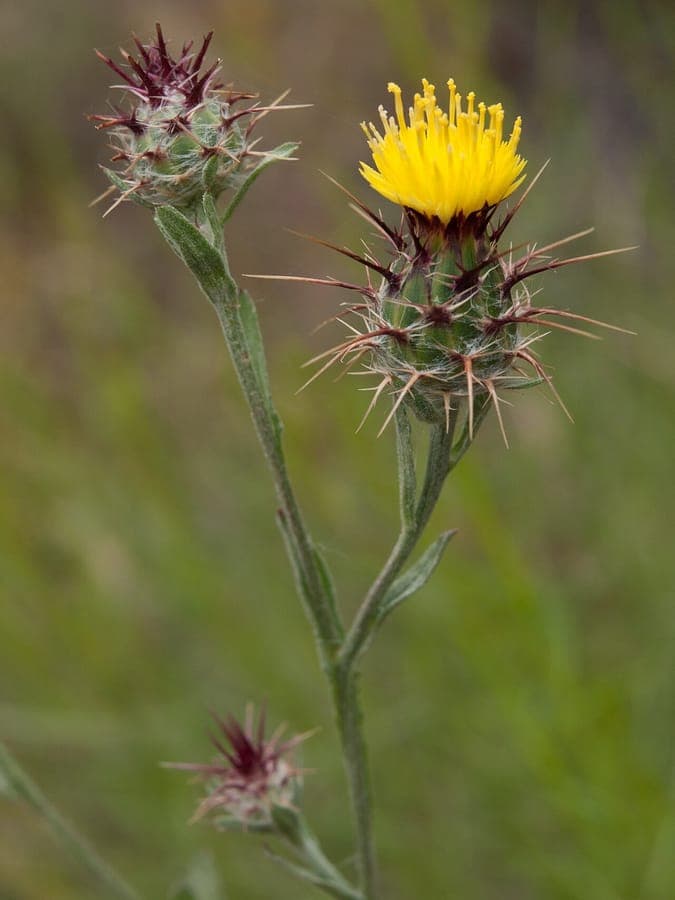
Franco Folini from San Francisco, USA / CC BY-SA 2.0, via Wikimedia Commons
Maltese centaury: complete guide
Centaurea melitensis
¿Quieres ver Maltese centaury: complete guide en tu jardín?
1 minuto, sin tarjeta de crédito
Overview
Centaurea melitensis, commonly known as Maltese centaury or Maltese star-thistle, is an interesting herbaceous plant native to the Mediterranean region. This annual plant bears small, yellow flowers and is characterized by sharp thorns that encircle the seed. Although the plant has a fairly attractive appearance, caution should be taken as it is considered an invasive plant in some areas.
Thanks to its drought tolerance and easy growth, this plant can thrive in dry, marginal soils where many other plants struggle.
Appearance & Bloom
Centaurea melitensis reaches 30-100 centimeters tall with narrow, grayish-green leaves. The plant grows upright and is laden with flowers. The flowers are small, approximately 1 centimeter, yellow in color, and very prolific. They appear in large, impenetrable masses at branch tips.
The most characteristic feature are the sharp thorns surrounding each flower head, which protect the seed. These thorns are extremely sharp and can cause pain when touched. After blooming, seed cones form with long, angular thorns.
The plant has a rough, grayish appearance due to its bristles and thorns. This gives it a rather imposing appearance despite its small size.
Ideal Location
Centaurea melitensis thrives in full sun with a minimum of 6-8 hours of direct sunlight daily. The plant is very light-hungry and will appear less vigorous in shade. A warm, sunny, dry microclimate is ideal.
The plant tolerates fierce, desiccating wind well and can therefore grow in exposed locations.
Soil
Centaurea melitensis grows easily in poor, lean, dry soils where many other plants cannot grow. The plant tolerates acidic to neutral soil and can even thrive in sandy, gravelly soils.
The plant tolerates even poorly fed soils well. Fertilization is usually not needed and can even be harmful by encouraging excessive leaf growth.
Diseño gratis
¿Quieres ver Maltese centaury: complete guide en tu jardín? Crea un diseño gratis ahora.
Watering
Once well established, Centaurea melitensis is very drought-tolerant. The plant can survive weeks without extra water. Young plants, however, will require careful watering until they are well established.
Water only when the soil feels very dry. Excessive water can lead to root problems. In extremely hot, dry seasons, minimal extra water can help, but it is not essential.
The plant thrives better in dry conditions than wet.
Pruning
Centaurea melitensis requires minimal pruning. The plant grows into an attractive form naturally. Caution is needed when pruning because the thorns are sharp.
Spent flowers can be removed, but this is not essential. If you wish to limit the plant's spread, you can remove flowers before they set seed.
Maintenance Calendar
Spring: Preparation and sowing
Summer: Minimal watering; enjoy blooms
Fall: Seed setting; careful handling when seed is ripe
Winter: Plant dies; clean up
Winter Hardiness
Centaurea melitensis is a tender annual and very frost-sensitive. It will die as soon as temperatures reach or drop below 0 degrees Celsius. In temperate regions, it is treated as an annual.
In very warm climates (USDA zones 10-11), the plant may possibly overwinter. In northern regions, it must be replanted each spring.
Caution
In some countries, particularly in America and Australia, Centaurea melitensis is considered an invasive plant that can disrupt wild areas. Check local regulations before planting this plant. The sharp thorns also pose a risk to animals and humans.
Despite these concerns, the plant remains popular in many gardens for its hardiness and beauty.
Conclusion
Centaurea melitensis is an interesting, hardy plant that thrives in dry, marginal soils. While it must be planted cautiously due to its invasive potential in some areas, it can be a valuable addition to xeriscaping gardens or Mediterranean gardens.
¿Quieres ver Maltese centaury: complete guide en tu jardín? Crea un diseño gratis ahora.
Sube una foto, elige un estilo y obtén un diseño fotorrealista con lista de plantas en menos de un minuto.
Más de 10.000 jardines diseñados
Sin tarjeta de crédito


Plantas similares
Calendula stellata: complete guide
Calendula stellata
Complete guide to Calendula stellata, the star-flowered marigold from Sicily: location, soil, watering and companion planting tips.
Korean chrysanthemum: complete guide
Chrysanthemum x rubellum
Chrysanthemum x rubellum is a hardy autumn perennial with single pink to copper flowers from August to November. Care and combinations.
Helianthus divaricatus: complete guide
Helianthus divaricatus
Helianthus divaricatus is a North American woodland sunflower with yellow summer blooms, ideal for naturalistic borders and shady edges.