
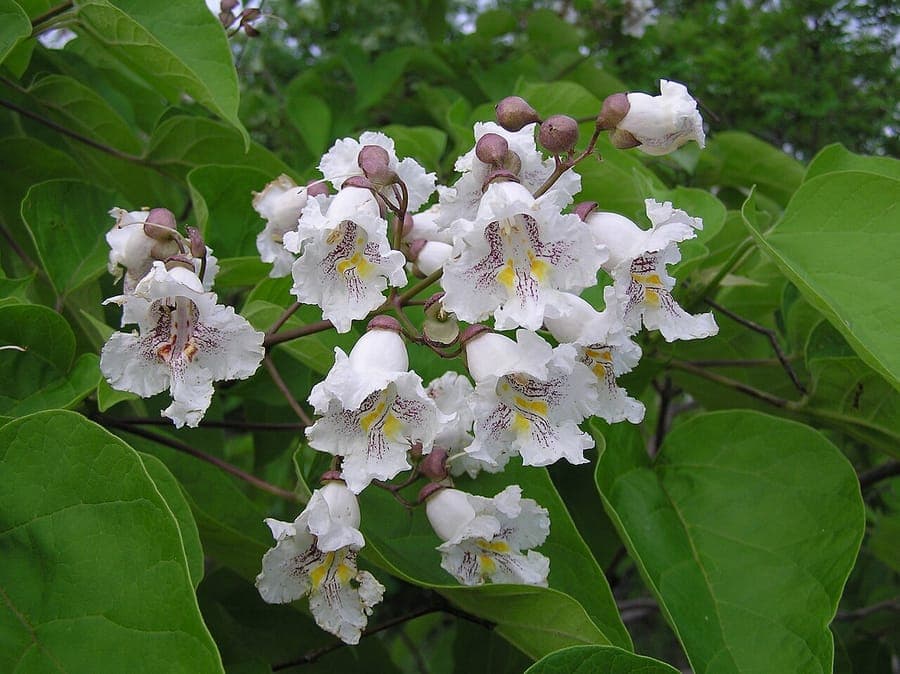
Le.Loup.Gris / CC BY-SA 3.0, via Wikimedia Commons
Indian-bean: complete guide
Catalpa bignonioides
¿Quieres ver Indian-bean: complete guide en tu jardín?
1 minuto, sin tarjeta de crédito
Overview
Indian-bean (Catalpa bignonioides), also known as common catalpa or cigar tree, is a striking deciduous tree from the trumpet-flower family (Bignoniaceae). This tree originates from the southeastern United States and has been widely introduced into European gardens. The Indian-bean tree is valued primarily for its extremely large, heart-shaped leaves and spectacular flowers in white and light violet tones.
The tree can reach 10 to 15 meters in height and forms a broad, rounded crown. The tree is not highly winter-hardy in northern Europe but grows well in many temperate gardens, especially in sheltered locations. The tree grows slowly but ultimately forms a very impressive specimen.
Appearance and Bloom Cycle
Indian-bean has extremely large, heart-shaped leaves that can reach 15 to 20 centimeters in length. Leaves emerge late in spring (May) and drop early in autumn (October). The color is bright green, turning yellowish before leaf drop.
From June through July, large, striking flowers appear in white tones with light yellow spots and purple lines. The flowers are approximately 5 centimeters across and grow in upright clusters. They have a pleasant vanilla-like fragrance. After blooming, long, slender seed pods form, reaching up to 40 centimeters and are very characteristic.
Ideal Location
Indian-bean grows best in a location with abundant sunlight. The tree thrives in light dappled shade but flowers much less prolifically in such conditions. Plant it in a sheltered location, not exposed to strong winds that cause leaf damage.
The tree is moderately winter-hardy and grows well in temperate gardens. In very cold climates, additional frost protection may be needed in young trees.
Soil Requirements
Indian-bean performs best on fertile, well-draining soils without waterlogged subsoil. The tree is moderately nutrient-demanding and grows well on normal garden soil. Heavy clay soils can be improved by adding sand and compost.
When planting, incorporate generous amounts of mature compost into the planting hole. The tree appreciates some feeding in spring during early years.
Diseño gratis
¿Quieres ver Indian-bean: complete guide en tu jardín? Crea un diseño gratis ahora.
Watering
After planting, water regularly for the first two years. Water deeply once weekly during normal summers. During extended dry periods, water more frequently to prevent stress. Once established, supplemental water is rarely needed.
Established trees require minimal extra water and are reasonably drought-tolerant.
Pruning and Maintenance
Indian-bean requires minimal pruning. Remove dead branches in late spring. The tree naturally forms an attractive shape. In winter, relatively worthless seed pods can be removed for neatness, though this is not essential.
The tree grows slowly, so aggressive pruning is unnecessary.
Maintenance Calendar
May: Late leaf emergence. June-July: Flowering and seed pod formation. August-September: Full leaf cover and nutrition. October: Early leaf drop. November-April: Winter dormancy.
Winter Hardiness
Indian-bean is moderately winter-hardy. In USDA zones 5 through 9, the tree grows without protection (minimum temperatures from -29 to -7 degrees Celsius). In most temperate regions, it flourishes without concerns. In very cold areas, young tree protection may be beneficial.
Young trees may benefit from burlap wrapping in their first winters.
Companion Plants
Indian-bean grows well alongside other deciduous trees such as Japanese pagodatree, sorrel, and European larch. The large leaves of catalpa provide shade for smaller understory plants.
Underplanting with shade-tolerant specimens works well.
Closing Remarks
Indian-bean is an exotic-looking tree that draws considerable attention in gardens. With its large leaves and striking flowers, it brings a tropical ambiance. For more information on tree care, visit gardenworld.app for comprehensive garden guidance. Young trees are available from specialized tree nurseries. Gardenworld.app is happy to help further.
¿Quieres ver Indian-bean: complete guide en tu jardín? Crea un diseño gratis ahora.
Sube una foto, elige un estilo y obtén un diseño fotorrealista con lista de plantas en menos de un minuto.
Más de 10.000 jardines diseñados
Sin tarjeta de crédito


Plantas similares
Tabebuia pallida: complete guide
Tabebuia pallida
Full growing guide for Tabebuia pallida: location, soil, watering, pruning, hardiness and companion plants for this tropical trumpet tree.
Northern catalpa: complete guide
Catalpa speciosa
Everything about northern catalpa (Catalpa speciosa): bold white flowers, fast growth, and how to grow this striking tree in your garden.
Desert willow: complete guide to Chilopsis linearis
Chilopsis linearis
Complete growing guide for desert willow (Chilopsis linearis): sun, soil, flowering, pruning, and winter care for this spectacular flowering small tree.