
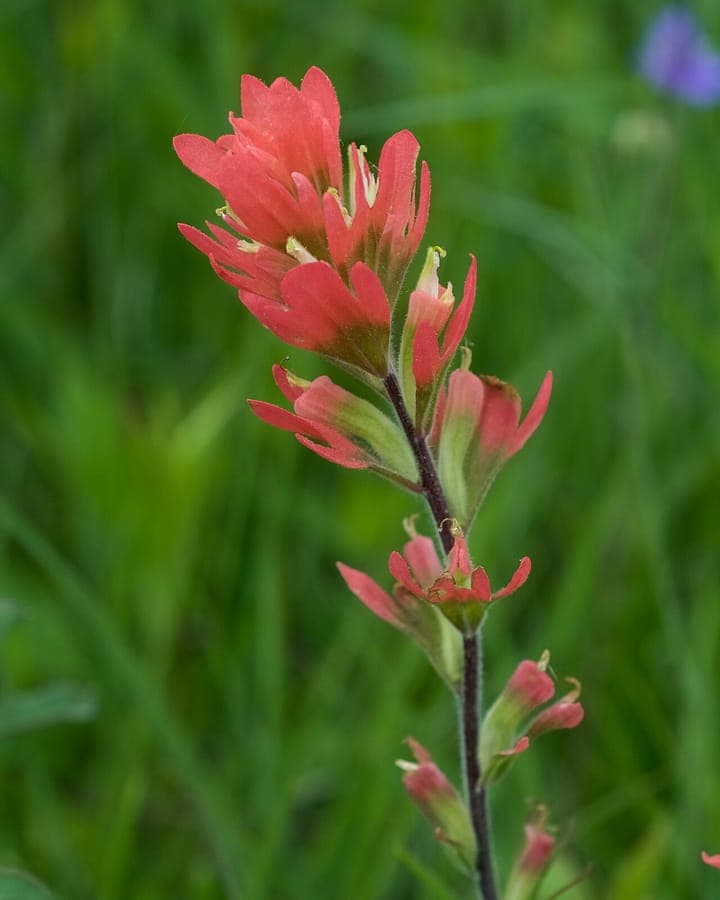
Eric Hunt / CC BY-SA 4.0, via Wikimedia Commons
Scarlet Indian Paintbrush: complete guide
Castilleja coccinea
¿Quieres ver Scarlet Indian Paintbrush: complete guide en tu jardín?
1 minuto, sin tarjeta de crédito
Overview
The Scarlet Indian Paintbrush (Castilleja coccinea), also known as scarlet painted-cup or scarlet paintbrush, is a striking biennial or short-lived perennial from eastern North America. With its intensely red flowers, it is a favorite in wildflower gardens and essential food for hummingbirds. The plant is semi-parasitic, meaning it is partially dependent on root contact with other plants.
Appearance and Bloom
The Scarlet Indian Paintbrush grows to 30-60 centimeters tall, with a narrow, upright form. Leaves are linear to lance-shaped, finely textured. The most dramatic feature is the flowers: densely-packed spikes of burning red blooms appear from May through June. These are actually colored bracts (leaf-like structures), while the true flowers are small and hidden within. Each spike cluster attracts hummingbirds.
Ideal Location
Scarlet Indian Paintbrush grows best in full sun. Plant in a location with at least 6-8 hours of direct sunlight daily. This promotes intensity of flower color and healthy growth. Slight shade is tolerated, but the plant blooms less abundantly.
Soil
The plant grows best in well-draining, somewhat lean soils. Sandy soils, even rocky soils, are acceptable. It does not grow well in heavy, clay-like, moisture-retaining soils. pH flexibility: neutrality to slightly acidic (pH 6-7.5). The plant tolerates lower nutrient levels; avoid very fertile soils.
Watering
Once established, the Scarlet Indian Paintbrush is highly drought-tolerant. Water moderately after planting, approximately 1 centimeter per week during the first growing season. Once established, it needs minimal supplemental watering. In very dry climates, occasional watering during extreme drought may arise. Avoid water-logging, which can promote disease.
Diseño gratis
¿Quieres ver Scarlet Indian Paintbrush: complete guide en tu jardín? Crea un diseño gratis ahora.
Pruning
The plant requires minimal pruning. Remove spent flower spikes to maintain compact form and encourage longer bloom. After blooming, the plant can be deadheaded to prevent uncontrolled seeding in warm climates. Usually very little active pruning is needed.
Maintenance Calendar
April: Growing season begins in North America, water carefully May-June: Peak bloom time, water as needed July-August: Bloom fades, reduce watering September-October: Seed dispersal occurs, collect seed if desired November-March: Winter dormancy, no maintenance required in cold climates
Winter Hardiness
Scarlet Indian Paintbrush is very hardy and grows in cold climates. The plant hails from mid-Canada to central USA, so it tolerates freezing temperatures well. In very cold climates (below -20 degrees Celsius), mulching around the base may be beneficial, but usually no protection is needed.
Companion Plants
Scarlet Indian Paintbrush combines well with: Aquilegia (columbine) Verbascum (mullein) Rudbeckia (black-eyed Susan) Echinacea (purple coneflower) Achillea (yarrow) Salvia (sage) Liatris (blazing star)
Closing Remarks
The Scarlet Indian Paintbrush is a striking, versatile flower for native and wildflower gardens, especially for those wanting to attract hummingbirds. With its fiery red flowers, drought-tolerant nature, and value to pollinators, it is an ecologically valuable choice. Plant in full sun in dry, well-drained locations where it can naturalize and grow with other wildflowers. GardenWorld.app helps you find the perfect spot for this glowing native gem.
¿Quieres ver Scarlet Indian Paintbrush: complete guide en tu jardín? Crea un diseño gratis ahora.
Sube una foto, elige un estilo y obtén un diseño fotorrealista con lista de plantas en menos de un minuto.
Más de 10.000 jardines diseñados
Sin tarjeta de crédito


Plantas similares
Northwestern Indian paintbrush: complete guide
Castilleja angustifolia
All about Castilleja angustifolia, the northwestern Indian paintbrush from dry western US steppes. Growing, care, and companion plant advice.
Wavyleaf Indian paintbrush: complete guide
Castilleja applegatei
Everything about Castilleja applegatei, the wavyleaf paintbrush from Oregon and California. Host plants, care, location, and garden use covered.
Bushy bird's-beak: complete guide
Cordylanthus ramosus
Complete guide to Cordylanthus ramosus, the hemiparasitic annual of western US steppes: ecology, host plants, cultivation and uses.