
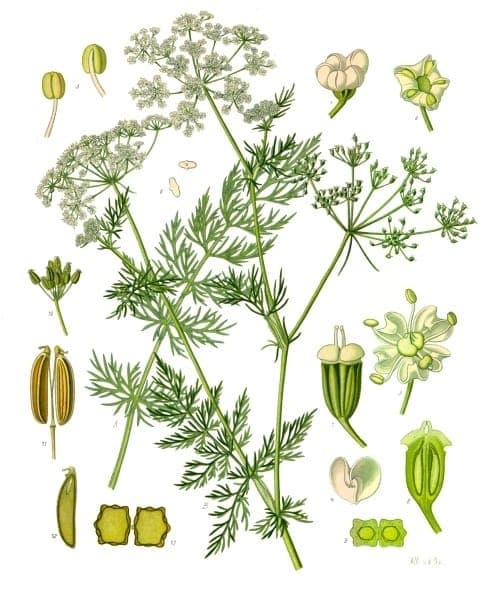
Franz Eugen Köhler, Köhler's Medizinal-Pflanzen / Public domain, via Wikimedia Commons
Caraway: complete guide
Carum carvi
¿Quieres ver Caraway: complete guide en tu jardín?
1 minuto, sin tarjeta de crédito
Overview
Caraway (Carum carvi), commonly known as caraway, is a biennial herb belonging to the carrot family (Apiaceae). The plant is valued primarily for its aromatic seeds, which are extensively used in culinary traditions throughout northern and central Europe. During its first two years, caraway develops modestly: in year one, it produces only a low rosette of fine foliage near the ground. By the second year, distinctive hollow stems emerge with further-divided leaves and white or pale pink flowers arranged in characteristic umbrella-shaped clusters.
The plant develops a long taproot that extends deeply into the soil, making it exceptionally drought-tolerant. The seeds are ovoid with two distinctive lengthwise grooves, making them easily identifiable.
Appearance and Bloom Cycle
During its first year, caraway forms a low leaf canopy of finely cut, feathery foliage with a soft texture and bright green color. The stems grow slender and hollow, reaching 30 to 60 centimeters in height. Flowers appear in July through August of the second year in white, pale pink, or very light yellow tones, arranged in umbrella-shaped clusters at the stem tips.
At the end of the second growing season, seeds mature and can be harvested for culinary and medicinal uses.
Ideal Location
Caraway thrives best in a spot receiving full sunlight. While the plant grows well on less nutrient-rich soils and adapts to partial shade, growth is slower in shadier conditions. Place caraway in a well-drained location. The plant dislikes waterlogging, so ensure the soil dries regularly between waterings.
The plant is highly winter-hardy and grows well in temperate to cold climates, tolerating temperatures as low as -30 degrees Celsius, making it suitable for virtually any garden location.
Soil Requirements
Caraway performs best in well-draining, slightly sandy soil with a pH between 6.0 and 7.5. The plant prefers moderately fertile rather than heavily enriched soils and actually grows better in leaner ground than in rich compost. If your soil is clay or loam-heavy, mix it with sand to improve drainage.
Avoid incorporating heavy manure when planting, as excessive nutrients promote leaf growth at the expense of seed production. For caraway, the principle is: less feeding yields better seed set.
Diseño gratis
¿Quieres ver Caraway: complete guide en tu jardín? Crea un diseño gratis ahora.
Watering
Caraway requires minimal water because the plant's deep taproot extracts moisture from deeper soil layers. Water only when the top 5 centimeters of soil feel completely dry. In normal growing seasons with regular rainfall, supplemental watering is unnecessary.
During dry periods, you may water once weekly, but ensure water drains well and doesn't accumulate around the roots. Excessive moisture increases the risk of root rot.
Pruning and Maintenance
Caraway is an extremely low-maintenance plant requiring minimal pruning. It forms its shape naturally. If desired in the first year, you can remove flowers to prevent seed production, though this isn't necessary.
Harvest timing arrives when seed stalks turn brown and seeds easily separate from the seedpod with fingernail pressure. Cut seed stalks and hang them upside-down in a dry location or place them in a paper bag to dry thoroughly.
Maintenance Calendar
March: Direct-sow seeds in the ground on a nutrient-rich planting site. Caraway must winter over to bloom and set seed properly. May-June (first year): Thin to approximately 20 centimeters between plants. July-August (second year): Flowering and seed development. September (second year): Harvest and dry seeds. October: Work the ground after seed harvest.
Winter Hardiness
Caraway is extremely winter-hardy, tolerating temperatures as low as -30 degrees Celsius. However, the plant cannot persist as a perennial. After seed ripening, the plant dies, which is typical for biennial species. This means you must resow seeds annually or allow self-seeding plants to remain.
Plants require no winter protection in typical growing regions.
Companion Plants
Caraway grows well alongside other Apiaceae herbs such as fennel and dill. Parsley also pairs well with caraway. Avoid strong nutrient-competitive neighbors that could overtake it.
Caraway itself has a suppressive effect on certain weeds, making it useful to place in garden areas where you struggle with them.
Closing Remarks
Caraway is a straightforward and practical plant that adapts perfectly to most growing conditions. With its delicate foliage and aromatic seeds, it brings both beauty and utility to your garden. For additional plant care information, visit gardenworld.app for comprehensive garden guidance. Seeds are available at major retailers, where you'll also find growing medium and other supplies. Gardenworld.app is here to help with more information.
¿Quieres ver Caraway: complete guide en tu jardín? Crea un diseño gratis ahora.
Sube una foto, elige un estilo y obtén un diseño fotorrealista con lista de plantas en menos de un minuto.
Más de 10.000 jardines diseñados
Sin tarjeta de crédito


Plantas similares
Whorled carrot: complete guide
Daucus involucratus
Daucus involucratus is a Mediterranean umbellifer with white flower heads framed by lacy bracts. Growing this gravel garden gem.
Daucus muricatus: complete guide
Daucus muricatus
Daucus muricatus, the spiny wild carrot, grows wild on Mediterranean coasts. Discover sowing, June-July bloom, and wildflower meadow use.
Daucus pumilus: complete guide
Daucus pumilus
Daucus pumilus is a dwarf wild carrot relative with white lacy umbels, thriving on dunes and coastal rock in poor, fast-draining soil.