
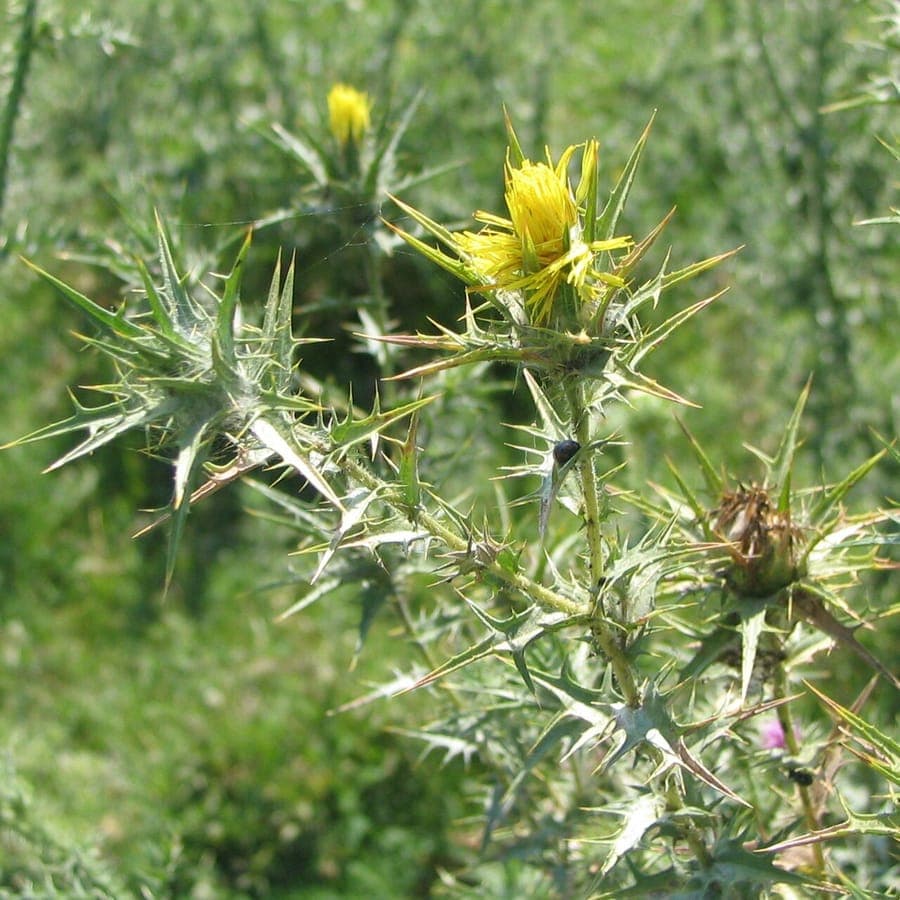
No machine-readable author provided. Bogdan assumed (based on copyright claims). / CC BY-SA 3.0, via Wikimedia Commons
Carthamus lanatus: complete guide
Carthamus lanatus
¿Quieres ver Carthamus lanatus: complete guide en tu jardín?
1 minuto, sin tarjeta de crédito
Overview
Carthamus lanatus, commonly known as Distaff Thistle, is a distinctive herbaceous plant from the Asteraceae family (daisy family). This plant grows naturally in Macaronesia, Europe, and extending to Iran. The plant stands out for its fine, spiny leaves and yellow flowers that appear for an extended period. A perfect choice for wildflower borders and dry garden areas.
Appearance & Bloom Cycle
Distraff Thistle reaches heights of 20 to 80 cm and forms a spreading structure with branched stems. The leaves are finely crafted, lance-shaped, green, and studded with fine spines. The yellow flowers (1 to 1.5 cm wide) cluster together and appear from July through October. The flowers surrounded by sharp bracts are very characteristic. The entire plant has a woolly, grayish-green texture.
Ideal Location
This plant grows best in very sunny, dry places on lean soils. Plant it in wildflower borders, dry rock gardens, or along slopes. The plant refuses to grow in shade or on wet soils. Full sun for at least 8 hours per day is essential. Windy locations are suitable for this robust plant.
Soil Requirements
Carthamus lanatus accepts virtually all soil types, even the poorest. Sandy, calcareous, and lean soils are ideal. pH can range from acidic to alkaline (5.5 to 8.0). The plant even grows on compacted grass and wastelands. Good drainage is important; waterlogging is poorly tolerated.
Watering
Once established, Distaff Thistle is extremely drought-tolerant. Water only during the growing season (May-June) if it is very dry. During the flowering period (July-October), occasional watering can help prolong bloom. The plant accepts minimal water supply very well. Water excess can cause rot.
Diseño gratis
¿Quieres ver Carthamus lanatus: complete guide en tu jardín? Crea un diseño gratis ahora.
Pruning
Pruning is not necessary. Do not remove spent flowers unless you want to prevent self-seeding. The plant dies back naturally after seed production. In wilder plantings, you can let this process occur naturally.
Maintenance Calendar
April-May: Direct sowing outdoors; plant grows rapidly.
June: Vegetative growth accelerates.
July-October: Flowering period; no maintenance needed.
November: Seed dispersal; plant dies back.
Winter Hardiness
Carthamus lanatus is biennial to very short-lived perennial. The plant dies back after seed production. In temperate climate it is usually treated as a biennial. The plant overwinters as a rosette in the first year and blooms in the second year. Fairly hardy to -10°C, but usually used as an annual sowing.
Companion Plants
This plant works well with other Mediterranean flowers. Combine with other thistles, wild cornflowers, and silver-leaved herbs. Bees readily visit the flowers. The plant establishes well via self-seeding in suitable conditions, resulting in natural, informal borders.
Closing
Carthamus lanatus is an excellent choice for those with dry, lean soils and sunny spots. With minimal maintenance requirements and years of flowering, this plant offers value without effort. Seek seeds from specialized wildflower seed companies. Visit gardenworld.app for more dry garden ideas. At local seed suppliers you can find seed packets. This is truly a plant for lazy gardeners.
¿Quieres ver Carthamus lanatus: complete guide en tu jardín? Crea un diseño gratis ahora.
Sube una foto, elige un estilo y obtén un diseño fotorrealista con lista de plantas en menos de un minuto.
Más de 10.000 jardines diseñados
Sin tarjeta de crédito


Plantas similares
Calendula stellata: complete guide
Calendula stellata
Complete guide to Calendula stellata, the star-flowered marigold from Sicily: location, soil, watering and companion planting tips.
Korean chrysanthemum: complete guide
Chrysanthemum x rubellum
Chrysanthemum x rubellum is a hardy autumn perennial with single pink to copper flowers from August to November. Care and combinations.
Helianthus divaricatus: complete guide
Helianthus divaricatus
Helianthus divaricatus is a North American woodland sunflower with yellow summer blooms, ideal for naturalistic borders and shady edges.