
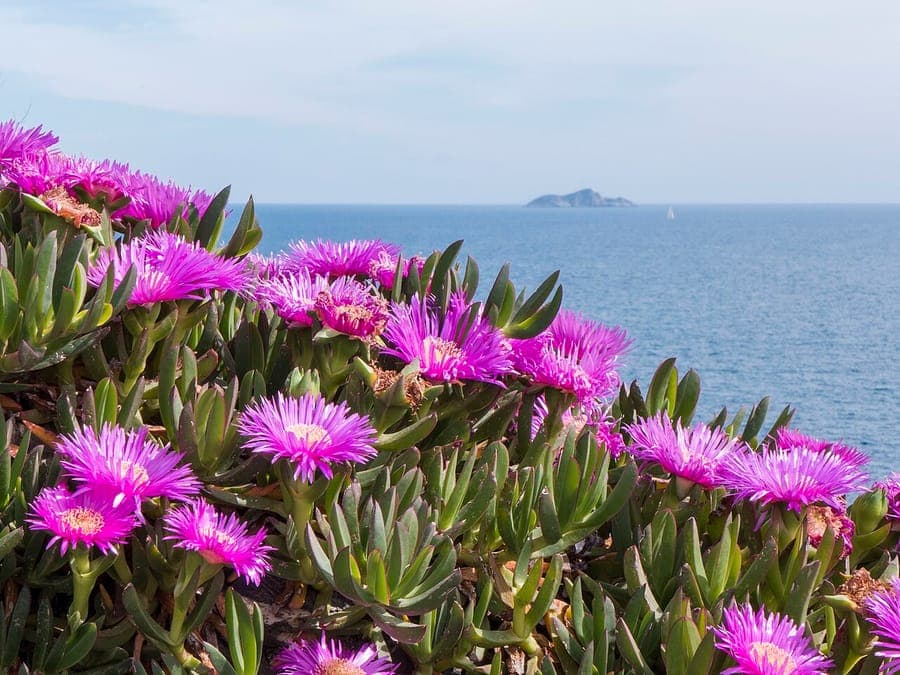
Digitalsignal / CC BY-SA 3.0, via Wikimedia Commons
Carpobrotus acinaciformis: complete guide
Carpobrotus acinaciformis
¿Quieres ver Carpobrotus acinaciformis: complete guide en tu jardín?
1 minuto, sin tarjeta de crédito
Overview
Carpobrotus acinaciformis, commonly known as Red Hottentot Fig or Griffe de sorcière, is a striking succulent from the Aizoaceae family (ice plant family). This plant is native to South Africa, growing primarily in the Cape Province. The plant stands out for its fleshy, juicy leaves and brilliant magenta flowers that appear throughout summer.
Appearance & Bloom Cycle
The Red Hottentot Fig forms low mats of 10 to 30 cm height with a spread that can reach meters. The leaves are long, compressed, and saber-shaped, grayish-green in color with reddish tints. The large flowers (3 to 4 cm wide) are bright magenta to purple and appear from April to October under favorable conditions, especially May through June. The flowers open in the morning and close in the afternoon - typical for Carpobrotus species.
Ideal Location
This plant thrives in very sunny, dry locations. Plant it on rock gardens, steep slopes, roof gardens, or in containers on sunny terraces. The plant refuses to grow in shade and requires full sun for optimal flowering. Strong wind poses no disadvantage. Ideal for Mediterranean gardens and coastal gardens.
Soil Requirements
Carpobrotus acinaciformis demands sandy, well-draining soils. pH can be neutral to slightly alkaline (6.5 to 8.0). Heavy soils almost certainly lead to rot. Add abundant gravel, sharp sand, and some organic material. Potting soil for cacti and succulents is suitable. Fertilizer need not be added.
Watering
This succulent is extremely drought-tolerant. Water only during very dry periods and then sparingly. During the growing period (April through October) watering can be done once every two to three weeks in very dry conditions. In winter, do not water - the plant rests. Excessive moisture causes root rot.
Diseño gratis
¿Quieres ver Carpobrotus acinaciformis: complete guide en tu jardín? Crea un diseño gratis ahora.
Pruning
Pruning is not necessary. However, you can remove old, dead, or damaged branches to shape the plant. Broken leaves can be removed. The plant naturally grows low and compact.
Maintenance Calendar
February-March: Planting season for mild climates.
April-June: Peak flowering period; minimal maintenance needs.
July-October: Continuous flowering; water only during extreme drought.
November-January: Rest period; no water; no maintenance needed.
Winter Hardiness
Carpobrotus acinaciformis is hardy to approximately -5°C (USDA zone 10). In temperate climates, it grows best in containers that can be protected or brought indoors during winter. In milder coastal regions, it can grow in the ground. Protection from cold and moisture is essential in wetter zones.
Companion Plants
This succulent works well with other Mediterranean and dry garden plants. Combine with Echeveria, Sedum, Sempervivum, and other succulents. Plant with dry grasses such as Festuca and silver-leaved plants such as Senecio. Bees and insects readily visit the flowers.
Closing
Carpobrotus acinaciformis is an essential choice for dry, sunny gardens with minimal maintenance requirements. With its prolific flowering and exotic appearance, this plant offers years of pleasure. Seek plants at garden centers with succulent sections. Visit gardenworld.app for more dry garden designs. At local garden centers you can usually find plant material. A plant for those with warm, sunny garden spots.
¿Quieres ver Carpobrotus acinaciformis: complete guide en tu jardín? Crea un diseño gratis ahora.
Sube una foto, elige un estilo y obtén un diseño fotorrealista con lista de plantas en menos de un minuto.
Más de 10.000 jardines diseñados
Sin tarjeta de crédito


Plantas similares
Carpobrotus glaucescens: complete guide
Carpobrotus glaucescens
Pigface or angular sea-fig is a succulent from Australia. Learn cultivation, care, and use for coastal and container gardens.
Delosperma nubigenum: complete guide
Delosperma nubigenum
Everything about Delosperma nubigenum: a prolific-flowering succulent from South Africa with orange blooms. Growing tips, care and design ideas for your garden.
Crocea Iceplant: complete guide
Malephora crocea
Discover Crocea Iceplant (Malephora crocea), a South African succulent with coppery-orange flowers. Perfect for dry, sunny gardens and rock gardens.