
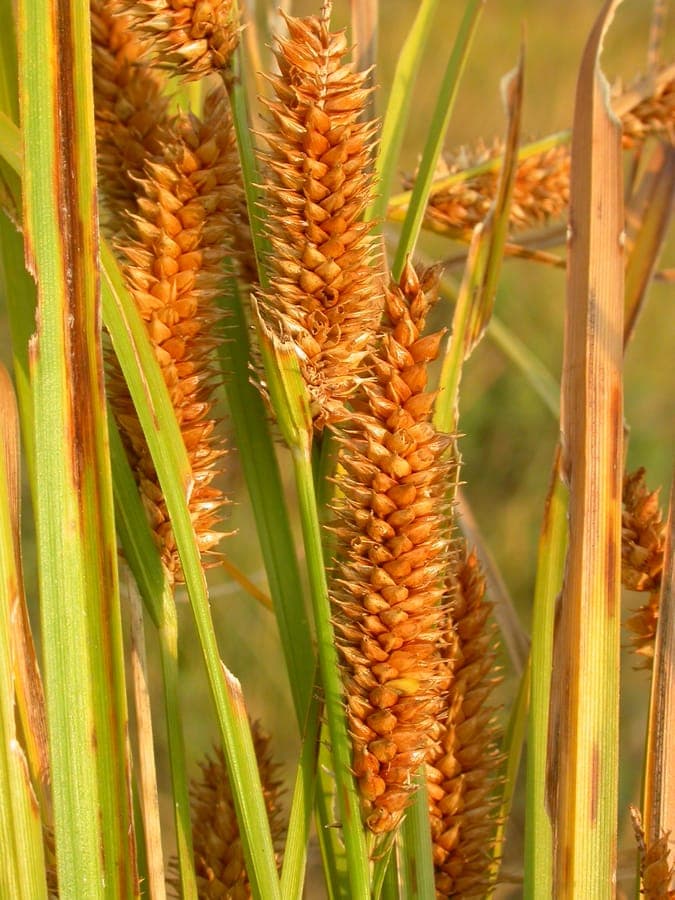
Matt Lavin / CC BY-SA 2.0, via Wikimedia Commons
Northern Beaked Sedge (Snavelzegge): complete guide
Carex utriculata
¿Quieres ver Northern Beaked Sedge (Snavelzegge): complete guide en tu jardín?
1 minuto, sin tarjeta de crédito
Overview
Northern beaked sedge (Carex utriculata), also called beaked sedge or bottle sedge, is a valuable aquatic-margin plant native to North America through central Mexico, and also widespread in northern and eastern Europe to Japan. This hardy sedge species is renowned for robustness in wet, marshy conditions. The plant forms elegant, fine tufts that perfectly structure waterside plantings and prevent erosion. Despite its North American name, it thrives excellently in European and temperate waterside environments.
Appearance & bloom cycle
Northern beaked sedge grows as a perennial plant, reaching 60-120 cm tall, with fine, grey-green foliage densely clustered. The plant forms dense, fountain-like tufts. Flowering appears May-June with inconspicuous brown flower spikes clustered near stem tops. The characteristic swollen fruits (utricles) are bottle-shaped – hence the common name 'bottle sedge'. These ripen from green to brown.
Ideal location
Northern beaked sedge thrives in wet environments – along ponds, stream banks, marshy meadows, and even in shallow water to 15-20 cm depth. The plant tolerates periodic flooding well. Position where you can appreciate the elegant form. The sedge grows both in full sun and partial shade, though flowering is richer in sun. The plant is very water-purifying – position several specimens in wetland zones.
Soil requirements
Northern beaked sedge demands high moisture but not necessarily rich nutrients. Heavier, clay-based soils are actually preferable to light sands – the plant needs moisture-retentive soil. In container culture (minimum 20-30 litres for small plants, larger for bigger specimens) use rich aquatic potting compost. pH can range 5.5 to neutral. Adding wetland compost improves growth significantly.
Watering
Northern beaked sedge doesn't need watering in conventional sense – it prefers permanent wetness! Ideal is a position where soil stays wet through the entire season, or in shallow water. Along waterside it grows perfectly with regular flooding. In containers: keep potting compost constantly wet. This plant responds poorly to drought – never allow it to dry out. Regular water addition is essential.
Diseño gratis
¿Quieres ver Northern Beaked Sedge (Snavelzegge): complete guide en tu jardín? Crea un diseño gratis ahora.
Pruning
Northern beaked sedge requires minimal pruning. In March you can remove dead foliage from previous season – gently pull the clump apart to loose dead material. This stimulates clean growth. Otherwise let the plant grow – it naturally forms beautiful, natural shapes. Remove only visibly diseased or damaged foliage.
Maintenance calendar
Spring (March-May): Plant young sedge March-April at waterside or in wet soils. Ensure plants receive adequate water – they grow vigorously with sufficient moisture. Early March, remove old dead material.
Summer (June-September): Plant grows vigorously, especially if warm and moist. Flowering peaks. Enjoy the growth. Monitor water – in dry summers waterside can dry. Top-up water if needed.
Autumn (October-November): Foliage takes on warm brown-golden tones. Plant slowly enters dormancy. Water remains essential.
Winter (December-February): Plant can stand underwater without problem. In extreme frost periods (below -15°C) foliage may be damaged, but plant regrows in spring. No feeding needed.
Winter hardiness
Northern beaked sedge is very winter-hardy throughout North America, Europe and Asia – it tolerates temperatures to -20°C or lower without issue. In temperate climates it's completely frost-hardy. The plant can even remain under ice-covered water. No winter protection needed, even in northern regions.
Companion plants
Northern beaked sedge fits perfectly in wetland gardens and waterside plantings. Combine with other sedge species (Carex elata, Carex oshimensis), aquatic plants (Iris sibirica, Iris versicolor), and reed species (Phragmites). For small water gardens, use northern beaked sedge as a specimen – it's elegant. In larger wetland areas, group plants for wave-like effect. Perfect as pond-edge planting for smaller gardens.
Closing
Northern beaked sedge is ideal for gardeners wanting water gardens or stabilizing waterside areas. The plant demands minimal maintenance – plant it, keep it wet, and it thrives. Very valuable for water purification through its root system. For water garden design inspiration visit gardenworld.app. Northern beaked sedge grows increasingly beautiful over years, forming denser tufts – it's an investment in water-based structure and nature!
¿Quieres ver Northern Beaked Sedge (Snavelzegge): complete guide en tu jardín? Crea un diseño gratis ahora.
Sube una foto, elige un estilo y obtén un diseño fotorrealista con lista de plantas en menos de un minuto.
Más de 10.000 jardines diseñados
Sin tarjeta de crédito


Plantas similares
Flat-stemmed club-rush: complete guide
Bolboschoenus planiculmis
Everything about Bolboschoenus planiculmis: growing conditions, watering, care, and use as a pond margin or wetland plant in garden design.
Great Plains flatsedge: complete guide
Cyperus lupulinus
Everything about Great Plains flatsedge (Cyperus lupulinus): growing conditions, care, garden uses, and ecological value. Tips for pond margins and dry sandy soils.
Golden beak sedge: complete guide
Rhynchospora corymbosa
Everything about golden beak sedge (Rhynchospora corymbosa): a dramatic tropical marginal for pond edges, bog gardens, and wet habitats.