
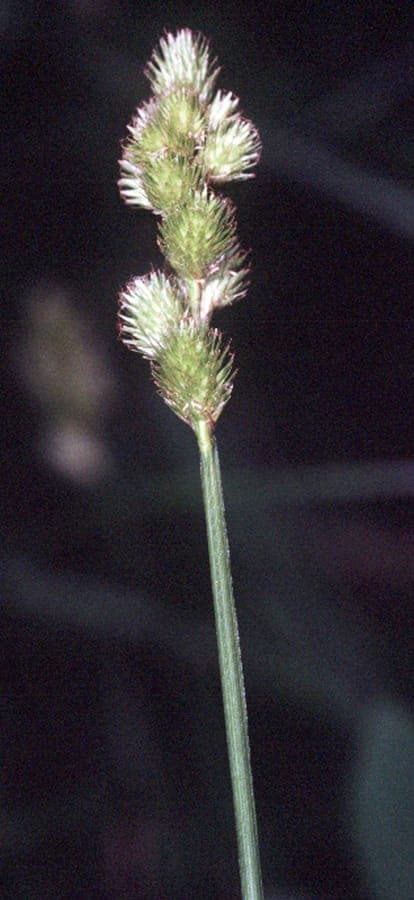
Robert H. Mohlenbrock. USDA SCS. 1989. Midwest wetland flora: Field office illustrated guide to plant species. Midwest National Technical Center, Lincoln. Courtesy of USDA NRCS Wetland Science Institute. / Public domain, via Wikimedia Commons
Carex tribuloides: complete guide
Carex tribuloides
¿Quieres ver Carex tribuloides: complete guide en tu jardín?
1 minuto, sin tarjeta de crédito
Overview
Carex tribuloides, commonly known as Blunt broom sedge, is a North American sedge from the Cyperaceae family. This frost-hardy graminoid plant grows naturally in Eastern Canada and Eastern United States, from Newfoundland to Florida and reaching the Gulf Coast and Mexico.
Blunt broom sedge is adapted to wet grasslands, wetland margins and moist forest floors. For front yard designs with water gardens or wet natural areas, it is an excellent choice. The plant provides erosion control on slopes and structure in wetlands.
The plant plays an important role in bird habitats through seed production.
Appearance & bloom
Blunt broom sedge reaches a height of 30-60 centimeters with dense, upright growth. The leaves are linear, finely woven, and grow in characteristic bundles. Color ranges from bright to dark green with brownish basal zones.
The flowering and fruiting stages are highly characteristic with triangular, brown fruits growing in compact clusters. These brown plumes are visible from July to October and give the plant ornamental value in the autumn landscape.
The fruits are dispersed by wind and water.
Ideal location
Blunt broom sedge thrives optimally in wet grasslands and wetland habitats with regular water saturation. The plant accepts full sun to partial shade, preferring partial shade in hot climates.
The plant is hardy to at least -10 degrees Celsius and grows throughout North America. In the Netherlands and Belgium, it is completely hardy.
The plant prefers wet to very wet sites.
Soil
Blunt broom sedge grows best in wet, nutrient-rich soil with abundant organic material. pH 5.0-7.0 is ideal. The plant tolerates acidic soils well and even grows in nutrient-rich waterlogged soils.
In gardens, it is best to add compost and leaf mold for optimal growth. Avoid dry soils.
Diseño gratis
¿Quieres ver Carex tribuloides: complete guide en tu jardín? Crea un diseño gratis ahora.
Watering
Blunt broom sedge requires regular to permanent moisture. The plant tolerates wet to very wet soil better than drought. In artificial water gardens, it grows well in shallow water strips.
Supplemental watering is barely necessary because the plant naturally seeks wet sites.
Pruning
Pruning is not necessary. The plant forms compact shapes by itself. Dead foliage can be removed in spring for aesthetic reasons.
From aging plants, substantial portions can be removed to stimulate rejuvenation.
Maintenance calendar
Spring (March-May): Plant begins growth. Remove dead foliage. Division of old clumps can occur.
Summer (June-August): Full growth. Minimal intervention. Plant offers ornamental fruits itself.
Fall (September-October): Plant prepares for winter with brown fruits. Seeds disperse naturally.
Winter (December-February): Plant sleeps under snow. Snow covers soil.
Winter hardiness
Blunt broom sedge is very hardy to -10 degrees Celsius and grows naturally throughout Canada. No protection needed.
Companion plants
Blunt broom sedge works well alongside:
- Other sedges: Form natural grasslands
- Wetland plants: Iris, astilbe, primula
- Bird food plants: Seed producing together
- Water plants: Shoreline situations
Avoid strong drought-preferring competitors.
Closing
Blunt broom sedge is a valuable plant for wet landscapes. On gardenworld.app you can integrate it into your front yard design: https://gardenworld.app/en/plant-blog/carex-tribuloides and https://gardenworld.app/en/plant-blog/wetland-sedges
¿Quieres ver Carex tribuloides: complete guide en tu jardín? Crea un diseño gratis ahora.
Sube una foto, elige un estilo y obtén un diseño fotorrealista con lista de plantas en menos de un minuto.
Más de 10.000 jardines diseñados
Sin tarjeta de crédito


Plantas similares
Flat-stemmed club-rush: complete guide
Bolboschoenus planiculmis
Everything about Bolboschoenus planiculmis: growing conditions, watering, care, and use as a pond margin or wetland plant in garden design.
Great Plains flatsedge: complete guide
Cyperus lupulinus
Everything about Great Plains flatsedge (Cyperus lupulinus): growing conditions, care, garden uses, and ecological value. Tips for pond margins and dry sandy soils.
Golden beak sedge: complete guide
Rhynchospora corymbosa
Everything about golden beak sedge (Rhynchospora corymbosa): a dramatic tropical marginal for pond edges, bog gardens, and wet habitats.