
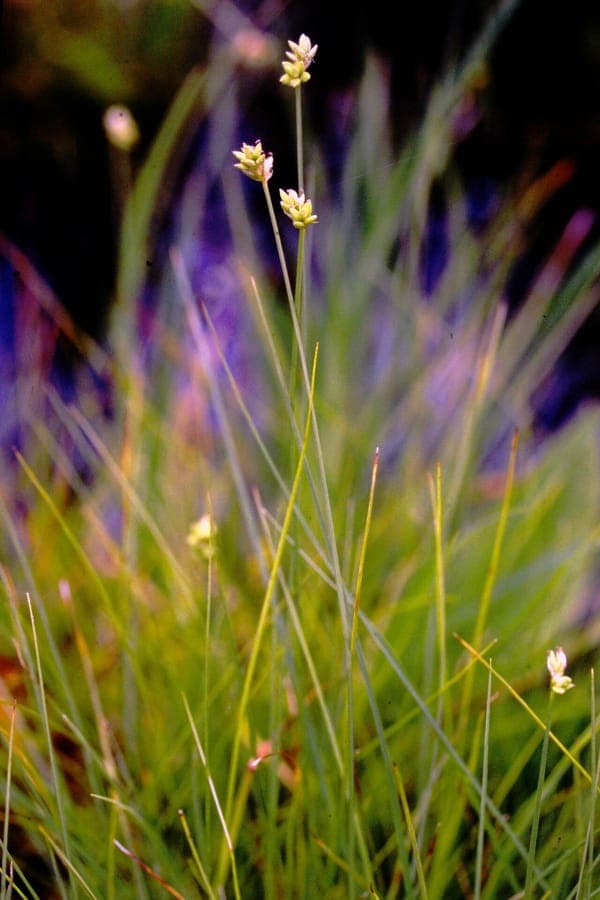
Allan Harris / CC0, via Wikimedia Commons
Carex tenuiflora: complete guide
Carex tenuiflora
¿Quieres ver Carex tenuiflora: complete guide en tu jardín?
1 minuto, sin tarjeta de crédito
Overview
Carex tenuiflora, commonly known as Sparseflower sedge or Tågstarr, is an elegant, compact sedge from the Cyperaceae family. This subpolar plant ranges from northern Europe to northern Japan and from subarctic America to northern USA. It is a winter-hardy, long-lived plant perfectly suited to alpine and mountain gardens. Growing to just 15-25 cm in height, this grass forms tight, fine-textured cushions that fit easily in alpine troughs. The plant grows slowly but creates a dense carpet of lasting value.
Appearance and bloom
Carex tenuiflora distinguishes itself through exceptionally fine, thin foliage. The narrow, delicate leaves form elegantly arranged, compact cushions with gray-green to dark green coloration. The flowering structures are very discrete, thin, kidney-shaped forms appearing in late spring. Yet again, value resides not in flowers but in permanent, subtle foliage that dominates year-round. This grass is absolutely a gem for rock gardens, alpine troughs, or alpine gardens.
Ideal location
Carex tenuiflora grows best in sunny alpine or mountain garden settings. The plant tolerates some partial shade, though full sun performs optimally. Well-drained ground at elevated, ventilated positions is essential. Alpine rocks, scree, or gravel beds are ideal. Avoid deep shade or wet lowland sites. This mountain grass requires mountain air and ventilation.
Diseño gratis
¿Quieres ver Carex tenuiflora: complete guide en tu jardín? Crea un diseño gratis ahora.
Soil
Carex tenuiflora demands excellent drainage with poor to moderate fertility. Heavier soils are unsuitable. Add gravel, perlite, or volcanic material for excellent drainage. This plant performs best on lean soils; rich substrates encourage lush growth damaging the compact form. pH can vary from acidic to neutral (pH 5-7). Drained alpine gravel or pumice mixes are ideal.
Watering
Although from a moister climate origin, Carex tenuiflora grows well in gardens on moderate dry regimes. Once established, verified plants show good moisture tolerance. Watering during growing seasons helps, but with assured drainage, water needs remain moderate. Never overwater. In winter, almost no water is needed if drainage guarantees dryness.
Pruning
Carex tenuiflora requires virtually no pruning. Remove only dead foliage mass in spring. As this plant grows very slowly and shows no exuberance, careful removal of dead material suffices.
Maintenance calendar
APRIL-MAY: Growing season starts, normal watering. JUNE-JULY: Water regularly given. AUGUST-SEPTEMBER: Monitor drainage, remove dead foliage. OCTOBER-NOVEMBER: Taper watering. DECEMBER-MARCH: Minimal care, no water unless very dry.
Winter hardiness
This plant is extremely hardy to zone 3 (below -40°C). Heavy snow can briefly cover small material. Protection never needed.
Companion plants
Perfect with alpines like Saxifraga, Dianthus alpinus, Sedum alpestre. Combines well with gray-green alpines for color harmony.
Final thoughts
Carex tenuiflora is a gem for alpine gardeners. Compact, hardy, and form-stable. The plant remains difficult to source but availability grows. Check alpine specialty nurseries for specimens.
¿Quieres ver Carex tenuiflora: complete guide en tu jardín? Crea un diseño gratis ahora.
Sube una foto, elige un estilo y obtén un diseño fotorrealista con lista de plantas en menos de un minuto.
Más de 10.000 jardines diseñados
Sin tarjeta de crédito


Plantas similares
Flat-stemmed club-rush: complete guide
Bolboschoenus planiculmis
Everything about Bolboschoenus planiculmis: growing conditions, watering, care, and use as a pond margin or wetland plant in garden design.
Great Plains flatsedge: complete guide
Cyperus lupulinus
Everything about Great Plains flatsedge (Cyperus lupulinus): growing conditions, care, garden uses, and ecological value. Tips for pond margins and dry sandy soils.
Golden beak sedge: complete guide
Rhynchospora corymbosa
Everything about golden beak sedge (Rhynchospora corymbosa): a dramatic tropical marginal for pond edges, bog gardens, and wet habitats.