
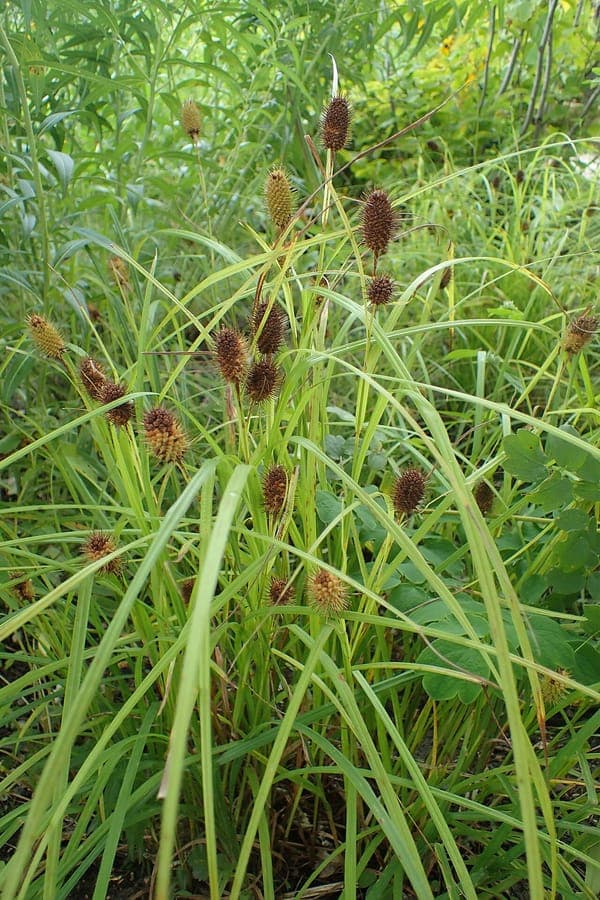
Krzysztof Ziarnek, Kenraiz / CC BY-SA 4.0, via Wikimedia Commons
Squarrose Sedge: complete guide
Carex squarrosa
¿Quieres ver Squarrose Sedge: complete guide en tu jardín?
1 minuto, sin tarjeta de crédito
Overview
Squarrose Sedge (Carex squarrosa), also known as Narrow-leaved Cattail Sedge, is an outstanding North American marsh sedge. The plant is characterized by stiff upright seed heads that protrude outward at angles ("squarrose"), providing architectural structure. This is a compactly growing, resilient sedge suitable for marshes, water margins, and very moist gardens.
Appearance and Bloom
Carex squarrosa grows in dense, upright tufts 40-50 cm tall. The leaves are fine and narrow, gray-green in color. The highly characteristic seed heads (June-August) have stiff, outward-projecting scales giving the plant an architectural, angular appearance. This texture remains interesting through October-November. The plant provides year-round structure in wet garden designs.
Ideal Location
Carex squarrosa grows optimally in very moist to marsh-like conditions with full sun to dappled shade. Ideal along water margins, in shallow marshes, and where periodic inundation occurs. The plant tolerates full sun as long as water is available. Consider this a true marsh and water margin plant.
Soil
The plant demands moist to wet, heavy soils with pH 5.6 to 7.3. Clay and peat are ideal substrates. Add peat moss when planting. Normal garden soils are unsuitable unless regularly waterlogged. This is essentially a specialist plant for hydrologically engineered sites.
Diseño gratis
¿Quieres ver Squarrose Sedge: complete guide en tu jardín? Crea un diseño gratis ahora.
Watering
Carex squarrosa requires constantly very moist to wet soil during the growing season. In marsh habitats and permanent water edges, supplemental watering is not needed. In normal gardens, deep watering weekly is necessary, especially May-September. Avoid drying out; the plant tolerates drought very poorly.
Pruning
Minimal maintenance. In March, carefully remove dead foliage. Leave seed heads standing through October-November; they are highly decorative and bird food. Division is unnecessary in optimal moist locations. The plant grows slowly but eventually forms fine, dense mats.
Maintenance Calendar
March: Remove dead foliage, maintain water level; April-May: Active growth under wet conditions; June-August: Seed heads appear with squarrose texture; September-October: Bird food, brown discoloration; November-February: Rest period, minimal water.
Winter Hardiness
Carex squarrosa is hardy to USDA zone 4a (-25 to -30C), suitable for all of the UK, Ireland, and northern France. Very moist winters (with ice) are not problematic. Plant remains winter-present.
Companion Plants
Combine Squarrose Sedge with other marsh plants: Iris laevigata (smooth iris), Typha latifolia (cattail), Acorus gramineus (grasslike), Carex elata Bowles' Golden (golden sedge), Pontederia (pickerel rush). For bird habitat: Scirpus species (bog rush).
Closing
Carex squarrosa is for those with true marsh or aquatic plant gardens. The stiff seed heads offer unparalleled architectural interest. For online ordering, seek wetland specialists. Gardenworld.app helps you optimally shape marsh gardens with this fascinating plant.
¿Quieres ver Squarrose Sedge: complete guide en tu jardín? Crea un diseño gratis ahora.
Sube una foto, elige un estilo y obtén un diseño fotorrealista con lista de plantas en menos de un minuto.
Más de 10.000 jardines diseñados
Sin tarjeta de crédito


Plantas similares
Flat-stemmed club-rush: complete guide
Bolboschoenus planiculmis
Everything about Bolboschoenus planiculmis: growing conditions, watering, care, and use as a pond margin or wetland plant in garden design.
Great Plains flatsedge: complete guide
Cyperus lupulinus
Everything about Great Plains flatsedge (Cyperus lupulinus): growing conditions, care, garden uses, and ecological value. Tips for pond margins and dry sandy soils.
Golden beak sedge: complete guide
Rhynchospora corymbosa
Everything about golden beak sedge (Rhynchospora corymbosa): a dramatic tropical marginal for pond edges, bog gardens, and wet habitats.